
Landing punches for the animals
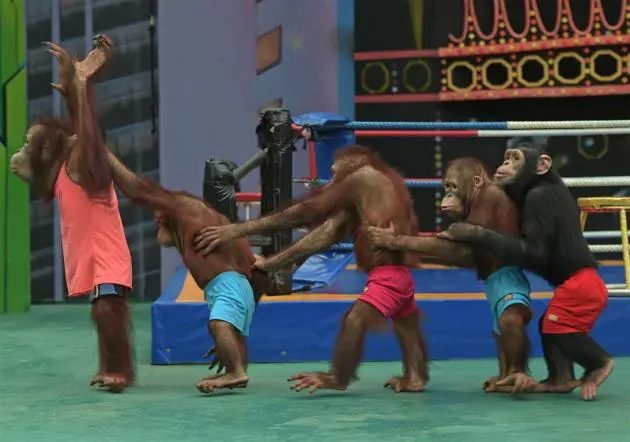


A Bangkok orangutan boxing show draws crowds and criticism as awareness of animal welfare grows in Thailand
BOXING GLOVES RAISED, two orangutans enter a ring at a Thai theme park, a spectacle that fascinates locals and tourists but sits increasingly at odds in a country slowly embracing animal welfare.
Every morning hundreds of tourists visit Safari World, a large zoo in suburban northern Bangkok, to see apes perform a show parodying human behaviour – in particular our predilection for violence, sex and alcohol.
Female orangutans, decked in bikini tops and miniskirts, pretend to seduce monkey musicians as rowdy ape fans drink beer and throw cans at the two orangutans play-fighting.
“It’s one of the funniest things I’ve ever seen,” says Aisha, a 23-year-old from Sri Lanka. “It’s incredible what they’re capable of.”
Others are less enthusiastic.
“I don’t like it at all,” says Erwin Newton, 30, from the US. “I don’t understand what is interesting in making animals behave in this violent, dirty way.”
To outsiders, Thailand’s treatment of animals can appear confusingly contradictory.
In this deeply Buddhist country it is not unusual to see pampered pooches pushed around in prams or entire temples providing sanctuary to stray cats and dogs.
Yet dogs might also be on a dinner table in the Northeast, while the Kingdom – a notorious animal-trafficking hub – retains its tradition of blood sports such as cock and bull fighting.
But there are signs that public attitudes are changing.
The country’s first-ever animal welfare law was adopted late last year – pushed through under the military government – after years of campaigning by increasingly vocal animal-rights activists.
The law now specifically bans “torture and cruelty towards animals” with exemptions for activities that are part of the country’s traditions.
The country’s animal fighting industry is also trying to make itself more humane.
Unlike in the Philippines, where roosters can be seen fighting with blades attached to their feet, Thai chickens now usually spar with their talons wrapped in fabric.
The cocks are judged on their fighting prowess, not their ability to kill their opponent, an event that is much rarer thanks to recent changes.
Thailand’s bull-vs-bull fights, which are popular in the South, also rarely lead to deaths, unlike the man-vs-beast version still thriving in Spain – and the bulls themselves are treated with celebrity status.
“Even in animal fights, there must be rules,” says Chaichan Laohasiripanya, secretary-general of the Thai Society for the Prevention of Cruelty to Animals. “They must consider the health of the animal, the length of the fight.”
Suddan Wisudthiluck, an anthropologist at Thammasat University, says the shift towards making the country’s traditions more animal-friendly stems in part from people keeping pets, especially in the cities.
“Animals are more and more seen as friends or family members,” he says.
All across Bangkok and other cities, salons, hospitals and clothes shops for pets are almost as ubiquitous as 7-Elevens and street food hawkers.
Acts of cruelty towards animals – especially dogs – often receive widespread publicity.
In July the arrest of a village headman who killed his neighbour’s pet dog after an argument was front-page news for days.
But despite recent crackdowns, Thailand is still host to a thriving dog meat trade in the Northeast to feed both local appetites and those in Laos, Vietnam and China.
Elephant rides are another popular tourist attraction that causes disquiet among activists, who say Thailand’s national symbols are often overworked and stressed ferrying tourists every day.
Just last week, an elephant in Chiang mai went berserk, killing his keeper before running off into the jungle with three terrified Chinese tourists on his back.
But the unease over the tuskers’ treatment has also led to the creation of an increasing number of ethical sanctuaries, where visitors are encouraged to view elephants in their natural surroundings and no rides are permitted.
However, the laws only go so far if they are not enforced.
Few attractions highlight the limitations of Thailand’s ability to enforce its own legislation more than the controversial Tiger Temple in Kanchanaburi.
Authorities say nearly 150 tigers have been kept at Wat Pha Luang Ta Bua without proper paperwork and have vowed to seize them, sparking standoffs in recent months between officials and angry monks blocking their way.
But the government has been powerless to resolve the issue, partly for fear of being seen to confront the clergy and also because officials readily admit they have nowhere to put such a large number of tigers.
Edwin Wiek, a campaigner from Wildlife Friends of Thailand, says Thailand’s animal rights journey has been typified by two steps forward, one step backwards with law enforcement his “biggest concern”.
Some people “just care about money and don’t hesitate to use [animals] to make some”, Wiek says. “But I think most Thai people love their animals.”
