
Broad appeal


Play
Billionaire philanthropists share their contemporary art collection with the public at a new museum in Los Angeles
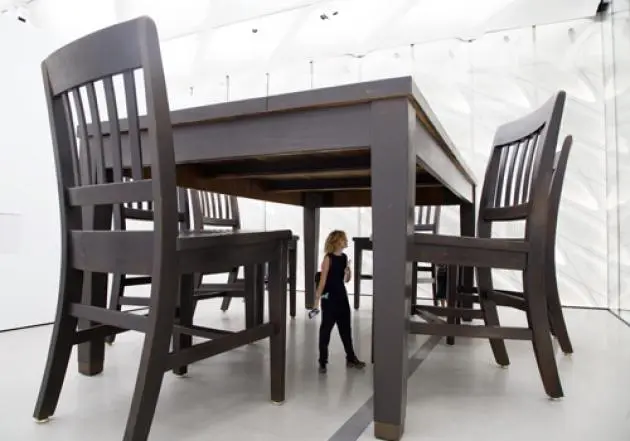
The Broad, a new art museum in Los Angeles showcasing one of the world’s most prominent collections of post-war and contemporary art, has finally opened.
The collection of billionaire philanthropists Eli and Edye Broad, compiled over 50 years, features works by top-shelf contemporary artists, including Jean-Michel Basquiat and AndyWarhol. Among the highlights are the world’s largest group of works by photographer Cindy Sherman and pieces by pop-art painter Roy Lichtenstein and performance and installation artist Joseph Beuys, as well as landmark works by Jasper Johns, Cy Twombley, Barbara Kruger, Robert Rauschenberg and Damien Hirst.
The Broad – pronounced to rhyme with “load” – also boasts a wide collection of work by contemporary German artists, Georg Baselitz, Anselm Kiefer and Imi Knoebel among them. The collection is worth US$2 billion (about Bt72 billion) and the museum has an initial endowment of $200 million.
“With the opening of the Broad, Los Angeles has become without question the contemporary art capital of the world,” Eli Broad said, adding that LA has more museum space for contemporary art than any other city in North America.
The Broads’ $2.1-billion foundations have already endowed a contemporary art wing at the LA County Museum of Art as well as the Museum of Contemporary Art, which Eli Broad co-founded.
Now, the couple’s personal collection of more than 2,000 works is taking centrestage. The collection is housed in a new asymmetrical, 11,148-square-metre building surrounded by a white concrete honeycombed “veil” its designers, New York architecture firm Diller Scofidio + Renfro, alternately describe as evoking a giant coral or sea sponge. While the museum’s architecture has won praise from critics, reaction to the collection has been mixed, with some describing it as obvious and unadventurous.
Philip Kennicott, writing in the Washington Post, lamented that many of the works on display were “the usual high-end trash,” while New York Times critic Holland Cotter called the inaugural display of more than 250 works “ordinary, old-school,[and] predictable.”
But the museum appeared to already be a hit with the public – helped no doubt by its policy of free admission. Three days before the museum opened, more than 85,000 people had already booked timed-entry tickets.
