
Fun at the Fringe


Play
UK artists show their creative prowess, while our own Babymime learns a lot
For any avid dance and theatre fan, critic or producer, visiting Edinburgh in August is a dream. And it was one that came true for me this year, when I was among almost 200 colleagues from around the world who attended the Edinburgh Showcase. While the British Council’s dance and theatre team had already pre-selected performances by established and emerging UK artists for us to choose from and most of these were booked before our arrival, we were still able to fit in many of the other performances at the Edinburgh Fringe Festival into our schedule.
This biennial programme, which is now in its tenth edition, was part of the reason why a great number of UK dance and theatre performances have been touring theatres and festivals across the globe. The following are some examples.
Two years ago at the Scottish capital I missed “Smashed” by veteran troupe Gandini Juggling and only managed to catch it earlier this year at the Hong Kong Arts Festival and found its choreography so unique that it was more like contemporary dance than a juggling act. In this year’s “4X4: Ephemeral Architectures”, director Sean Gandini pushed the boundary further by not only inviting Royal Ballet dancer Ludovic Ondiviela to choreograph but also four ballet dancers to perform with four jugglers and a chamber orchestra to play an original score. It showed that the two differently regarded performing arts genres indeed have a lot in common, especially in terms of discipline and precision, and the result was startling fun and sheer beauty.
Another familiar artist was New York-born and London-based Brian Lobel, whose previous work was part of the British Council’s “Live at Scala” in Bangkok a few years ago. Presented as part of the Forest Fringe, in his “you have to forgive me, you have to forgive me, you have to forgive me”, a line taken from an episode of “Sex and the City”, he asked his audience to fill out a long questionnaire on relationships. A die-hard fan himself, Lobel then picked an episode of the world famous series for me to watch with him lying in bed, set up with a partition for some privacy while onlookers watched it as a live installation. Admittedly, I learned as much from the episode as from our conversation and am currently applying these lessons to my life.
Audience participation was also key in Cardiff-based dancer and choreographer Jo Fong who gave “An Invitation…” to the audience, seated in a traverse set up with two rows facing each other, to co-create the performance with her and her dancers. And in this era of border crossing, contemporary dance performance “O” by Project O, also invited the audience, some more hands-on than others, to take part in their investigation of racism and sexism issues.
The British Council has been promoting works by disabled artists for many years and Glasgow-based dancer and choreographer Claire Cunningham’s “Give Me a Reason to Live”, in which she drew a comparison between the Nazi’s euthanasia programme and the UK’s government’s welfare reform, was engagingly political. It also provided proof that, in able hands and deft minds, a work by disabled artists is more than a social act but an artwork in itself.

Experiments in sound design could be seen in experiential performances like Verity Standen’s “HUG”, in which the audience, sitting blindfolded randomly in an empty room, was aurally and physically embraced by chorus singers. More technological advances were evidenced in EarFilms’ “To Sleep to Dream”, in which the audience, also blindfolded, listened to live narration by an actor amidst a 3D soundscape and was transported to a land where dreaming was prohibited. Many of my colleagues, having watched a few shows in different corners of the city prior to this, admitted to both sleeping and dreaming in this experience.
Apart from these experiments, more straightforward spoken dramas and comedies – less frills and in some cases more thrills – were solo acts set in theatre-in-the-round configuration including “Confirmation”, in which Chris Thorpe tackled political extremists. In Paines Plough’s “Every Brilliant Thing”, the audience, while not laughing, helped stand-up comedian Jonny Donahue read the long list of positive things about living. Another work which discussed a serious subject matter in a simple, frank and heartfelt manner was the two-hander “So It Goes” by up-and-coming company On the Run with Show and Tell.
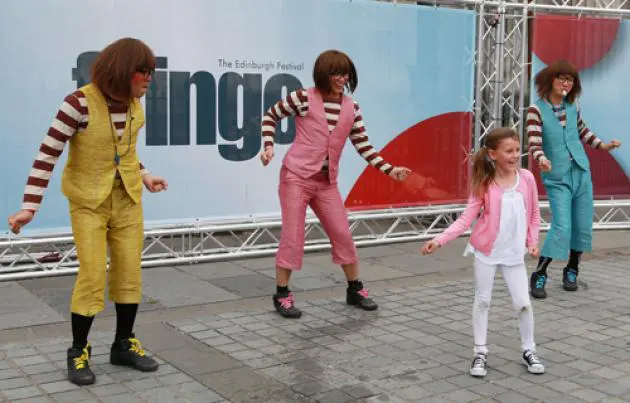
I realised only later that Babymime had arrived 10 days before me and my first afternoon there coincided with their last performance, which jetlag forced me to miss. A subsequent phone conversation with one third of Babymime – Nutthapol “Ta” Kummata – demonstrated that the professional Thai mime trio had learned a lot from their first experience at Edinburgh Fringe and it won’t be their last.
“At the beginning of this year, the three of us decided that we should gain more experience outside Asia, and our fellow Thai performers Mute Mime, who have had more international experience than us, suggested Edinburgh Fringe, the oldest and the largest of its kind, for a start.
“The festival is very open – anyone who applies can perform. We registered as a street performance troupe, instead of performing in a theatre which would cost more, and every day at 10am we put our card in a ballot box and then found out where and when we could perform. With limited stages and time slots, some troupes might not get to perform on certain days – we performed eight out of 10 days there and we got to watch other Fringe shows on the street and in the theatres. Of course, after a few days we realised that some stages and time slots worked much better than others,” Ta tells me.
“The first performance was like culture shock for us – what worked well in Thailand and many Asian countries didn’t quite work there – and we needed to adjust a good deal. We also realised that with the 45-minute time slot, many performers spent more than half of it interacting, more efficiently with words, with the crowd and then they performed what they’d prepared. Before we arrived, we hadn’t carefully prepared this ice-breaking part, so we turned on Thai music and danced to it. We also learned an important lesson that in street performance we should always leave room for improvisation to better connect with the audience who are free to move to other stages at any time.”
Ta offers a marvellous example of improvisation. “One street performer, seeing a lady watch him from the third-storey balcony, yelled, ‘Juliet, wait for me’, and then climbed up the water pipe to her. He then stripped down to his underpants and disappeared with her for about five minutes after which he announced that was his performance.”
Although they earned some money from audience donations, it was not enough to cover their costs. “We applied for support from the Ministry of Culture but didn’t get any. Meanwhile, I’ve heard that another commercial Thai show in a theatre, not on the street, ‘Ladyboys of Bangkok’, on top of its popularity, received substantial private sponsorship,” Ta says.
With or without state support, Babymime has submitted their application for Edinburgh Fringe 2016 and Ta says “We now know how to prepare our street performance and better manage our budget – for example, we don’t need to stay so close to the city area so we can spend less on rent.”
The writer’s trip was supported by the British Council. He wishes to thank Patcharawee Tunprawat, Carole McFadden and Bronwen Franklin Pierce for all assistance.
