
Khon as magic and spectacle


Play
Back by popular demand, "The Episode of Prommas" is grander, livelier and more engaging than ever
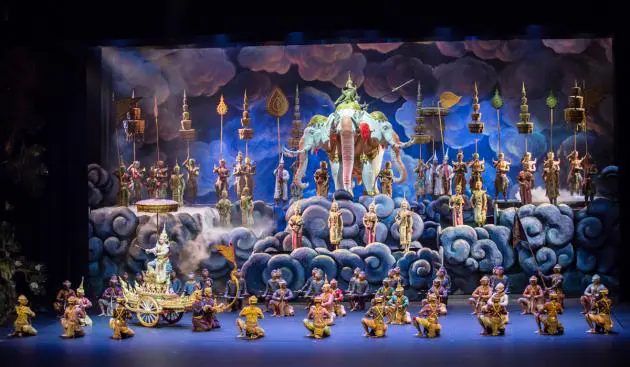
WITH HER ROYAL Highness Princess Maha Chakri Sirindhorn in attendance on behalf of Her Majesty the Queen, the Seventh Royal Khon Performance – “The Battle of Indrajit: The Episode of Prommas” – made a magnificent debut last Thursday at the Thailand Cultural Centre.
The show, presented by the Queen’s Support Foundation, continues through December 6.
These performances of the beloved masked theatre of Thailand have proved immensely popular. Previous productions have brought to life other chapters from the epic Ramakien – “Nang Loi”, “The Battle of Maiyarap”, “Jong Tanon”, “The Battle of Kumbhakarn”, “The Battle of Mokasak” and “The Battle of Indrajit: Nakabas”.
At each show members of the audience are invited to share their impressions through a questionnaire, with the results submitted to Her Majesty, says Thanpuying Charungjit Teekara, who chairs the production committee and is assistant to the foundation’s secretary general. Based in part on the feedback, the Queen decides which episode will be presented next. Last year there was demand for a revival of “Prommas”, which had so impressed audiences in 2007 and 2009.
This year’s production is again based on the rendering penned by King Rama II, as well as a “concert script” by Prince Narisara Nuvadtivongs and the “Chui Chai” script by King Rama VI.
Further refinements in the presentation ensure that this edition is more impressive than ever.
The Chui Chai scene in particular is stunningly beautiful. Khon master Chamuen Samuhapiman, also known as Luang Wilatwong-ngam, did the original choreography while taking the role of the transformed Indra – so successfully that he was granted the family name Indranat by an appreciative monarch and subsequently styled himself Ram Indranat.
That same choreography formed the basis of the rigorous training now used by the Fine Arts Department and the Bunditpatanasilpa Institute.
There are wondrous stage sets for each of the show’s six scenes, and modern technology is deployed to thrilling effect.
In Act 1, “Delaying the Battle (The Palace of Romakan City)”, the curtain rises on the throne of Mangkonkan, nephew of King Tosakanth of Longka. Pipatpong Kiewman plays the demon Mangkonkan, a minor character in the Ramakien but here given the spotlight. “He’s different from other demons – very strong and well-built – and, since he doesn’t come from Longka, the dance is unique as well,” Pipatpong told the press.
The battle itself sees two armies engaged in fierce combat, and Mangkonkan’s arrow pierces Phra Ram’s armour. Phra Ram returns fire and his arrow saps Mangkonkan’s strength, so the demon magically becomes a multitude of cranes filling the cloudy sky. Phra Ram brings him down with another shot, though, amid remarkable staging and lighting effects and gripping interaction among the two rivals and Phra Lak and Hanuman.
Act II, “Battle News at Longka Throne Hall”, takes place in an enchanting set, dominated by Tosakanth’s gorgeous Glass Arch. Hearing of Mangkonkan’s demise, the king sends Kalasoon to inform Indrajit while he resumes the empowering ceremony of the Prommas arrow.
A furious Indrajit sets out for battle, assuming the guise of the god Indra and accompanied by an army of demons become gods. Phra Lak is fooled by their transformation and dances with these seeming celestial beings, only to be struck by the Prommas arrow, fired by Indrajit. The blow renders the entire simian army unconscious, save for Hanuman, who breaks the neck of the elephant Erawan before being knocked to the ground by Indrajit wielding the Prommas bow.
Phra Ram returns to the scene and learns from Hanuman that the battle is all but lost. Warrior Phipek suggests a ploy that might yet save the day.
Erawan is a remarkable invention, towering three and a half metres, clad in full battle regalia and with mechanical agility that seems quite real. Its trunk, neck and all three heads move and the beast can even bow. The same unforgettable scene features a sculpted, golden concave moon atop Mount Sappaya.
Nonetheless, the greatest admiration is perhaps reserved for the elaborate costumes that give each scene such spectacle. They’re fashioned from impeccable silk brocade using special techniques to bring out the patterns. Woven with gold and silver silk threads, brocade from Nakhon Si Thammarat has been famous since the Ayutthaya Era, the fabric of royal garb and of wrappings for Buddhist texts. The weaving process is so complicated that “Muang Nakhon brocade” almost became extinct.
Pusana Fonramdee, who plays Hanuman, said he too was deeply moved by show. “I wear a mask, so the audience can’t see my facial expressions, but there are a lot of emotional scenes in this episode, and finding other ways to express Hanuman’s anger, grief or delight is very challenging.”
Every time the rival armies march, the viewer’s breath is taken away, and, adding to the show’s appeal, there is a great deal of humour. This year there are no political jokes, which is a little disappointing, but seeing the elephant Erawan in motion is always guaranteed to raise a smile, as is the scandal of simian troops flirting with supposedly heavenly beings.
One low point is the prelude dance, which is rather long and might tax the patience of younger viewers anxious to see the battle scenes and the fantastic “gadgets”, such as the peacock stick. There’s also room for improvement in the set changes, which are distractingly noisy.
Overall, however, this is a production not to be missed, and seats should be booked in advance to avoid disappointment. As a most welcome “bonus”, there are many young talents in the show – more than 800 students auditioned – an impressive sign that the young generation is taking an interest in their cultural heritage.
BATTLE ENGAGED
- “The Battle of Indrajit: The Episode of Prommas” runs until December 6 at the Thailand Cultural Centre. There are 24 performances for the general public and 20 for schoolchildren.
- Tickets cost Bt620 to Bt1,520 (Bt120 for students).
For details, call (02) 262 3456 or check www.ThaiTicketMajor.com.
- Find out more at www.KhonPerformance.com.
