
Asian finance chiefs bolster cooperation over Middle East risks
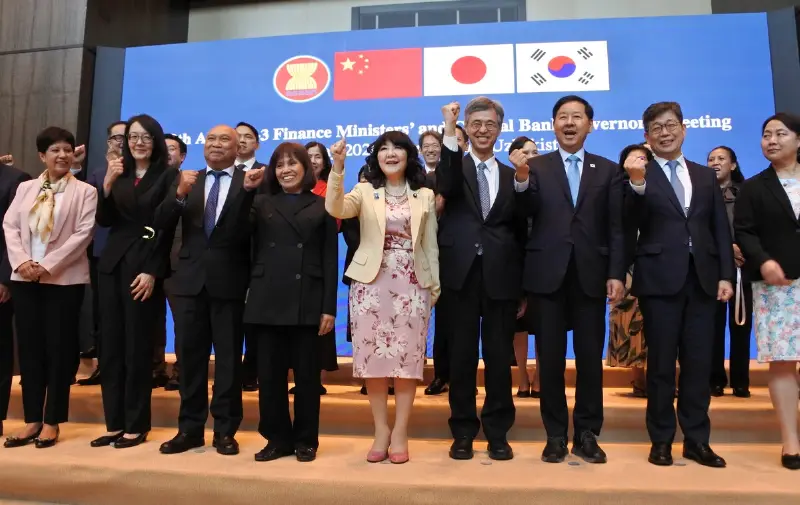


Japan, China, South Korea and ASEAN officials cited rising uncertainty as they backed stronger currency swaps, Japan aid and ADB support.
- Finance ministers and central bank chiefs from Japan, China, South Korea, and ASEAN nations agreed to tighten policy coordination in response to escalating conflict in the Middle East.
- As part of the cooperation, the officials endorsed efforts to improve the Chiang Mai Initiative, a regional currency swap framework designed to provide financial stability.
- The group welcomed Japan's plan to provide $10 billion in financial aid to Asian economies facing crude oil shortages to protect supply chains for oil-related goods.
Asian finance leaders moved on Sunday (May 3) to tighten their policy coordination as worsening tensions in the Middle East raised concerns over the region’s economic outlook and access to key resources.
Finance ministers and central bank chiefs from Japan, China, South Korea and the Association of Southeast Asian Nations reached the agreement during talks in Samarkand, Uzbekistan.
In their joint statement, the officials said that “the escalation of conflict in the Middle East has amplified downside risks to the regional outlook significantly.”
They said countries in the region needed to preserve multilateralism and work more closely together as they face common challenges and mounting uncertainty.
The talks were co-chaired by Japan and the Philippines. Japan’s delegation included Finance Minister Satsuki Katayama and Bank of Japan Deputy Governor Ryozo Himino.
Katayama told a post-meeting press conference that participants shared the view that regional cooperation would be essential in limiting the economic impact of the situation in the Middle East.
The officials also endorsed efforts to improve the Chiang Mai Initiative, the regional currency swap framework designed to provide support during financial crises.
The joint statement also welcomed Japan’s plan to extend 10 billion US dollars in financial aid to Asian economies hit by crude oil shortages.
The assistance is intended to help protect supply chains for oil-related goods. Asian economies depend heavily on crude oil and other resources from the Middle East, while Southeast Asian countries manufacture many oil-linked products used in Japan, including medical-related items.
The Asian Development Bank also opened its annual meeting on Sunday. The ADB announced that it would provide 70 billion US dollars by 2035 to help build cross-border power supply networks and digital infrastructure in Asia.
ADB President Masato Kanda, a former Japanese vice minister of finance for international affairs, said at a press conference that the support would contribute to an “open, resilient and inclusive future” and sustainable prosperity for everyone in the region.
The bank also unveiled a framework to help develop supply chains for critical minerals across the region. Japan will provide 20 million US dollars for the framework.

[Copyright The Jiji Press, Ltd.]
