
Great ideas to help the world
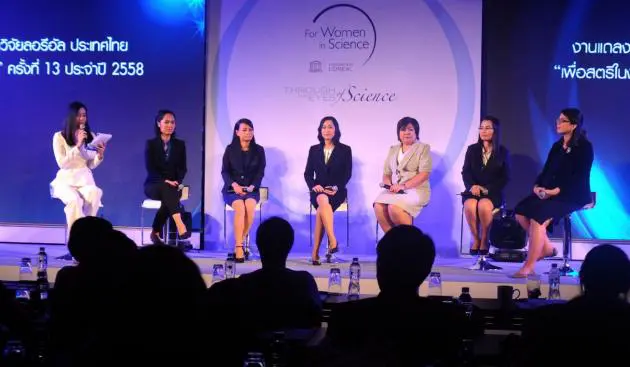


L'Oreal's "For Women in Science" Fellowships recognise advances that could soon be saving lives
L’OREAL (THAILAND), backed by the Thai National Commission for Unesco, has granted fellowships to six women researchers to foster sustainable development in fields ranging from agriculture to curing cancer. In its 13 years, the programme has helped finance research by 55 female scientists.
The “For Women in Science” 2015 programme extends to life sciences, material science and chemistry. In the first, the recipients are Assistant Professors Watcharin Loilome of Khon Kaen University for a study on “Risk Biomarkers Discovery for Screening and Surveillance of Cholangiocarcinoma” and Benjamas Cheirsilp of Prince of Songkla University for her research on the “Isolation and Screening of Oleaginous Fungi for Bioconversion of Lignocellulosic Wastes from Palm Oil Mill to Biodiesel Feedstocks”.
In material sciences, the fellowships went to Associate Professors Sirilux Poompradub of Chulalongkorn University for her study “Development process and improvement of properties of natural rubber products for industrial applications and environmental friendliness” and Siwaporn Meejoo Smith of Mahidol University for “Materials innovation for environmental applications”.
The chemistry grants to Mahidol University associate professors Darunee Soorukram for her study “Asymmetric Synthesis of Bioactive Secolignan Isolated from Thai Medicinal Plants” and Pattaraporn Kim for “Syngas Production from Carbon dioxide and Water through Solid Oxide Electrolysis Cell”.
A jury of scientists based its choices on the benefits of the research, accuracy in the process and peer acceptance.
Dr Watcharin has discovered a way to monitor the advances of cholangiocarcinoma, a form of cancer involving mutated cells in the bile duct. “Risk bio-markers, either in serum or urine, can be used to effectively screen the population at risk of developing cholangiocarcinoma,” she explains. “This will lead to early diagnosis, resulting in effective and curative treatment.”
Dr Benjamas’ studies on the technological means to cultivate oleaginous fungi promise to create renewable energy from the natural breakdown of waste. “The wastes would produce not only oil but also a fungi biomass that can be used as either compost or animal feed. The research should be useful to government and industries because this process might be able to reduce energy costs and import dependency and consequently increase the competitiveness of the industry in Thailand.”
Studying the use of rubber, abundant in Thailand, Dr Sirilux suggests that the Kingdom could become a world leader “in the global rubber industry and the sustainability of natural resources”.
“The innovative use of rubber in both its original and waste forms to produce plastic-based green materials and reinforcing agents for rubber will not only improve the properties of several kinds of rubber products, but also promote environmental and economical friendliness,” she says. “My research will be published and a patent registered both nationally and internationally.”
Dr Siwaporn says her studies too ought to enhance Thai “research competitiveness in materials innovation for environmental applications
through fostering international collaborative networks.
“This initiative utilises expertise in many areas of the material-sciences field, so the links provide opportunities for training Thai researchers in cutting-edge science. The materials-innovation research could lead to the feasible implementation of low-cost environmental-protection plans and pollution clean-up systems in small industrial sectors and rural areas, thus benefiting the wider community.
“We hope our research to date will stimulate more interest from the industrial and academic sector, accelerating the development of real-life applications of this technology for national benefit.”
Dr Darunee delved into the chemical compounds in plants known as lignans.
“The asymmetric synthesis of bioactive secolignan from Thai medicinal plants will let us understand the structural and stereo-chemical information of these natural compounds,” she says. “This information is very important in the field of pharmaceuticals and organic chemistry. Fresh knowledge regarding reactions and transformations, as published in the international journals, will have a valuable impact on the organic-synthetic community and related research areas.”
Dr Pattaraporn aims at no less than reducing harmful carbon dioxide in the atmosphere. This could be accomplished through the production of synthetic gas – “syngas” – from CO2 and water using a “solid oxide electrolysis cell”.
“Syngas gan be utilised as a fuel or a precursor for the production of many important chemicals, thus having an impact on economics and social welfare. In-depth research guidelines and existing knowledge presented in international publications encourage younger researchers to share their own knowledge and to create networks for further research and development.”
L’Oreal (Thailand)’s Sitanun Sittikit points out that research has been at the heart of the cosmetics firm’s business for 107 years.
“Eugene Schueller, our founder, strongly believed that advancing science and technology was the key to raising the quality of life around the world. So we’re glad to have run the ‘For Women in Science’ programme for 13 consecutive years in Thailand and to have been part of the inspiration and support that Thai female researchers deserve to produce meaningful research.
A BOOST FOR SCIENCE
- L’Oreal’s “For Women in Science” fellowship was launched in 2002. It offers Bt250,000 grants to Thai women scientists ages 25 to 40.
