
Sony just can't help itself


Play
Fans of compact cameras have come to expect dramatic improvements with every new model in the RX100 line. The Mark IV shows once again that the maker can do no wrong
SONY GARNERED a lot of attention from enthusiasts of compact cameras four years ago with its RX100 large-sensor model. The New York Times listed it as “One of the 50 Best Inventions of 2012”. That success was due to innovative design and a one-inch image sensor.
There have been new editions every year since, each with improved performance and added features – and of course higher prices to match – and now there’s the RX100 Mark IV.
A compact digital camera made to maintain that trend in better quality and performance, this is another leap forward from the Mark III.
Among other things, the Mark IV is great at super-slow motion. It’s capable of shooting video clips at 960 frames per second, compared to just 120fps from its predecessor. You can get 4K video rather than the Full HD 1080p clips of the Mark III.
Burst mode is 16fps, up from 10 on the Mark III. Shutter speed is a blinding quick 1/32,000 of a second, phenomenally better than the previous model’s 1/2,000.
And it all comes down to a newly designed one-inch stacked CMOS sensor that has a DRAM chip attached to buffer massive amounts of image data. Because of the stacked structure and the quick-buffering chip, the Exmor RS CMOS sensor produces read-out speeds five times faster than conventional models can manage.
Sony says the sensor is the world’s first one-inch-type stacked CMOS device with a built-in DRAM chip. The breakthrough gives the RX100 IV cutting-edge functions, including 40x super-slow motion and an Anti-Distortion Shutter, previously only available on professional still cameras and video cameras.
The Anti-Distortion Shutter is amazing, greatly reducing image anomalies caused by the “rolling shutter” phenomenon.
In super-slow motion, the camera records an extremely high frame rate, up to 960fps, and you can still pause on movements that are invisible to the human eye. Grab some video of your golf swing and you’ll be able to analyse it and find the flaws.
A built-in ND filter works with the super-high-speed shutter to ensure top-quality images even in extremely bright conditions. Earlier versions of the camera, as good as they were in low light, tended to overexpose in bright light.
The shutter and ND filter give the RX100 IV wide-range shooting coverage, up to eV19. That means you can keep the background out of focus even in extreme bright settings.
And the high-speed sensor allows for continuous shooting, up to 16fps, to get the fast |action at the racetrack or wherever you go.
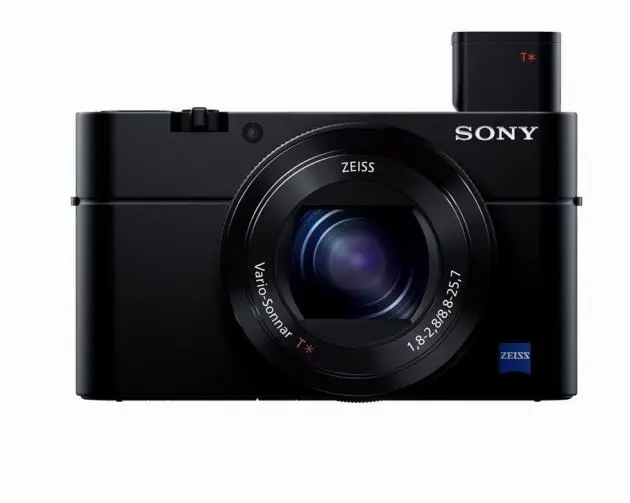
Adding to the Mark IV’s professional appeal is a viewfinder, an indispensable feature in serious photography. The retractable XGA OLED |Tru-Finder provides clear |corner-to-corner viewing, and at high resolution, equivalent to 2,359k dots. The view through the piece is really bright and aided by optics with Zeiss T Coating to reduce reflections.
The 3.0-type screen is also |hi-res and can tilt upward 180 degrees for easy selfie shots and downward 45 degrees when you’re peeking over the heads in a crowd. The greater flexibility leads to more creative compositions.
The large-diameter Zeiss Vario-Sonnar T 24-70mm lens has an f/1.8-2.8 aperture. The minimum f/1.8 allows for sharp shots in low light, while the maximum f/2.8 prevents camera shake and subject-motion blur. At a focal length of 70mm, the camera easily captures sharp portraits with professional-looking blurred backgrounds.
The RX100 IV is powered by a high-speed Bionz X processor that processes the light conversion from the sensor into digital images, resulting in crisp details, rich tonal gradations with low noise, and more realism. This is further bolstered by ISO 12800 sensitivity, which can be manually lowered to ISO 80.
The Fast Intelligent AF system provides high-speed, highly accurate contrast-detection autofocus by minimising wasted lens motion, predicting the AF range and accelerating lens drive. Thus you can capture ever-more-fleeting moments.
Lock-on AF automatically adjusts the AF target frame size to match the subject’s size. This improves the focusing system’s tracking so your subject always remains sharp.
Another nice feature of the new RX100 is that the shutter-related functions have been improved. The self-timer now lets you bracket the time more generally and can grab up to nine different exposures within that bracket.
If you shoot in low light with manual focusing, Bright Monitoring is a great help. Focusing in the dark is tricky, so there’s a customisable button that lights up the scene within the display, superseding Live View Display.
In fact there are five customisable buttons affording easy access to various functions. The Custom (C) button allows you to program more than 40 possible functions to best match the camera’s capabilities to your shooting style. The others are the Centre, Left and Right buttons on the control wheel and the control ring around the lens. This last one’s first setting is used for zooming. Change it to access exposure compensation, ISO setting, creative style and picture effects.
The built-in Wi-Fi adapter has several useful functions. It can be linked to a smartphone with NFC assistance so that the phone becomes a remote control for composing and taking shots, and so that the shots can be sent to your phone for quick sharing online.
The Wi-Fi connection also lets you view your shots on any TV set with DLNA capability. Just use the “Send to TV” function.
To use the phone as a remote control, you first need to download the PlayMemories Camera app for your phone. The same app can be used to download more apps for additional camera-shooting modes.
The Motion Shot app (Bt170), for example, will shoot a series of actions, like your subject jumping up and down, and then compile them into one shot depicting the whole sequence in a trail. Star Trail (Bt330) and Light Trail (Bt170) are also interesting for effects.
The customisable buttons, the Function (Fn) button and the mode dial make the RX100 extremely easy to operate. Fn provides quick access to all available shooting parameters – drive, ND filter, white balance, exposure compensation, flash settings, focus mode, focus area and ISO sensitivity.
The shooting modes accessible from the mode dial are Intelligent Auto and Superior Auto, Program Auto (P), Aperture Priority (A), Shutter Speed Priority (S), Manual Exposure (M), MR (Memory Recall) 1, 2, 3, Movie Mode, HFR Mode, Panorama and Scene Selection.
I definitely enjoyed Superior Auto. Both Intelligent Auto and Superior Auto are at the same position on the dial, so you need to choose one from the screen menu.
They’re similar, but Superior Auto recognises more environments and, in certain complex light conditions, such as backlight, it will take several shots at different exposures and come up with a single preferable image. It makes it a snap to get pleasing shots.
Both auto modes evaluated scenes correctly in my test – macro, landscape or portrait. A more advanced photographer has the option of extra control with P, A, S and M modes.
When shooting in Movie Mode or HFR Mode, you have the options of Program Auto, Aperture Priority, Shutter Speed Priority and Manual Exposure, depending on the results you want.
There are several creative and effect options for jazzing up pictures. “Vivid” will make them look almost surreally so, and then there’s Sunset, Portrait, Clear, Neutral, Black and White, and Sepia.
The fun effects include Toy Camera, Pop Color, Retro Photo, Partial Color, Soft Focus, HDR Painting, Miniature, Watercolor and Illustration. Picture effects available for movies are Toy Camera, Pop Color, Posterization, Retro Photo, Soft High-key, Partial Color and High Contrast Mono.
As outstanding a performer as it is, the RX100 IV packs a big lens, so you’ll have to wait two seconds for it to be fully extended ready for the first shot. Once it’s out, though, shooting is very fast – three-tenths of a second to focus and shoot and two-tenths to get set for the next shot.
The Sony Cyber-shot DSC-RX100 IV retails for Bt32,990. You can get a leather case with strap for another Bt4,490. The battery recharges via a micro USB port, but if you want an external charger for a spare battery, that’s an extra Bt3,490.
Key Specs
- Sensor: One-inch (0.52x0.35-inch) Exmor RS CMOS sensor with 20.1 effective pixels
- Lens: Zeiss Vario-Sonnar T Lens with 24-70mm equivalent focal length and aperture of f/1.8-2.8
- Focus: Contrast detection AF
- Focus mode: Single-shot AF, Continuous AF, DMF, Manual
- Light-metering mode: Multi-pattern; Centre-weighted; Spot
- ISO: 125-12800, extendable to 80, 25600
- Shutter speed: 30 to 1/32000
- Screen: 2.95-inch Xtra Fine tilt-able TFT LCD in 1.2 million dots
- Viewfinder: Electronic with 2.3 million dots, 0.59 magnification, 100 per cent coverage
- Interface: USB 2.0, micro HDMI, micro USB Terminal
- Wireless capabilities: NFC, Wi-Fi 802.11 b/g/n
- Battery: 1,240mAh
- Dimensions: 101.6x58.1x41mm
- Weight: 298 grams
