
Toward a foam-free world


Play
Thais have curbed their use of Styrofoam, but the food containers remain a threat
LOY KRATONG IS tomorrow, a prime time to remind celebrants that clogging the waterways with Styrofoam is hardly meritorious, but a campaign aimed at breaking the habit is also continuing to wean people away from the foam food packets that clutter our lives year-round.
The Thai Environment and Community Development Association, which also goes by the catchier name Magic Eyes, assembled the press at Bangkok Bank headquarters on Silom Road last week to get the message out. We’ve got to stop using Styrofoam to make our kratong, funeral wreaths and food packaging, it said.
So the organisation is training teachers, putting on stage shows and getting corporations to sign no-foam pledges.
Magic Eyes has since 1988 written and presented 17 different shows for kids and feels it’s made good headway in promoting environmental conservation and ecologically minded behaviour in homes and workplaces.
The stage performances are designed to be a fun way to learn about the environment, using engaging characters and tunes. More than 35,800 kindergarten and primary-school pupils have seen the shows, and follow-up assessments indicate that they remember what they’re taught and take the message home.
The show this year, to be presented in February, is called “Come Be Magic Eyes Ambassadors and Say No to Styrofoam”. Bangkok Bank is the sponsor.
Association president Khunying Chodchoy Sophonpanich pointed out that a lot of the stuff young people are sold these days quickly turns into waste. She cited a report from Biodegradable Packaging for Environment Plc that underlines the lack of any recycling and disposal system for Styrofoam.
“Styrofoam is not biodegradable and it gives off toxins when burned,” she said. “As a result, Styrofoam containers are just left lying around, clogging drains and harming the environment in other ways.
“Magic Eyes has been successful in its campaign for a no-foam Loy Kratong, using the direct message that people should respect to the river. And in recent years we’ve also succeeded in curbing the use of foam in the making of funeral wreaths by pointing out that putting your name on a foam wreath is shaming yourself publicly because people can see you’re not helping the environment.
“Yet we continue to harm the environment through the use of Styrofoam,” Khunying Chodchoy said. “According to the government’s Pollution Control Department, from 2009 to 2013 the amount of Styrofoam waste almost doubled, to 61 million pieces per day. On average, every person discarded one more piece of Styrofoam every day.”
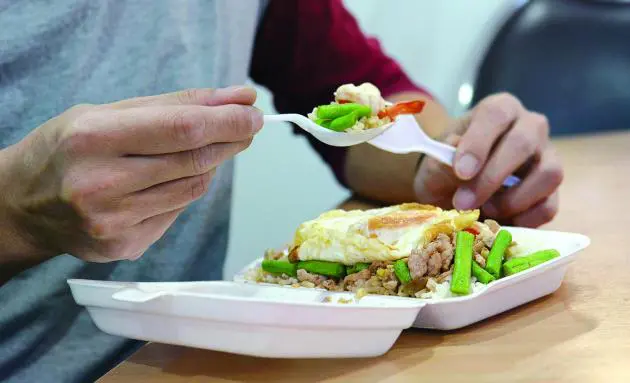
Styrofoam food packaging remains the biggest problem by far, she noted.
“Our eating habits today contribute to the waste because we rely so much on Styrofoam food containers, which are not only bad for the environment but also your health. Studies have shown that, due to the heat and the fat in the food, Styrofoam containers can contaminate the contents, creating a health risk. Many big cities, such as New York and Boston, have banned the use of Styrofoam in food packaging.”
Specifically, said Assistant Professor Siranee Sreesai of Mahidol University’s Faculty of Public Health, Styrofoam contains dioxin, styrene monomer, vinyl chloride monomer, tolene and benzene. “When these substances come in contact with heated food containing fat, they contaminate the food,” she said. “In the long run, the toxins build up in bone marrow, the liver, the kidneys and cells and can add to cancer risk.
“In terms of the environment, only clean foam can be recycled, but because it’s so light, you’d need a vast amount to fill a truck that normally hauls 300 kilograms of material, which makes recycling impractical. Foam instead needs to be buried, which requires a lot of space and it doesn’t break down in the ground, or burned at 800 degrees Celsius, which causes a different kind of pollution.”
Central Food Retail deputy managing director Pattaraporn Penprapat and Jintana Thamvanit, president of the Preschool Education Association under the patronage of Her Royal Highness Princess Maha Chakri Sirindhorn, signed a formal agreement to promote the “no foam” campaign. Pattaraporn said Central Food last year banned the use of foam at all 160 branches of its Tops supermarkets and has asked its overseas suppliers to avoid foam-wrapping the fruit they ship.
Khunying Chodchoi said the campaign’s stage shows are a good way to teach youngsters about everyday dangers, and “the knowledge stays with them for life”.
“Since children are the centre of the family, the lessons are passed on to the parents. Before each performance, the teachers are given training on the content so they can teach the songs to the students and prepare them with the basic knowledge. The songs are fun and can be sung anytime, so the teachers can incorporate them into their class curriculum.”
Cheewan Wisasa has meanwhile created a picture workbook titled “No Foam” that will be given to the 15,000 children who’ll see the show at the Thailand Cultural Centre. Another 100 copies will go to each of the 250 schools with teachers participating, a total of 25,000 books.
CATCH THE SHOW
“Come Be Magic Eyes Ambassadors and Say No to Styrofoam” will be staged at 10am and 1pm from February 2 to 5 at the Thailand Cultural Centre. Tickets are Bt50.
Interested citizens can see the show on February 6 and 7 at 2pm. Tickets cost Bt150 to Bt700 from the association (02 262 0073 and 02 262 0078).
To help gauge the success of the campaign, schools and the general public are encouraged to post photos of the lessons being put to practical use on www.facebook.com/TAVISES
Find out more at www.MagicEyes.or.th
