
Still on the pilgrim's path
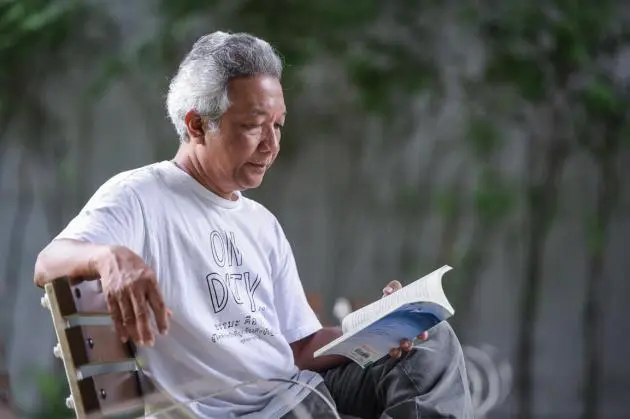


Pramuan Pengchan, author of the much-loved "Walk to Freedom", finds the meaning of life in a little girl's smile
PRAMUAN PENGCHAN has never stopped walking since the immense success of his 2007 travelogue “Deun Su Issaraphab” (“Walk to Freedom”). He’s still making his pilgrimages, both around the country and further afield, and he’s still publishing books.
“Deun Su Issaraphab” recounted his inspiring 1,200-kilometre walk from Chiang Mai, where he lives, to his native Samui in Surat Thani. He had only his small knapsack with a change of clothing, his hat, a bottle of water, paper to jot down his thoughts, and postcards to send to his wife, but no food and no money.
It was a genuine spiritual odyssey and caught the public’s imagination, selling 60,000 copies to date and now in its 20th printing. It’s been translated into English and Chinese and will soon appear in Japanese.
In the years since, Pramuan, now 61, has ventured much further. He’s written three books about his time in India and another about his trek to Mount Kailash in Tibet. Six more titles compile his moving and motivational public talks on various topics. Sukkhapabjai Publishing unveiled his latest release, “Phaowana” (“To Cultivate the Spirit”), at this year’s Book Expo.
Pramuan holds a doctorate from Mysore University in India and once served as a professor of philosophy at Chiang Mai University. In an interview with The Nation, he spoke of love, compassion and faith that might yet rescue this troubled world.
HAVE YOU FOUND THE MEANING OF LIFE?
When I leave home on a journey I want to be free from attachments, but when I returned to India, which had such a formative effect on me as a young student, I had a chance to reflect on what was inside me. The book that came out of that is titled “Jarik Dan Nai” (“Inner Pilgrim”). Many of my beliefs derive from Indian Buddhism. So I was able to free my mind of thoughts that were influencing me.
My book “Kailash”, about the mountain regarded by Buddhists as the centre of the spiritual universe and a living entity, came from my visit to Tibet. I almost experienced the end of life, because the life force is barely perceptible in the highlands, where the oxygen is so thin.
Instead I found a miracle in the feeling of joy that came from my strong foundation of faith. Without faith we might believe we’re going to die. In the past when we spoke about faith we often associated reasoning with karma, but the true happiness I felt in almost dying is the real core of living. No matter how stable your life, financially or socially, it will be undermined if we don’t have faith.
WHAT CAN WE EXPECT IN YOUR NEXT BOOK?
Last year I went to Nepal to make a documentary for the 10th anniversary of the TV show “Khon Khon Khon”. We went to Muktinath, a sacred place for both Hindus and Buddhists, at the foot of the Thorong La pass in the Himalayas.
On the way we met two little girls who earned their living selling stones from the Gandaki River. While we were waiting for our car, the girls spotted a lovely doll on the backpack of one of the photographers and their eyes were sparkling. The bigger girl gathered the courage to reach out and touch the doll, quietly so the owner wouldn’t notice. The little one wanted to do the same, but she was too small to reach it, so she jumped up and was able to touch it for an instant, but that was enough to make her happy.
And that was it, for me – I think I found the meaning of life, and I didn’t need to go to Muktinath. The meaning of life is what we tend to forget, that the world we’re living in is not that complicated.
I remember getting my first pair of shoes. My aunt bought them for me. I walked home barefoot, holding the shoes in my hands, and placed them next to me when I went to bed so I could felt them. There’s this sort of feeling, a sense of belonging and loving. We instil meaning in things, whether it’s a rock or that doll or those shoes. If we can remember this as adults, we’re just like the children. The only difference is that what we give meaning to might be more subjective and complicated.
People attach meaning to desires that then influence us to judge the world as good or bad, right or wrong, so that whatever doesn’t quite fit our meaning becomes an obstacle. Once we are free from desires, though, we have love and compassion that will drive us towards valuable outcomes, perhaps not exactly what we formerly desired.
A mother’s love for her child, the love of nature and the wish to protect the world – these feelings are natural and quite subjective and can’t be explained through ready-made perceptions. Consider day and night – we shouldn’t become alarmed when the light fades because it’s natural. We should still be happy.
CAN YOU ENCAPSULATE YOUR ADVICE FOR LIVING A WORTHWHILE LIFE?
What is it that drives so many people towards the same goal? The competition is exhausting. So many people wanting to go out and celebrate New Year are influenced by the media and they all want to go to the same places, so they will fight over the road, accommodations, the food and so on. If there is only one gold medal, only one person will succeed and everyone else will fail.
So we see more people seeking alternatives. They redefine what it is that represents success to them and then they can be different from others. Some people might be content with simple lives in the countryside or a small house with a little garden. Having choices in life is essential – everybody has the power to decide and make their own choices freely.
The meaning of success is very subjective, but the ultimate goal is to have love and compassion. There is no inner feeling more powerful than love. I can use the word “faith” and be confident in the meaning, but many people have forgotten the meaning. Faith is about having confidence, a feeling we don’t need to question. Faith is the path, while love and compassion are the goals. This is universal.
