
Taking care of your pet as best you can


Play
Adopted cat Varee is full of the joy of life while Phantom soldiers on
THE WOMAN’S SMALL, wooden house in Samut Prakan was full of cats, all wandering around the main room, jumping in and out through the open windows.
The house smelled really bad, and the animals themselves didn’t look so healthy. Many had eye and skin infections; others were obviously injured, and one lovely cat was missing part of her back leg.
The poor cat had given birth just a few days before. Her kittens lay on a rag out in the open. Mama wasn’t trying to feed them. She needed a private corner, a safe place to take care of her babies, but the woman wasn’t providing it.
My heart went out to the little cat and her babies. I and the rescuers with me even asked the woman if we could have the family, but she refused.
“The cats came to me,” she said.
Some people believe if a cat comes to your home of her own free will, she will bring good luck. I suppose this belief works with one or two cats, but she had 50 or more. Since they weren’t neutered, her feline population was growing. There’s such a thing as an excess of luck, isn’t there?
She just didn’t have the money to care for them, but even when we asked if we could take maybe 10 cats, treat them for infections, neuter them and find good homes for them, she still refused.
“I take care of them the best I can,” she said. “I won’t give them up.”
Westerners I’ve met take their refusal to give up their animals in another direction. Two years ago, when elderly cat Phantom was scheduled to join my household because his owner was moving to another country, the owner changed her mind and decided to have the vet euthanise the cat.
“He has no quality of life,” the owner said. “I’m the only one who can take care of him.”
Well, my vet refused, and Phantom is with me.
Readers will remember the 18-year-old cat’s health problems, from his Eosinophilic granuloma, which has now cleared up, to the infections those tumours left behind.
Last week, Phantom finally met the cancer expert who has been following his case. He checked Phantom and was really impressed by his good health, apart from those tumours.
Yet, although he had been recommending surgery to clear up all these problems, he changed his mind.
“Phantom is strong enough to survive the surgery,” he said, “but he’s old. It will take at least one year for him to recover. The pain and discomfort would kill him.”
Then I asked him about an abbreviation I didn’t understand in Phantom’s lab report.
“I’m sorry,” he said. “It means `squamous carcinoma’.” Ah. The granuloma had been hiding cancer.
How sad I felt for this wonderful animal, and when I told the expert Phantom’s story, his face changed.
“The same thing happened to me,” he said in disgust. A Westerner once brought her cat to him to put down. She was leaving Thailand and felt that no one could take care of her pet the way she could.
He knew how I felt. With new purpose, he looked at Phantom again. “Perhaps he can still survive,” the expert said. “Let’s see how painkillers and antibiotics work, and then we’ll assess in two weeks.”
So Phantom’s case is ongoing. As for that house in Samut Prakan, some weeks after we visited the woman, she asked the rescuers to return and take all the cats away.
“I’m bored caring for them,” she said.
By then, the kittens of that lovely little cat had all died, but she was alive and easily caught.
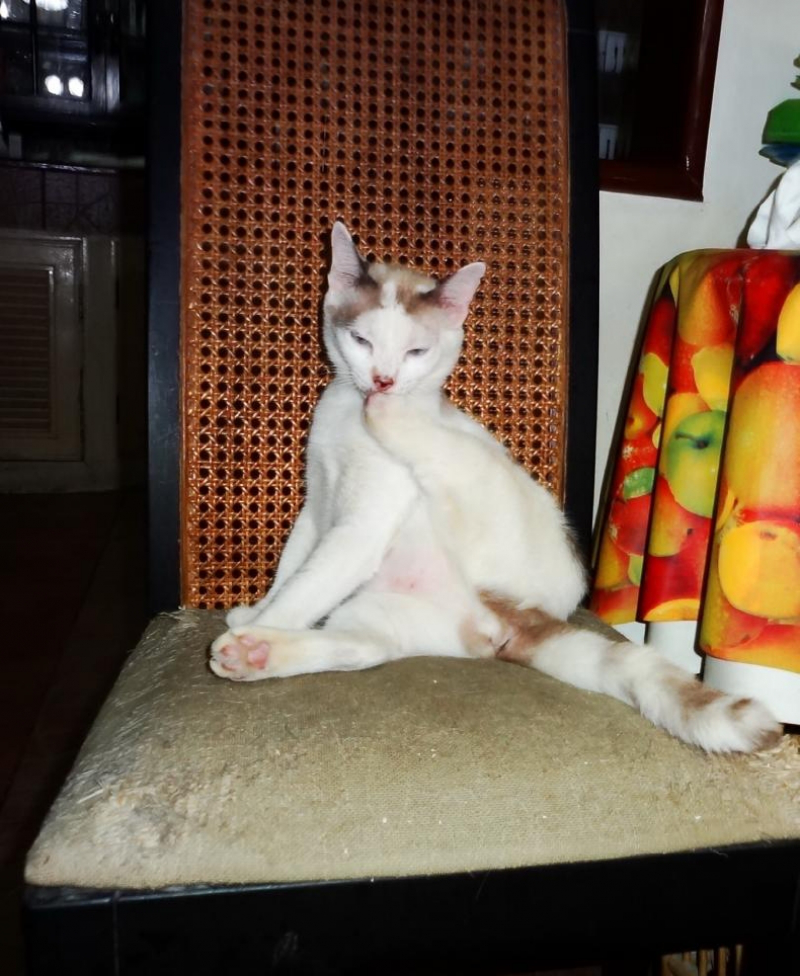
Now, she’s with me. Perhaps readers remember her – Varee, who travels very well on her three legs, thank you.
