
Oodles of noodles


Play
A look inside Lanzhou’s ramen rush
One man's endeavour to introduce his beloved hometown’s noodles to the world has started to gain traction, as his dedication coincides with China’s aggressive project to urbanise the northwest city of Lanzhou.
At the rate storefronts are expanding in China and abroad, it won’t be long before Lanzhou beef noodles become a globally renowned Chinese dish, creating more momentum for the billion-dollar industry.
Lanzhou City, situated along the Yellow River, was once a critical juncture on the Silk Road. It was previously known as the Golden City. The likelihood of bumping into ramen restaurants in the Gansu capital is almost as high as coming across a convenience store in Taipei City.
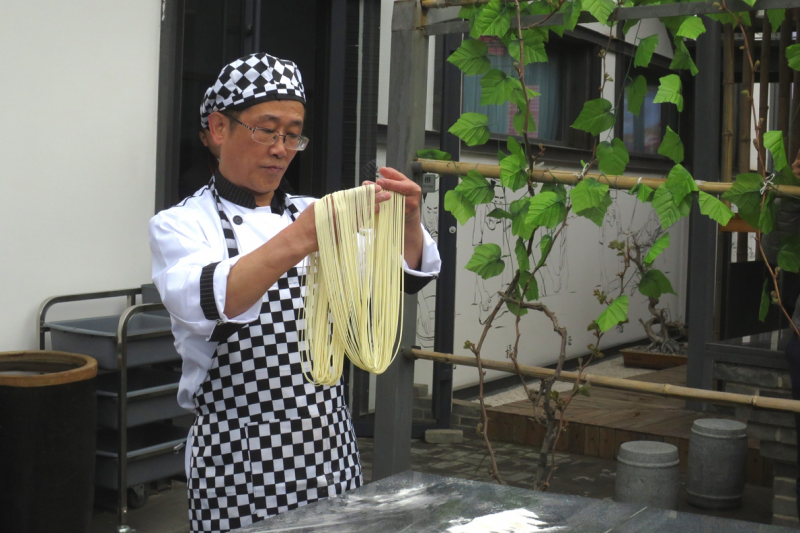
Ramen literally means hand-pulled noodles in Chinese. The noodle soup in Lanzhou is marked by the vast selection of noodles, each stretched to different widths and thicknesses, paired with clear broth, coriander, beef slices and chilli oil and so on.
Wang Xing-jun, chairman of the Lanzhou Stretched Noodles Industry Association (LSNIA) in Gansu province, says he expects to see the number of Lanzhou ramen storefronts increase to 100,000 globally by 2030.
“We are waiting for the government to approve Lanzhou ramen as a cultural artefact,” says Wang, as he shows reporters around the association’s research base, pointing to models for the construction of a ramen museum in the city centre, as well as a massive industry park near the local airport.
Lanzhou is commonly recognised in China as the home of beef ramen. One mission Wang’s association seeks to accomplish is to set up a certification system for Lanzhou noodle shops, in order to help consumers recognise which stores follow traditional, authentic methods.
According to the association’s estimates, today there are approximately 2,000 beef noodle shops in Lanzhou alone, around 60,000 stores in surrounding provinces such as Henan and Xinjiang, and 5,000 Lanzhou-style noodle joints overseas.
Wang boasts that the entire industry’s profits exceed 20 billion yuan (Bt108.2 billion) per year – including other revenues such as kitchen equipment sales – and is looking to reach 100 billion yuan by 2020.
“Fifty franchised Lanzhou ramen brands are now members of our association. The goal is to reach 100 brands, spanning |more than 10,000 storefronts,” Wang says. “We learned this concept of franchising from Taiwan.”
Wang freely admits he drew some ideas from the business model of Taiwan’s book retailer Eslite Group, recalling an impressionable meeting with Eslite’s founder and chairman Robert Wu in Beijing last year.
“I admire how Eslite places great value on creating experiences and handicraft,” says Wang, who hopes to promote the health benefits and warmth of handmade noodles.
“You know how they say there is nothing better than a mother’s home-made dishes. We can also learn much from the spirit and insistence of handicrafts in Japan. People here do not have that now, but we want to gradually push this spirit.”
Wang adds that he believes that people have a certain type of energy in their grip, so manually stretched noodles are more easily digestible than those made with machines.
Besides inspiration from Eslite Corp., the ramen association has also formed close connections with Taiwan’s food organisations. It is vying for opportunities to expand in the island, in its talks with the Taiwan Halal Integrity Development Association and other industry associations in Taiwan.
“There are restaurants in Taiwan that claim to sell Lanzhou ramen, but they are not run by Lanzhou locals, but rather by people from the Fujian area, so the taste is very different,” |Wang concludes.
