
When the camera rolls


Play
An exhibition of vintage movie cameras goes on show at a Bangkok Cinema
BEST KNOWN for collecting and restoring and old movies, the Thai Film Archive also plays another significant role in preserving the history of the Thai film industry by searching for and rehabilitating the equipment that made these films possible – props and cameras,
From the single lens camera developed by Louis Le Prince in 1888 through the 35mm models developed by Arri, Moviecam and Panavision, cameras have constantly evolved and today the movie camera, as we knew it, is dead, replaced by computers and digital technology.
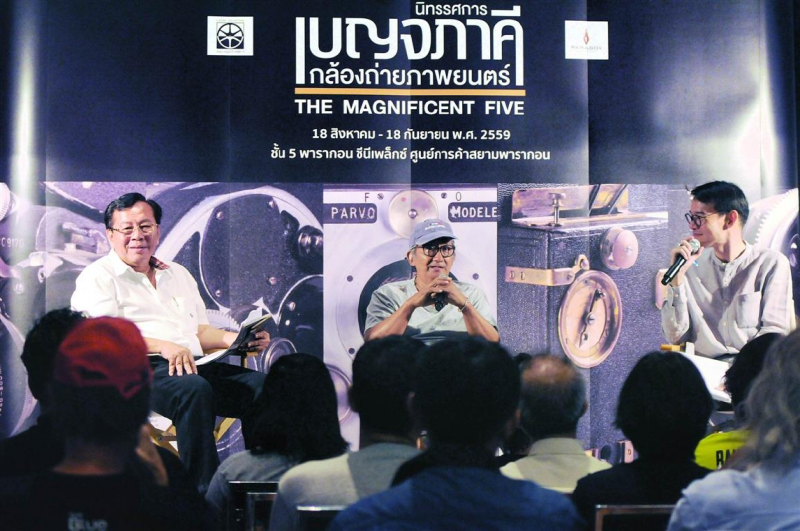
Now five of the cameras used in the past are on show at Paragon Cineplex in “The Magnificent Five”, an exhibition that offers a fascinating trip back in time.
The archive director Dome Sukvongse emphasises that all five cameras have played a major role in the Thai movie history.
“We hope that people interested in the process of invention will visit this exhibition,” he says.
The oldest in the show is the Pathe Studio motion picture camera, built in 1903 by Charles Morand Pathe, one of the pioneers of the French Film industry. The wooden body is covered with leather made of Moroccan pigskin and was the very first motion picture camera to gain popularity. A hand-cranked 35mm contraption, it was the most used movie camera in the world before World War I. Prince Sanbassatra, the father of Thai cinema, used the Pathe as did the Wasuwat brothers.
The camera on show is not unfortunately the one that Prince Sanbassatra used but was purchased online by the film archive..
“Many historical cameras became obsolete and lost. Fortunately, there is an online market that we constantly monitor and buy the items we consider will benefit our narrative
of Thailand’s film history,” says Dome.
Four of the five cameras on show – all bought online –still work. They include the American-built Bell & Howell 2709, which Henry MacRae used to film the 1923 movie “Nangsao Suvan” (“Suvarna of Siam”). Although produced and directed by American filmmakers, the film was one of the very first to feature Thai actors. The same camera model was owned by the Wasuwat brothers and used in the Srikrung Sound Films production studio.
Also on show in the Debrie Parvo which was built in 1908. Able to load 390 feet of 35mm, it was able to film continuously for almost six minutes. The Russian camera was used by the Royal State Railways Topical Film Service as well as by acclaimed cinematographer Patipak Pimlikit for 1927’s “Unexpected”.
The Mitchell Standard, which was developed in 1921 and is often called the Mickey Mouse ear magazine, holds from 400 feet to 1,000 feet of 35mm film. Gaining in popularity as silent films gave way to sound, the model was used for filming “The King of the White Elephant” in 1941 and also the recently restored “Santi-Vina” in 1954.
The latest in the collection is the Arriflex and was the most popular among Thai filmmakers after the 16mm era. The one on show in the exhibition belonged to the late director Vichit Kounavudhi and he used it to shoot most of his acclaimed movies including “Look Isaan” (“Son of the Northeast”) and “Ruan Pae”.
Cinematographer Porniti Virayasiri who worked with Vichit on “Look Isaan”, says that the Arriflex was the most widely used by Thai cameramen.
“The picture showing in the viewfinder is exactly what appears on film. It also has a zoom lens while the other types had only single lenses,” he says
Fellow cinematographer Panya Nimcharoenpong who worked with Piak Poster on many of his films including “Wai Onlawon” and “Kaew” as well as with Euthana Mukdasanit on “Pheesua Lae Dokmai” (“Butterflies and Flowers”), agrees, adding that that the Arriflex was the most convenient camera on the market at that time.
More cameras are on show alongside props and other related items at the Thai Film Museum in Salaya, Nakhon Pathom.
“The Magnificent Five” continues through Sunday at Paragon Cineplex on the fifth floor of Siam Paragon.
