
Splendours of Singora


Play
Songkhla’s old town springs back to life with art galleries and cultural museums
AS IN OTHER Asian conglomerations, the historic old town of Songkhla in Thailand’s south is struggling to hang on to its traditional charms in the onslaught of progress. Here, as elsewhere, modern constructions are slowly but surely replacing the mix of historical Chinese and European-style shophouses lining Nakorn Nai, Nakorn Nok and Nang Ngam roads.
In recent years, though, residents as well as some non-residents have been fighting back, making every effort to raise awareness of the importance of heritage preservation and maintaining the dynamism of the Songkhla’s old town, a busy trading port back in the 17th century when Persian Muslim merchants founded the Sultanate of Singora in what is present-day Songkhla. Westerners and Chinese migrants came later, giving the town its unique mix of cultures.
Over the past decade, Klaomard Yipintsoi and Noppadol Kaosam-ang, founders of About Studio/About Cafe, one of Bangkok’s most dynamic art centres in the late ’90s, have been travelling back and forth between Bangkok and Songkhla in an attempt to restore life to five old buildings.
“A decade ago we came down south to visit my uncle, a doctor who worked in Hat Yai’s business district, a 40-minute drive away. We drove through the old town and fell in love with the charming old buildings. The nostalgic atmosphere reminded us a lot of About Studio/About Cafe in Bangkok. So we decided to buy one building. We had no plans to do anything with it. We just loved the art-deco structure and wanted to restore it to its original condition,” says Klaomard, who later founded the About Art Foundation.
It took the couple almost a year to restore the building to its former glory and they named it Yap Fah Woon in a nod to the Chinese name of Klaomard’s father. The site now serves as their private residence. Their interest didn’t stop there, however, and they now own five buildings in total and are also renting a former mechanical workshop. Some have been fully renovated while the others still require a lot of work.
“When we started to buy the buildings, many people kept asking what we were doing here – a town in which neither of us have a history. My family’s trading company Yipintsoi once had a Southern office in Hat Yai and that led people into thinking that we were buying these properties for commercial purposes. Each building has its own history and reflects different periods and generations,” Klaomard adds with a smile.
A newly renovated three-storey building has been renamed Misiem’s in honour of the late sculptor, who was Klaomard’s grandmother. It now houses Misiem’s paintings and sculptures as well as her art supplies, notebooks and furniture. Works by other artists from About Art Foundation’s collection are also on display. Among them are Pinaree Santipitak’s 1996 installation “Confident Bodies” involving an array of 120 female torsos sculpted from saa (mulberry) bush fibre, Navin Rawanchaikul’s acrylic painting “In the Memory of About Cafe”, and Kamin Lertchaiprasert’s “Thai Painting”.
Another property named Yap Fah Mi has also been completely restored and the couple has turned it into a three-room boutique hotel reserved for their acquaintances. The neighbouring Yap Fah Kuang and an old rice storage facility are currently under restoration.
The sites are now open to the public on Saturdays and Sundays or by appointment until the end of next month.
“We have positioned ourselves as outsiders who appreciate the historical values of the buildings in the old town. When our long-time artist friend Navin Rawanchaikul came to visit us, he was fascinated by the community’s mixed culture and came up with an idea of holding a community-based art project to recall the glory and bring back the energy of this old town,” says Klaomard.
Known internationally for his artworks that speak about identity and cultural convergence, Chiang Mai-based Navin has revived the city’s old town with his project “OK Nakorn – Singora Diary” featuring his signature old-fashioned movie billboard, monochrome mural, video installation and music video that connect art and the community.
At an old Chinese shophouse that once served as a mechanical workshop but is now rented by About Art Foundation as an exhibition space, Navin is showcasing his panoramic painting “Singora Diary”. This is made up of more than 70 panels depicting the community’s members, the charming architecture of the old buildings and portraits of Persian Muslim and European merchants recreated from old photos taken when the town was a busy port.
The site also screens the music video of the song “OK Nakorn”, which talks about the good old days of the old town community and is played by Navin and his production team together with the residents themselves.
Navin has also installed a 15-metre-long painting in old-fashioned billboard style in place of the original hoarding of the old and now defunct Saha Phapayon cinema. Titled “OK Nakorn” (“OK City”), the mural depicts hundreds of community members as if they were movie stars.
Songkhla entrepreneur Pakorn Rujirawilai, who runs a printing company, also bought a row of three shophouses on Nakorn Nai road and has recently opened them as a history museum devoted to his native town.
A collective of instructors and students of Mahavajiravudh School led by Charas Chanpromratana are helping to run the site, which is called Baan Jeen Sam Hon (literally “three Chinese-style shophouses”). Though the restoration isn’t yet completed, visitors can marvel at old documents, photographs, print advertisements, furniture and household utensils related to the city and the ways of life of its people. The terraces of the houses have been transformed into a multi-purpose space, which is occasionally used for cultural workshops.
“These three houses were abandoned for 20 years, but Pakorn realised their historical values and was worried that they would be demolished by new developers. He decided to buy them and restore their charm. This small museum is designed to stimulate people to think more about their roots and communities,” says Charas.
“I’ve collected almost all sort of things related to Songkhla and many of them are showcased here. I’m proud of my origins.”
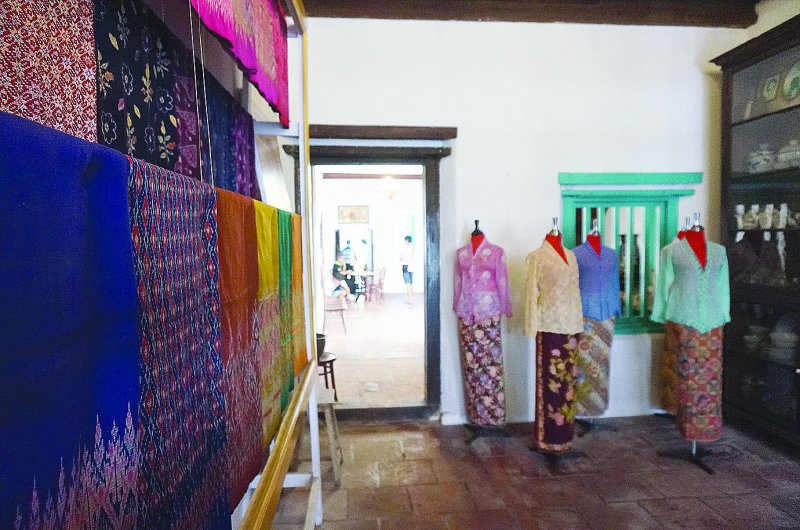
Another museum called 238 Inspiration House after its number opened last year opposite Baan Jeen Sam Hong and is home to a large number of rare textiles. It’s the brainchild of Panya Phoonsin, an engineer born in Chiang Mai but whose work with PTT Exploration and Production (PTTEP) brought him down south. Panya, who was inspired by historian and traditional Thai fabric collector Paothong Thongchua, spent many years gathering fine samples of the textiles and costumes and spent his own money to rent the abandoned shophouse and renovate it. With more than 1,000 exhibits on view, it tells Songkhla’s history as a busy trading port.
“I’d travelled to many villages around Songkhla and found textiles from China, Indonesia, Myanmar and India, many of them more than 100 years old,” Panya says. “While Koh Yor is known for hand-woven textiles, many other villages in the area also have a distinctive weaving style. I found Songket fabric that once belonged to the brocade family of textiles of Indonesia and a 140-year-old pha sin from Myanmar. Many of the patterns are legendary in the sense that no one can weave them anymore.”
EYES ON THE PAST
Misiem’s and another five sites run by Klaomard Yipintsoi and Noppadol Kaosam-ang under the About Art Foundation are open to the public free of charge on Saturday and Sunday or other days by appointment until October 30. For details, call (090) 991 0111.
The Baan Jeen Sam Hong Museum on Nakorn Nai Road is also free admission and open Saturday and Sunday or other days by appointment. Visit “NAS Nakorn-nai Art Street” page on Facebook.
The 238 Inspiration House on Nakorn Nai Road is open Saturday and Sunday from 9.30am to 4pm. Again, no admission charge.
Navin's old-fashioned billboard-style painting “OK Nakorn” at the Saha Phapayon cinema on Pattalung Road opposite Banbod Mosque is on view daily until October 30. For details, call (081) 111 9621.
