
Japan’s museums go global


Play
With the Olympics approaching, far more foreign visitors are anticipated
As the number of foreign visitors to Japan reached a record high of 19.73 million in 2015, the number visiting museums and art galleries is also on the rise. What should be done to help these visitors enjoy a range of exhibitions and deepen their understanding of Japanese culture? We look at new initiatives being employed and the challenges that museums and art galleries are likely to face.
Foreign visitors can be commonly spotted on weekdays at the Tokyo National Museum in Ueno.
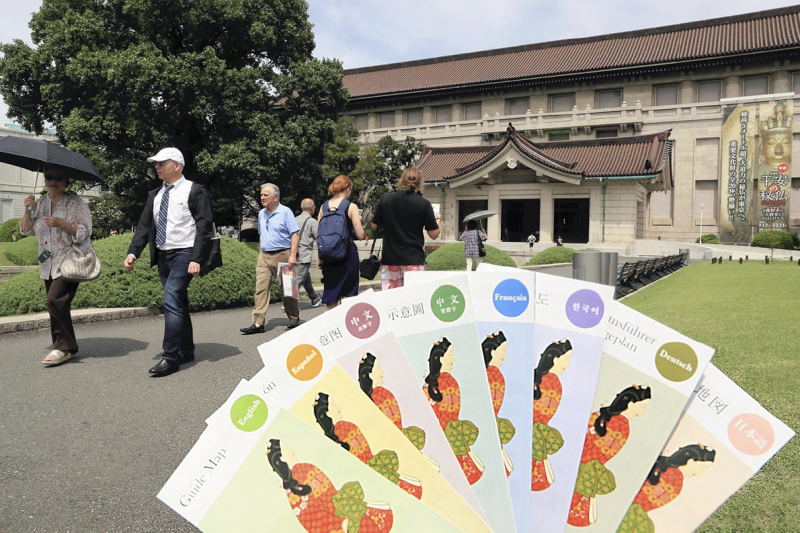
A 75-year-old Australian visitor with an English brochure in hand said he came to see the katana swords and classical paintings. He was pleased to find the information he wanted explained in his native language.
The main building of the museum, where visitors can view Japanese art, offers brochures in traditional and simplified Chinese, Korean, French, German and Spanish as well as Japanese and English. Last fiscal year the museum printed 86,000 copies of the English brochure. Its website can also be viewed in the same eight languages, and exhibit labels are printed in Japanese and English.
“We’ve established a specialised department called International Relations that handles the translations,” says Minako Miyao of the Public Relations and Press Department.
“What’s most important is user-friendliness. For example, if we were to label exhibits in several languages, it would detract from the exhibits.”
A work-around is a smartphone app with the information in other languages. The free Tohaku Navi app is currently available in Japanese and English and more languages will be added. Wi-Fi was made available in the building this fiscal year to encourage visitors to use the app and the museum is considering lending out phones equipped with its app.
According to a rough estimate by museum staff, 19 per cent of visitors to the permanent exhibitions were foreigners in fiscal 2013 and 23 per cent in fiscal 2015.
The proportion of foreign visitors viewing permanent exhibitions in 2015 was 13 per cent at the National Museum of Western Art and 10 per cent at the National Museum of Modern Art in Tokyo. Foreigners comprised 2 per cent of visitors to all exhibitions at the National Art Centre in Tokyo.
Other national museums are experiencing the same trend, but not all are capable of providing the same services as the National Museum.
“Human resources are required to provide these services, and budgets are limited,” a museum spokesperson says.
“In terms of exhibit presentation,” explains Japan Museum Management Academy president Eiji Mizushima, “Japan’s museums and art galleries are world-class. However, they fall behind when it comes to internationalisation, such as support for foreign visitors. Museums need to work together to come up with a comprehensive solution, in addition to the museums’ own efforts.”
Low-cost stopgaps might become necessary, such as using volunteer staff and the social media. Museums must also consider how they can provide exhibitions and services that appeal to travellers from China, South Korea, Taiwan and elsewhere, the largest proportion of foreign visitors to Japan.
With an eye on the Tokyo Olympics and Paralympics in four years, there is an urgent need for each museum to provide better support for foreign visitors. The National Art Centre established a Communications and International Affairs office in June and began searching for concrete measures to put into place.
The Tokyo Games are not the goal. Comprehensive initiatives are needed that look beyond the event.
