
A hug from a billionaire


Play
Mohan Murjani chooses Thailand, his adopted home, to launch a classy line of men's accessories
INDIA-BORN RETAIL billionaire Mohan Murjani has, at age 70, decided to undertake the final project of his life in Thailand, a country he’s fallen in love for its warm people and rich culture.
The chairman of the Murjani Group founded by his father has chosen Thailand to launch the Vanderbilt New York line of men’s fashion accessories. He’s lived in Phuket for four years and still isn’t quite retired.
The first Vanderbilt New York store opened at Blu Port Hua Hin two weeks ago, swiftly followed by four more in Bangkok – at Central Westgate, the Emporium and Central Bangna.
Born in British India, raised in Hong Kong and educated in Britain and the US, Murjani in 1966 joined the business that his father, BK Murjani, founded in Shanghai in 1930.
The Murjani Group subsequently moved from retailing in Shanghai to manufacturing in Hong Kong, establishing one of the largest factories in the world, with annual production of 10 million units.
The same year Mohan joined the firm, the group launched its first brand in the United States, Marco Polo. In 1975 it introduced the first designer jeans, by Gloria Vanderbilt. In 2004 it presented Tommy Hilfiger to India, that country’s first international lifestyle designer brand. Gucci, Jimmy Choo, Bottega Veneta, Calvin Klein and French Connection followed.
In 2007 Murjani built India’s first luxury mall, the Galleria, in Mumbai, and within six years Murjani brands had 1,300 points of sale in 98 Indian cities.
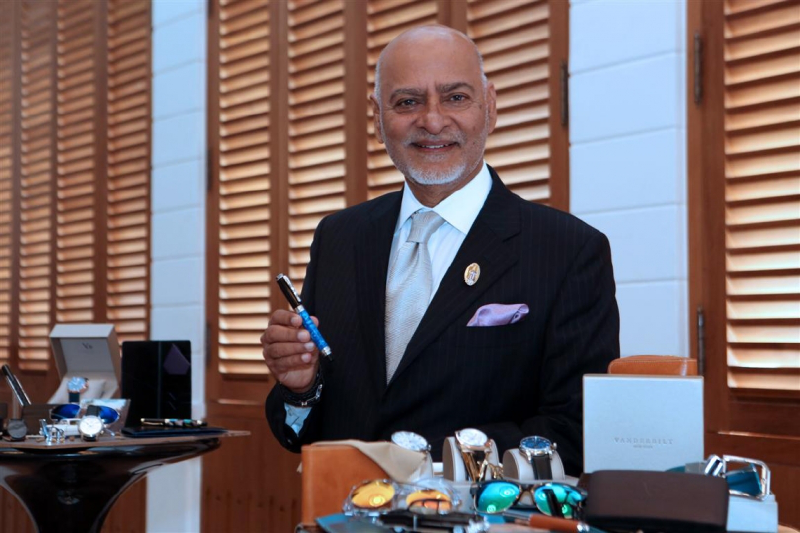
The Vanderbilt New York accessories collection combines the sophisticated styling of the past with modern, urban twists. The look is called “Modern Heritage”. The line includes cool aviator sunglasses and classic watches, pens, wallets and belts.
Murjani says the firm’s “mission” was to reflect the famously wealthy Vanderbilt family’s “legacy of taste, excellence and quality – and at accessible prices”.
The name Vanderbilt “is synonymous with lavish lifestyles and the elegant fashions and grace of Victorian-era America”, he says.
“We were convinced of a huge opportunity for a well-designed, high-quality men’s accessories business involving a major international designer brand, particularly in Asia.
“We felt it best to launch in Thailand and then grow the business exponentially throughout Asia, followed by the rest of the world. No major international designer brand has ever been launched from Thailand, but we thought it would be nice to do it for a country, people and culture we greatly love and respect.”
Murjani is aware that “a big segment of the working population in Thailand” doesn’t have a lot of money to spend, and it’s them he wants to provide with products they can afford to buy for themselves or as gifts.
The strategy is to make Vanderbilt New York as “unique” as Gloria Vanderbilt and Tommy Hilfiger, he says.
“Everyone already knew about Gloria Vanderbilt before she decided to make her designer jeans and sell them at four times the price of regular jeans. Nobody had done that before. But in 1975 you couldn’t wear jeans to a proper restaurant, so her concept
was quite different and the jeans sold out within an hour of going on sale.
“On the other hand, nobody had heard of Tommy Hilfiger when he first started out as a young designer, and he was struggling,” Murjani says. “I fell in love with him as a human being. I felt he was somebody I wanted to back for a lifetime. The challenge was how to get people to know about him, and that’s how we came up with the ads that are still being studied in every marketing class.”
The firm started formulating strategy for the Asian debut of Vanderbilt New York about three months ago, he says. The first information put out was “about the Vanderbilt family, nothing about the product, because I wanted Thai consumers to be familiar with the name Vanderbilt.
“And I think it’s been a good response. People have followed us on Facebook. Now we’ve launched the stores, with celebrities, media coverage and advertising.”
Murjani says his first rule in business is “respect the customer” – “Our family has stayed in business for 86 years based on this understanding.
“You can’t think that consumers are stupid or you can cheat them or do something without them finding out about it. Before you even start on the product design, you place the consumers on a pedestal. Whatever you want to sell, you’d better be sure it will make them happy. Otherwise all of your marketing is useless. Make sure they’re happy and they’ll tell their friends. There is no better marketing than word of mouth.”
Though his firm makes full use of digital marketing, Murjani is attuned to the drawbacks.
“What’s great about digital is that everything is instantaneous, but the message is also gone very quickly,” he says. “In the past when you put an ad in a magazine, it took time to reach the target audience, but that same ad was around for months.
“Today, as soon as you put something out, it reaches millions of people. But the downside is that there’s so much other information coming out at the same time. So consumers see your message and seconds later there’s another message. Yours has gone in the flood of information.
“So whatever you do has to be effective and has to feel real, not just a make a flash, and you have to ensure you reach people in different ways and not just use a single approach.”
Murjani had only recently given Tommy Hilfiger to the world when he first visited Thailand, “and I had time on my hands”.
“I was really impressed with Thai culture and the Thai people, especially the way they respect their elders and their parents and look after each other. In Western societies when parents grow old, they’re put in a home and nobody visits them. Thailand is the opposite. When I walk down the street, people are friendly.
“And I’m comfortable here as a Hindu, too. Thai Buddhism makes use of the Sanskrit language. I just love Thailand!
“My goal in life is to help as many people as I can. I don’t have to set up a formal foundation – I like to go up and hug people, sit with them and make them feel better. You can help people with money or just a hug. That’s what gives me happiness.”
