
Portraits of the Lao Woman


Mattie Do, the first female director to come out of Laos, talks about her new film “Dearest Sister”
Laotian Filmmaker Mattie Do describes herself as a “DIY director”, a woman who started her filmmaking career by accident and with zero knowledge. A former make-up artist who worked on a film set to pay for her ballet tuition, she is now the landlocked nation’s first female director and did her country proud by bringing her second film “Nong Huk” (“Dearest Sister”) to screen at the recently ended Bangkok Asean Film Festival.
The film will be released in Laos and in Thailand’s Northeast week before arriving in Bangkok cinema next Thursday.
Mattie, meanwhile, is busy in flying to festivals with her movie and last week, she sat down to chat with XP at a condominium in the Sukhumvit area where she was residing during her stay in Bangkok.
She admits to being overwhelmed by the warm response to her film at the festival, explaining that she wanted introduce Laos through a different kind of movie in the hope that it will give audiences a different and more real perspective of her country.
“When we talk about Laos, people tend to think about rural villages and exotic scenery. This film is different; it’s a portrait of contemporary society,” she says.
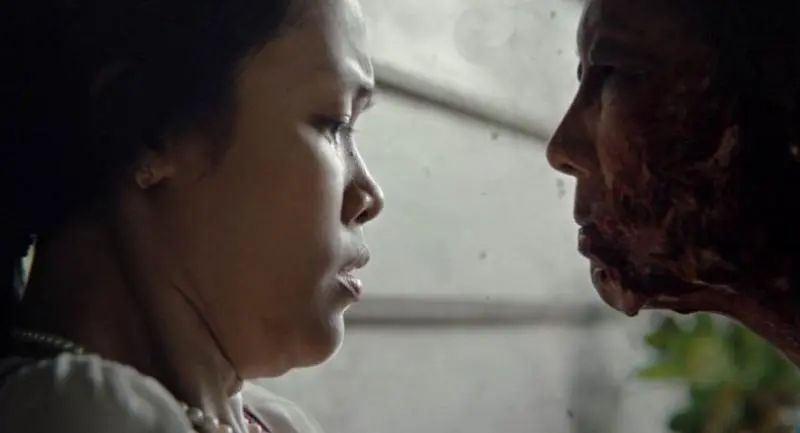
“Dearest Sister” tells the story of Nok (Amphaiphun Phommapunya), a village girl who moves to Vientiane to care for her rich cousin Ana (Vilouna “Tod Lina” Phetmany) who has mysteriously lost her sight. Ana is married to Jakob (Tambet Tuisk), an Estonian who is away on business. At first Nok feels uncomfortable in the new environment and Ana’s housemaid and gardener are hardly welcoming. Soon Nok discovers that Ana sometimes sees a ghost and when that happens, she will unconsciously mutter random numbers. Nok buys a lottery with the number she hears and wins.
She then has to choose between nursing her cousin back to health or keeping her sick in order to get rich herself.
“Dearest Sister” is the second in Mattie’s trilogy about Lao women. Her debut “Chanthalee” focused on Lao women in the context of family. “Nong Huk” is about women in an urban society and the last will be about Lao women living overseas.
“I wanted to make a film with Lao women as the protagonists as we never see this in Lao movies. In general women are involved in a romance, crying over the men they love. In fact our roles in society are much more diverse,” she says.
This theme is clearly shown in “Dearest Sister: Nok and Ana are from different backgrounds and social classes. Ana is among Vientiane’s middle classes while Nok is from a poor family in a remote village. The film also reflects the social hierarchy through the housemaid, gardener, Ana’s elitist friend and the expat society, which some Lao women dream of entering through marriage as a way to elevate their social status.
“Normally there are two choices for a girl like Nok: learn and adapt to a mature lifestyle or fall into the dark hole of greed. There are many women like Nok who go in so deep that it is impossible to turn back. It reflects the mistaken way of thinking that the only way to have a better life is to marry a Westerner, and they are not all good people. The reality is not a fantasy, a Cinderella tale, and I try to bring all that to the big screen,” says Mattie who lives in Laos with her husband Christopher Larsen, the writer of the screenplays for her movies.
The actress who plays Ana is a well-known singer at home and “Dearest Sister” marks her film debut. “It’s difficult to plays a blind character and also be introverted, keeping everything in the mind. I’m grateful to Mattie for guiding me through the role. I think the films gives a good and detailed perspective of women in urban Laos,” she says.
The relationship between Ana and Jakob also reflects the cultural differences in a mixed marriage. “Jakob can
speak Lao but he talks in English to his wife. Likewise, Ana can speak English but she chooses to speak Lao to him. They are both headstrong and they don’t try to understand each other even though they are in love. The way Jakob behaves towards Ana’s parents also reflect his attitude. Details like this are never told in Lao films though they happen enough in real life,” Mattie says.
The director says she came up with the concept for the film while she was making “Chanthalee”, which was a horror flick. She mentioned the idea to her husband, who appeared puzzled at the notion of a ghost giving numbers, although this, like hearing numbers in a dream, is often seen in Laos, Thailand and Cambodia as a sign to buy lottery tickets bearing those numbers.
“The numbers given by the ghost in the film are believed to be unlucky but when Nok hears them, she still takes the risk to buy lottery tickets because she is greedy.”
However, the ghost that appears in “Dearest Sister” is nothing like the standard spirit in Thai or Japanese film fare. “I didn’t want a scary ghost. I’ve tried to portray the Lao ghosts that my grandmother told me about when I was young. She told me that they were just like normal people,” she says.
Despite being born and raised in the US, Mattie has first-hand experience of Lao superstition. “When my mother died, some people asked me whether I dreamed of her and whether my mother had given me any numbers. I was so angry,” says the 36-year-old director.
Mattie was born to a Lao-Vietnamese father and Lao mother, who escaped to Thailand in 1975. Her parents stayed in a Nong Khai refugee camp where her elder brother was born before being resettled in California. She has always loved listening to the ghost stories told by her grandmother and learned a great deal about the nature of the Lao people in
Lao American society.
After graduating from high school, she refused to continue her studies. “I was too stubborn to follow my parent’s will,” she says, though she did agree to study hairdressing and beauty as her parents wanted her to have skills that could earn her a living
And it was makeup that led her to the film set. Ten years ago, Mattie was in Rome with Larsen, who worked at a film school there, and decided to study ballet. Then 26, she knew she was starting too late to make it a career but to earn the cash to pay for the lessons, her boyfriend helped her find work on the school’s film sets.
Mattie and Larsen headed to Laos in 2008 to visit her father, who had just moved back to his homeland and invited his children to join him. They initially intended to only stay for the summer but a meeting with Lao Art Media owner Anousone Sirisackda and producer Douangmany Soliphanh changed their minds. The oldest and most respected feature film production company, Lao Art Media produced the first part of “Sabaidee Luang Prabang” and the Japan-Thailand- Laos co-production “Bangkok Nites”.
The pair wanted Larsen to make a film, a proposal he turned down, saying he was a scriptwriter not a director. He suggested to Anousone that Mattie be given the chance and sat his wife down with a pile of filmmaking books. And thus “Chanthalee” was born.
That is why I call myself as the DIY filmmaker,” she laughs.
While “Chanthalee” was well received as an arthouse movie, “Dearest Sister” is more commercial and targets a wider audience. Mattie is also attracting attention from film festivals but says that some people remain sceptical about her ability, hinting that her husband is helping.
“In fact, he refuses to help even when I am facing problems on the set. He reminds me that it’s my job as the director and he can’t step into it otherwise people won’t respect me. What he is good at is taking me away from the set when I became too stressed and calming me down before sending me back to work,” she says.
Mattie is now thinking about locations for the last film in the trilogy as well as looking for funding. The movie, which will focus on Lao women living in the West, should be in a country where it snows, she says, to give it the right atmosphere.
Her next film, she adds, will be a sci-fi fantasy set in the year 2065. It’s about loneliness and time travel and will centre on a man living alone in a countryside far away from civilisation.
