
Seeing dots in Singapore


The National Gallery Singapore is covered in polka dots – Yayoi Kusama must be in town
SINGAPORE’S National Gallery has been dipped in polka dots for a major retrospective of the art of Yayoi Kusama, the eccentric Japanese purveyor of optical delusions.
Polka-dot patterns in different colour combinations –yellow with black, red with white, you name it – cover the walls, floors, ceilings, staff uniforms and even the food and drinks on sale.
Kusama, 88, is eccentric for an understandable reason. She’s experienced hallucinations since childhood and to this day lives voluntarily in a mental institution, rarely venturing out except to her nearby studio.
But admirers around the world, including retailers like Louis Vuitton, which applied her patterns to bags and clothing, are happy to share in her hallucinations – the dots, pumpkins and meshes of netting.
In 2005 Kusama had polka-dot stickers and balloons for a Tonson Gallery show in Bangkok. The year after that she wrapped trees along Orchard Road in dotted fabric for the Singapore Biennale.

“Dots Obsession” at the courtyard
Now she’s back in Singapore with the exhibition “Yayoi Kusama: Life is the Heart of a Rainbow”, which opened on Friday. It’s her first major exhibition in Southeast Asia, with more than 120 paintings, soft sculptures, collages, videos and large sculptural installations dating back to the 1950s.
The first thing you see are inflatable spheres covered in black and yellow dots hanging from the courtyard ceiling. She made them in 1996 and is still pursuing her “Dots Obsession”.
Kusama’s parents had a commercial pumpkin patch in the town of Matsumoto and she began having hallucinations, not just about gourds but also dense fields of dots and nets. She began incorporating these visions into her art as a form of therapy, seeking peace of mind through “self-obliteration” within the never-ending patterns, as she puts it.
“We see Kusama’s work as a powerful introduction to important modern-art movements and methods such as surrealism, pop, minimalism, performance and conceptual art,” gallery director Eugene Tan told the press while offering a preview of the show last week.
Her dual, simultaneous exhibitions at Tokyo’s National Art Centre and Washington’s Hirshhorn Museum had just wrapped up. The latter set an attendance record for the museum, drawing 475,000 visitors in 11 weeks.
“Kusama has exhibitions travelling the world and it’s not intentional that we have her here following the shows in Japan and the US,” gallery co-curator Adele Tan said. “It took nearly a year to prepare for this exhibition, which we wanted to coincide with the school break.”

Inside the sensorial “infinity mirror” room called “Gleaming Lights of the Soul” is a glittering cosmos of tiny coloured lights endlessly reflected in mirrors.
Getting one of her celebrated “infinity mirror” rooms was something of a coup. This one is called “Gleaming Lights of the Soul” and fits two people at a time. You’re allowed 20 seconds to submit your senses to the glittering cosmos of tiny coloured lights endlessly reflected in mirrors.
As can be imagined, the psychedelic room is a huge draw. You should book a timed-entry ticket online.
There’ll be no personal appearance at the show by the 88-year-old creator, but she stars in a welcoming video, red wig and all. She reads a message in Japanese with English subtitles. “Every day I struggle intensely from morning to night to create artworks. The creation of art is a solitary pursuit,” she says. “I want to keep fighting until my last breath … The fight stretches to infinity.”
Russell Storer, the gallery’s deputy director of “curatorial and collections”, has met Kusama in her studio close to the psychiatric hospital where she’s lived by choice since the mid-1970s. “She’s still active and works in her studio every day,” he said.

Samples from the ongoing “My Eternal Soul” series are surrounded by soft sculptures in outlandish forms.
You get a solid sampling from the brilliantly hued “My Eternal Soul” series-in-progress, begun in 2009. Aiming to complete 100 paintings, Kusama has kept going and topped 500 so far, and Singapore has hung 24 of them.
There are the familiar nets and dots and morphing shapes, as well as new additions, such as female profiles and alien figures. Also on view are recently made stuffed-fabric sculptures in vivid colours and outlandish shapes.
“Kusama’s world is complex – full of colour and powerful symbolism,” Storer said. “In each piece you’re transported into a universe that’s deeply intimate as well as potentially boundless.”

The exhibition traces the development of Kusama’s signature dots, nets and pumpkins.
The show’s been arranged progressively in three segments. In one area you witness the development of her signature dots, nets and pumpkins, in a second her “body” pieces involving performance and video. The third presents the recent work, particularly large installations.
The tour begins with a small array of 1950s paintings done in Kusama’s hometown, Matsumoto, and in Kyoto, where she studied the traditional style of painting called nihonga. “Self Portrait” from 1952 has an eye floating in a cloud of dots.
From 1959, when she moved to New York (and stayed for 16 years), is a monochrome painting of interconnecting white nets. Two of her “Infinity Nets”, from 2000 and 2016, underline the link with repetitive patterns extending into infinity.
In her hallucinations, the pumpkins of her childhood – the family lived on the gourds through the lean years of World War II – ended up talking to her, as did the dots and nets and animals. All have been faithfully depicted in paintings.

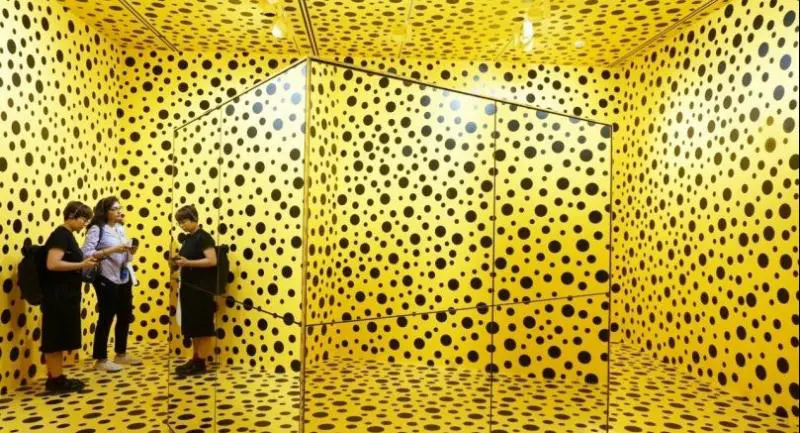
Peek inside the mirrored cube in Yayoi Kusama’s dazzling enclosure called “The Spirits of the Pumpkins Descended into the Heavens” and you glimpse a field of pumpkins stretching to infinity.
Recently she designed a pumpkin infinity room, titled “The Spirits of the Pumpkins Descended into the Heavens” (six people at a time fit in this one). Its walls, floors and ceiling are covered in yellow and black polka dots. There’s also a mirrored cube with a small window on one side, and if you peek inside you see a vast field of pumpkins stretching to infinity.
Storer pointed out two pumpkin paintings nearby, one from 1981 and the other 2015.
“You can see how consistent she is in returning to this motif,” he said. “Her family grew pumpkins and it was the staple of their diet during the war. She found its shape appealing – solid spiritual balance, generous unpretentiousness – and felt a connection with it.”

Two large pumpkin sculptures reveal on close inspection a new technique for the artist – colour schemes forming a mosaic.
During her years in New York, the human body came to the forefront of her art – in protest against both the Vietnam War and gender inequality. She staged free performances at the Brooklyn Bridge, on Wall Street and in Central Park where people stripped naked and were painted in polka dots.
Struggling for recognition as a woman and an Asian among the city’s predominantly white male artists, her 1966 performance “Walking Piece” was documented in 24 photographs. Kusama is seen roaming the Big Apple clad in a kimono and carrying an umbrella.

“Song of a Manhattan Suicide Addict" video installation
The 2010 video installation “Song of a Manhattan Suicide Addict” shows off Kusama’s musical talent. In red wig and dotted red clothes, she croons her own composition about dealing with depression. Mirrors on either side endlessly reflect her, various psychedelic effects and a moving sequence of artworks.

The “Love Forever” series comprised of 50 silkscreen prints is displayed in the same room of “I Want to Love the Festival Night”, revealing numerous light bulbs and mirrors beyond.
The vibrant colours vanished in the 2004-07 series “Love Forever”, comprised of 50 black-and-white drawings rendered in marker pen but turned into silkscreen prints just for this exhibition.
“I Want to Love the Festival Night” was also specially created for the gallery. It’s a wall with three holes at different heights revealing numerous light bulbs and mirrors beyond.
SHARE THE HALLUCINATION
The exhibition “Yayoi Kusama: Life is the Heart of a Rainbow” continues through September 3.
The National Gallery is open daily (except Monday). Admission is S$25 (Bt615) for non-residents ($30 for an all-access pass).
Timed-entry tickets are recommended. Get them at www.NationalGallery.sg.
