
Luxury at a new level


Property developer AP (Thailand) looks to Italy for the inspiration behind its new downtown development
The sound of heavy machinery in full operation cuts through the silence of the Alps as we approach the small towns of Crevoladossola and Domodossola in the Piedmont region of northern Italy, just 23 kilometres from the border with Switzerland. We are almost at a quarry owned by Tosco Marmi and the miners are busy extracting the Palissandro marble that is found nowhere else in the world. Once extracted, the marble is taken to down to the factory in Domodossola from where it will be shipped to clients around the globe.
Renowned for its quality and colour, Palissandro marble comes from this one quarry owned by Tosco Marmi Group and is today a primary choice of interior designers all around the world.
Thailand too has fallen in love with this stone and it has been used extensively throughout the new ultra-luxury condominium Vittorio next to the EmQuartier shopping centre. Developed by AP (Thailand), the 28-storey high-rise sits on a 1.29-rai plot on Soi Sukhumvit 39 and has just 88 residential units, thus offering a high level of privacy. In busy Bangkok, that doesn’t come cheap and that’s reflected in the price – the apartments are priced from Bt35 million to Bt107 million or about Bt350,000 per square metre. Now complete, the condos are open for booking.
AP chose to celebrate its first ultra luxe residence, which has been five years in the making, by taking a group of reporters to Italy to experience their inspirations first-hand. The interiors of Vittorio, including the gallery’s Galleria Medici lobby, utilise the rare Palissandro Bluette marble, which owes its beauty to its luminous grey-blue-brown veins.
Palissandro, says Marcello Peretti, the company sales manager, is mean wood in its original form hence the pattern looks like wood or tree shapes. This marble has become increasingly popular over the last 10 years, and with demand so high, the price has shot up.
“We chose to use Palissandro Bluette because it is the most beautiful. It is also rare, found only in Tosco Marmi’s quarry. It is widely accepted among world-class architects and the global design community. Besides its three luminous colours, it glows like a jewel when it comes into contact with light and its natural prints are like those of rosewood. To get the marble tiles to fit together in a continuous montage is a complex process when you use it as floor and wall tiles,” says Vittakarn Chandavimol, chief of AP Thailand Condominium’s Business Group.
Somkiat Jitsangboon, managing director of the Empire Granite Company, who chose Palissandro Bluette for AP says his decision was based on the developer’s wish to have marble with blue hints throughout the lobby.
“It was not easy at first as most marble is white, brown and grey. Then we found the quarry in Italy and were able to place an order,” he says.
Somkiat has been importing Italian marble for decades, flying to Carrera – the world’s mecca of marble to try and match his client’s needs and finally finding the unique Palissandro Bluette.
Marble has long been popular in Thailand as well as other countries but up until about a decade ago, the trend was for certain forms and styles.
“The trend in marble patterns comes and goes. The price depends on demand. Thai customers love the clean white colour with a uniform pattern,” says Somkiat.
The pattern of Palissandro marble, however, is not in the least uniform and so AP relied on Somkiat to choose the right slabs, having him to lay the tiles digitally before placing them in the hallway.
“We extracted only 30 per cent to use at Vittorio, discarding another pieces because of the freeform pattern, defects in the marble and transportation,” says Vittakarn, adding that the overall price was well into the millions of baht.
Five years ago, Vittorio Condominium was given the French name “Galerie Rue de 39” but was changed in honour of the developer’s inspiration –the art and architecture of Florence, the ancient capital of Italy’s Tuscany region.
Sappasit Foongfaungchaveng, head of Corporate Marketing and director of AP Sign Lab, has a soft spot for Italy, having spent an internship in Florence while working as a curator at the Thailand Creative and Design Centre.
“When I became involved with the project I started by trying to find the definition of luxury. Privacy later became the key concept and that made me think of Florence’s Uffizi Gallery,” he says.
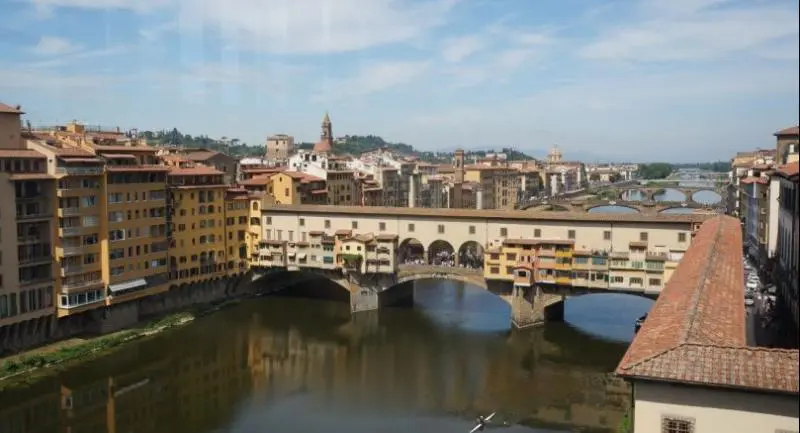
The Uffizi Gallery is a world-renowned art museum where paintings and sculpture by foremost Italian artists grace the interiors of the Vasari Corridor, an overhead passageway between the palaces and mansions of wealthy families in ancient Florence.
While the Uffizi Gallery itself is packed with tourists who come to see the masterpieces of Leonardo Da Vinci and Sandro Botticelli, the overhead passageway is closed to the public and can only be seen from the exterior as it spans the Arno river by the Ponte Vecchio bridge on its way to Palazzo Vecchio on the other side of the river.
And so the Vasari Corridor has found its way to Bangkok, transformed into the project’s interior layout of each unit and separating the unit’s living quarters from the back-of-the-house utility area. Even the lift access is separate for service staff and residents. “Each unit has a separate wall and an interior layout that ensures the greatest privacy,” he says.
AP also has spent millions buying art works by well-known Thai artists including the late national artist Khien Yimsiri, Natee Utarit and Pinaree Sanpitak and these will give the lobby and other areas a gallery-like ambience.
Here again, the developer has been inspired by the Uffizi Gallery, considered one of the world’s most important and famous museums for paintings and sculptures. Curated art pieces selected by AP will also be used to decorate the residences and handed over to the owners, where they will become the property of the condo’s legal entity.
