
The commandeur takes a bow


Play
A veteran Dutch choreographer receives France’s highest cultural state distinction
Among the highlights of the 37th annual edition of Festival Montpellier Danse earlier this month was the conferral of commandeur des arts et des lettres upon internationally revered choreographer Hans van Manen by France’s Ministry of Culture and Communication representative Brigette Lefevre. Lefevre, who is also director of the Festival de danse de Cannes and former director of the Paris Opera ballet company, made the presentation in the the courtyard of Agora, the festival’s main hub. This made him the first Dutch performing artist to have ever received France’s highest cultural state distinction and the Netherlands’ minister of education, culture and science Jet Bussemaker was also on stage delivering her speech, in French.
Earlier that morning in another corner of this dance centre, van Manen shared some insights with the international media. He is now 85 but shows no signs of retiring after a career that has seen him create more than 120 modern ballets that are being performed by some 50 companies including the Bolshoi Ballet and the Mariinsky Ballet. “I’m a choreographer and I love my job,” he said with a smile.

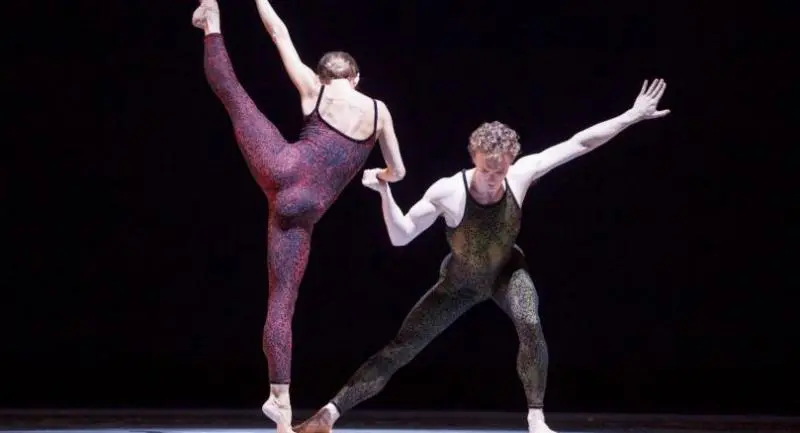
One of van Manen's major hits, “Frank Bridge Variations” (2005) was inspiredby Benjamin Britten's “Variations on a Theme of Frank Bridge”. PHOTO BY ANGELA STERLING
Currently a resident choreographer with the Dutch National Ballet, he also noted that instead of going freelance, he prefers to work for a company. “The dancers are my muses,” he explained.
“The company is what makes you creative. You know the dancers, the repertory [of works] of the company and then you know what to make for that repertory. Dancers are very inspiring for me. I never use dancers as robots [who simply follow what I ask them to do]; I use personalities and that’s very important. [Being part of the company] I know that now and then I have to make a new work.”
He also stressed that even though his ballets do not tell stories, they’re not abstract either as he always makes sure that his dancers’ emotional expressions and eye contact communicate with the audience.
Music is also very important to van Manen, especially now, when he is creating a new work. “The only thing I know is my next date for [a new] ballet is March 18, 2018. I know that there are four dancers I want to work with; I don’t know yet whether this is going to be a ballet for four dancers, though. I started listening to the music by a Spanish composer and pianist, which I like very much. People started asking me about this new ballet and I said, ‘I don’t know –ask me four weeks before [March 18], then I’ll know. I like to work with my back against the wall.”
While admitting that his biggest influence was George Balanchine, van Manen said he’s constantly influenced by everything around him, including his friends who’re come from many different walks of life, though he admits he doesn’t know how he’s being influenced.

“Adagio Hammerklavier” (1973) is a piece for three pairs of soloists and is inspired by Christoph Eschenbach's performance of the adagio from Beethoven's “Piano Sonata no. 29 in B major”. PHOTO/ HANS GERRITSEN
In the afternoon, the festival held a public screening of three short films that documented his rehearsal process as well as his exemplary works. Later that evening, a few hundreds of metres away at the festival’s largest venue Opera Berlioz at Le Corum, the capacity crowd enjoyed a quadruple bill of the Dutch master’s works from four different decades, namely Adagio Hammerklavier” (1973), “Two Gold Variations” (1999), “Sarcasmen” (1981) and “Frank Bridge Variations” (2005).
Two years ago at the Hong Kong Arts Festival, I witnessed how the Dutch National Ballet’s dancers combined their fabulous dance techniques with narrative skills in “Cinderella”. Their performance in these four non-narrative works by van Manen in southern France topped that and underlined their immense level of musicality that’s passed from the master choreographer whose pas de deux put as much emphasis on the men as the women. Theatricality was most evident in “Sarcasmen”, a duet with live piano accompaniment in which the musician, interpreting Prokofiev’s “Cinq Sarcasms opus 17,” was always active in the stage actions that were keenly filled with irony, humour and eroticism as if the three performers were in a play.
Thai audiences, thanks to Bangkok’s International Festival of Dance and Music, have watched Introdans and Nederlands Dans Theatre perform works by many different choreographers. The time has now come, we would hope, to watch Dutch National Ballet performing works by the Dutch commandeur.
The writer’s trip was supported by Festival Montpellier Danse’s press office. Special thanks go to Maiwenn Rebours and Natalia Matus.
