
You could be at risk of lung cancer despite never having smoked
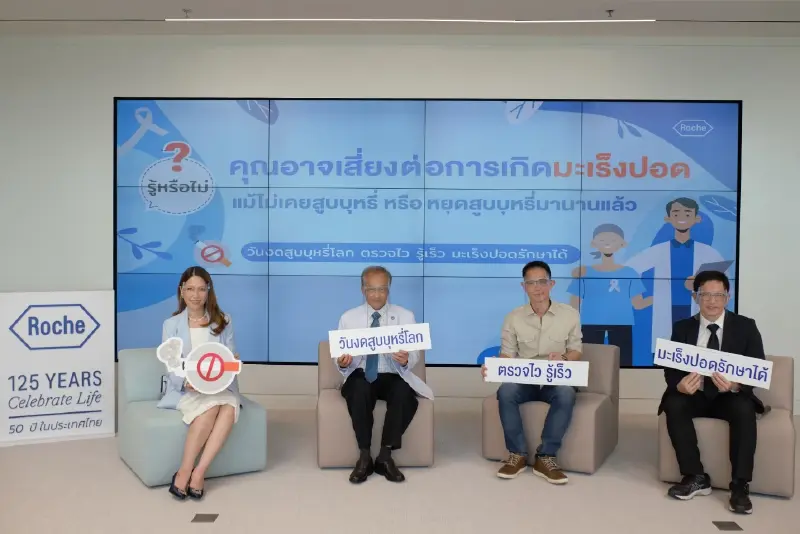


Roche Thailand has introduced a new method in lung cancer diagnosis using a low dose computerised tomography scan which provides accurate diagnosis in the vital early stage of the dreaded disease.
The company announced the novel method at a seminar on May 27 titled “Did you know? You could be at risk of lung cancer” to promote public awareness regarding the risks of lung cancer and other diseases related to smoking on the occasion of World No Tobacco Day on May 31.
Key speakers at the seminar included Vichaiyut Hospital respiratory specialist Dr Manoon Leechawengwongs and Dr Narinthorn Surasinthon, anti-aging and regenerative medicine specialist from Bumrungrad International Hospital. The session also featured two guest speakers, one who had been diagnosed with early-stage lung cancer after having smoked for some time but had kicked the habit for years and another, whose mother had never smoked before, to share their experiences in diagnosis and treatment.
Statistics from the World Health Organisation’s Global Cancer Observatory report showed lung cancer was the second highest cause of death from cancer in Thailand in 2021, with 23,717 new cases reported – an average of 65 patients per day.
Last year 20,395 Thais died due to lung cancer, or an average of 56 persons per day, putting Thailand in 18th place of disease severity.
Despite the high rate of cases, the number of patients being diagnosed in the early stages in Thailand is relatively low compared to those in developed countries such as the United States, United Kingdom, France, Space, Italy and Japan.
“Since the success in treating cancer largely depends on how early a patient is diagnosed with it and receives treatment, it is evident that challenges in reducing the mortality rate from lung cancer in Thailand lies in providing persons at risk of this disease with a fast, accurate and affordable screening test,” said Manoon.

“If patients are diagnosed when they are in the fourth stage, or the spreading stage of lung cancer, they will have a 0-10 per cent chance of surviving more than five years after treatment. However, the chance of survival improves to 13-36 per cent if cancer is detected in the third stage, and to 53-92 per cent if it is found during the second or first stage,” he explained.
Thailand has an early-stage lung cancer detection rate of only 15 per cent, Manoon said.
He therefore urged people in high risk groups, like those who have been smoking or exposed to cigarette smoke or other chemicals that cause cancer to get tested immediately if they have the following persisting symptoms: hoarse voice, change in voice, chronic coughing, blood in phlegm, wheezing, prolonged chest pain, pain when swallowing, or lung infection.
“Healthy people could also be at risk of getting lung cancer as the risk factors of this disease could be heredity. If your family members have a history of chronic lung diseases and emphysema, you could inherit a faulty gene that may cause lung cancer,” he warned.
“However, the heredity factor is responsible for only 20 per cent of lung cancer patients, while 80 per cent developed the disease due to their behaviour and the environment – for example, smoking more than 20 packs of cigarettes per year, being exposed to asbestos, nickel and chromium due to an industrial work environment, riding a motorcycle in areas with PM2.5 dust particles, or burning incense sticks regularly.”
During the seminar, Arun Thepkaew shared his experience after he was diagnosed with second stage lung cancer at 68 years of age. Arun had been smoking two packs of cigarettes a day for 13 years but had quit the habit for 35 years.

“Last year I went to a doctor after experiencing chronic coughing, and was diagnosed with lung cancer,” he said. “This helped me get treatment at an early stage and the result has been satisfactory. I can live a normal life without being a burden to others. I vowed to follow the doctor’s orders in reducing risky behaviour and avoiding environments that could worsen my condition.”
Yod Kusolmanosuk shared the story of his mother Kimtiang, 72, who had been diagnosed with first stage lung cancer despite never having smoked.

“My mom often burned incense sticks while praying before going to bed,” he said. “Ten years ago, she was also diagnosed with the spreading stage of colon cancer. Last year, I took her for an annual physical check-up, in which the doctor suggested that she get a low dose CT scan since her heredity factor indicates she could be at risk of lung cancer. The scan revealed she had first stage lung cancer, which is lucky for us as treating it in this stage means a high chance of success, compared to colon cancer in later stages that she has had to deal with.”
Bumrungrad’s Dr Narinthorn said there are three methods of screening for lung cancer: chest X-ray, a CT scan and low dose CT scan.
“Chest X-ray is often included in annual physical check-ups as it is fast and inexpensive,” he said. “However, it is inefficient in detecting cancer cells in the early stage because the cells are too small for X-rays to pick up,” he explained.
“The CT scan has higher accuracy, but it is expensive and not many hospitals have the equipment, which results in patients having to wait for a long time to get scanned,” the doctor said.
“But the low dose computerised tomography scan, or in short low dose CT scan, is six times more accurate than chest X-rays and can therefore detect cancer cells early, allowing for quicker treatment, which will help reduce patient mortality from lung cancer by 20 per cent,” he said.
“The low dose CT scan for lung cancer screening is both fast and efficient. Therefore, all patients in risk groups should go in for this.”

The US National Comprehensive Cancer Network suggests people over 50 and those who have been smoking more than 20 packs a year should get low dose CT scan every year as a precaution against lung cancer, Narinthorn pointed out.
“Those who have never smoked but carry other risk factors, or even health-conscious people, can consult their physician to get a low dose CT scan, as detecting this cancer at an early stage will significantly increase the success rate of treatment and reduce the chance of cancer recurring,” he strongly advised.
You can watch the seminar via the following YouTube channels: https://www.youtube.com/watch?v=vJWl48RAeng or https://www.youtube.com/watch?v=yQGpUZqRvn4.
