
The legend of the Songkran
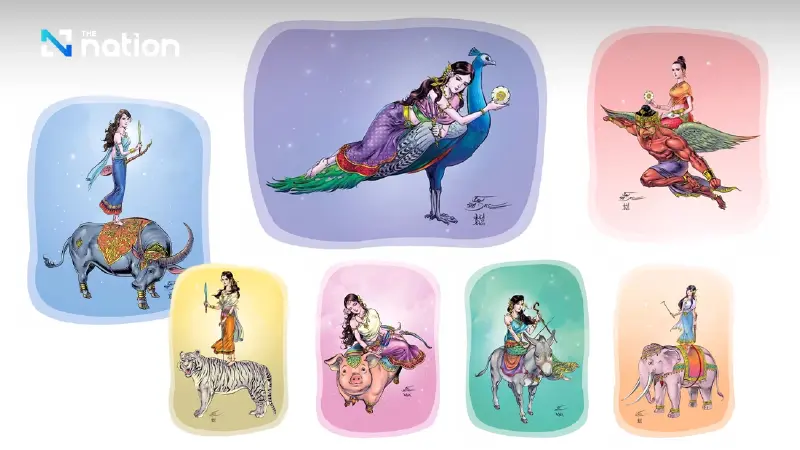


Songkran, Thailand’s traditional New Year festival, is one of the country’s most cherished celebrations. Rooted in ancient customs, it marks the movement of the sun into Aries and symbolises a fresh start.
But beyond the famous water fights and joyful gatherings, Songkran carries deep cultural significance—especially with the annual appearance of the Songkran Goddess, a celestial figure believed to bring fortune and predictions for the year ahead.
The Story Behind Songkran
The word “Songkran” comes from the Sanskrit “Saṁkrānti”, meaning “to move” or “to transition”, referring to the sun’s shift into a new zodiac sign.
The story of Songkran's origins is recorded in inscriptions commissioned by King Rama III. These inscriptions, engraved on seven stone tablets, are displayed in the pavilion of Wat Pho (Wat Phra Chetuphon Vimolmangklararm) in Bangkok.
The legend of Songkran begins with a wealthy man who, despite his riches, had no children even after reaching middle age.

One day a drunkard mocked him, saying his wealth was meaningless without an heir. Deeply saddened, the man decided to perform a ritual for three years in devotion to the Sun and Moon, praying for a child.
One day, as part of his ritual, he and his servants washed rice seven times with clean water and offered it to a sacred banyan tree. The gods, moved by his sincerity, sought the help of Lord Indra. In response, Indra sent a celestial being named Thammabal (Dharmapala) to be born as the man’s son, later known as Thammabal Kumar.
Thammabal Kumar was an exceptionally bright child, quickly learning the language of birds and mastering the sacred texts of the Brahmin religion, known as the Tripitaka, by the age of seven. His remarkable abilities gained him widespread fame, which caught the attention of King Kabin Brahma (Kabilaprom), the deity representing the Sun.
Intrigued by Thammabal’s intelligence, King Kabin Brahma decided to test his skills by challenging him to a wager, escalating to a contest of extraordinary proportions.

The challenge ended with Thammabal Kumar emerging victorious, prompting King Kabin Brahma (the Sun God) to call upon his seven daughters to prepare for a unique task.
As the Sun God, King Kabin Brahma's head was so powerful that, according to legend, if it touched the earth, it would set the world ablaze; if cast into the sky, it would cause drought; and if thrown into the sea, it would dry up the waters.
Thus, his seven daughters were entrusted with the task of receiving his head, placing it in a vessel and carrying it around Mount Meru, the sacred centre of the world, before storing it in the Kandhuli Cave on Mount Kailash. Every year, one of the daughters would take turns performing this sacred ritual.
The entire story symbolises the movement of the sun, which is the essence of the word “Songkran", referring to the transition of the sun from one zodiac sign to another, marking the start of the Thai New Year.
This ritual, deeply rooted in ancient beliefs and mythology, symbolises the cyclical passage of time and nature's eternal rhythm, giving rise to the celebration of Songkran.
The Seven Songkran Goddesses
The Seven Songkran Goddesses were originally celestial maidens residing in the heaven of the Four Great Kings. They served Lord Indra and were the daughters of King Kabin Brahma, the deity representing the Sun.
Each of these seven goddesses represents a day of the week, and their selection for each year’s Songkran is determined by the day on which Songkran falls according to the lunar calendar.


Tungsa Devi is the Songkran goddess of Sunday. She wears a Pauhrat garment and adorns herself with a pomegranate flower. Her attire is decorated with ruby gemstones. Her food is figs. She holds a discus in her right hand and a conch shell in her left. Tungsa Devi travels on the back of Garuda.


Koraka Devi is the Songkran goddess of Monday. She wears a Pauhrat garment and adorns herself with a cork tree flower. Her attire is decorated with pearl gemstones. Her food is oil. She holds a sword in her right hand and a staff in her left. Koraka Devi travels on the back of a tiger.


Raksot Devi is the Songkran goddess of Tuesday. She wears a Pauhrat garment and adorns herself with a lotus. Her attire is decorated with agate gemstones. Her food is blood. She holds a trident in her right hand and a bow in her left. Raksot Devi travels on the back of a boar.


Monta Devi is the Songkran goddess of Wednesday. She wears a Pauhrat garment and adorns herself with a champaka flower. Her attire is decorated with cat’s eye gemstones. Her food is dairy products. She holds a needle in her right hand and a staff in her left. Monta Devi travels on the back of a donkey.


Kirini Devi is the Songkran goddess of Thursday. She wears a Pauhrat garment and adorns herself with a magnolia flower. Her attire is decorated with emerald gemstones. Her food is sesame seeds and nuts. She holds an elephant goad in her right hand and a gun in her left. Kirini Devi travels on the back of an elephant.


Kimita Devi is the Songkran goddess of Friday. She wears a Pauhrat garment and adorns herself with a water lily. Her attire is decorated with yellow sapphire gemstones. Her food is bananas and water. She holds a sword in her right hand and a lute in her left. Kimita Devi travels on the back of a buffalo.


Mahothon Devi is the Songkran goddess of Saturday. She wears a Pauhrat garment and adorns herself with water hyacinth flowers. Her attire is decorated with black spinel gemstones. Her food is venison. She holds a discus in her right hand and a trident in her left. Mahothon Devi travels on the back of a peacock.
The day when the Songkran goddess leads the sun’s transition from Pisces to Aries marks the beginning of the Songkran Festival, known as Maha Songkran Day. The second day, Nao Day, signifies the sun's position at the midpoint between Pisces and Aries. Finally, New Year’s Day (Chalerm Sak) occurs when the sun fully enters Aries, marks the official start of the new year.
This legendary tale behind Songkran reflects the grand transition of nature and seasons, which deeply influence our lives.
