
Uncovering history: why Sanam Luang was once called ‘Thung Phra Meru’ and its royal significance
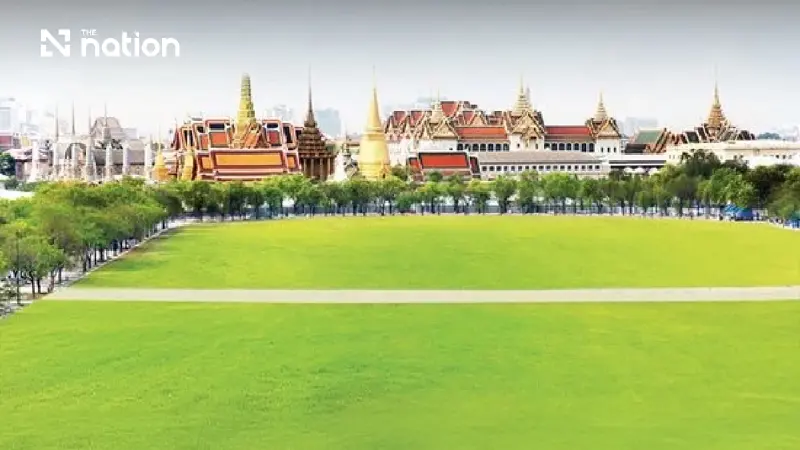


Once known as Thung Phra Meru, Sanam Luang has witnessed royal rites, rice fields and revolutions — a ground where Thai history continues to unfold

The open ground known today as Sanam Luang was not always as vast as it now appears. In earlier times, the area was only about half its present size.

Sanam Luang during the reign of King Rama I
Sanam Luang dates back to the foundation of the Rattanakosin Kingdom. Situated between the Grand Palace (Phra Borom Maha Ratchawang) and the Front Palace (Phra Bovorn Sathan Mongkhon), the open field was originally used for royal cremations of kings and members of the royal family. Because of this, it was known as “Thung Phra Meru,” meaning the royal cremation ground.
When there were no royal cremations, the field lay largely unused—overgrown and marshy.
Sanam Luang during the reign of King Rama III
In the reign of King Nangklao (Rama III), a dispute arose between Siam and Vietnam over the Cambodian frontier. The King ordered that rice fields be cultivated on Thung Phra Meru to demonstrate to the Vietnamese that Siam was a prosperous nation with abundant food supplies—so well-provisioned that even the land in front of the Grand Palace was turned into paddy fields.
Sanam Luang during the reign of King Rama IV
Under King Mongkut (Rama IV), the area continued to be used for royal rice cultivation. However, His Majesty disliked the name Thung Phra Meru, finding it inauspicious. In 1855 (2398 BE) he issued a royal proclamation renaming it “Thung Sanam Luang” (“the royal ground”) stating:
“The paddy field before Wat Mahathat has long been called Thung Phra Meru after a ceremony that occurs only rarely and is of an inauspicious nature. Henceforth, this area shall be known as Thung Sanam Luang.”
Sanam Luang during the reign of King Rama V
During King Chulalongkorn’s (Rama V) reign, the Front Palace (Wang Na) became vacant after the death of Prince Boworn Wichaichan. His Majesty abolished the position of the Front Palace and established the title of Crown Prince (Sayam Makut Ratchakuman) following Western royal practice.
The King ordered the expansion of Sanam Luang into the former palace grounds, doubling its size to approximately its current area. Tamarind trees were planted around the perimeter to provide shade, inspired by the boulevards the King had seen during his European visits.
In the process, the eastern wall of the Front Palace was dismantled, and structures such as the Phlapphla Sung pavilion were removed to make way for new roads. The present eastern section of Sanam Luang, in front of Thammasat University, corresponds roughly to where those palace structures once stood.
Sanam Luang during the reign of King Rama VI
During King Vajiravudh’s (Rama VI) reign, Sanam Luang served as a venue for royal ceremonies and public recreation, including horse-racing and golf.
Sanam Luang during the reign of King Rama VII
After the 1932 (2475 BE) revolution, many religious and royal ceremonies were transferred to government ministries. Long-standing traditional rites such as the Royal Ploughing Ceremony (Phra Ratchaphithi Charot Phra Nangkhan Raek Na Khwan) and the Triyampawai and Triyangban ceremonies were discontinued for a time, though some were later revived—again using Sanam Luang as the ceremonial ground.

Sanam Luang during the reign of King Rama IX
In the reign of King Bhumibol Adulyadej the Great (Rama IX), Sanam Luang became a lively weekend market, established in 1948 (2491 BE). Initially, it sold produce and plants from farmers but gradually expanded to a wide range of goods.
In 1978 (2521 BE), the government under General Kriangsak Chomanan decided to relocate the market to make room for the Bicentennial Celebrations of Rattanakosin. The State Railway of Thailand therefore allocated land in the Phahonyothin area to Bangkok Metropolitan Administration, which developed it into the now-famous Chatuchak Weekend Market, opened in 1982 (2525 BE).
On 13 December 1977 (2520 BE), the Fine Arts Department registered Sanam Luang—an area of 74 rai 63 square wah—as a national historic site, officially published in the Royal Gazette.

References
Sujit Wongthes, Where Did Bangkok Come From? (Matichon Publishing, first edition, February 1985)
Assoc. Prof. Songsiri Vichiranon, “The Development of the Weekend Market,” Journal of Academic and Research, RMUTP 7(1), March 2013
Kred Prawatisart v2 Facebook page
