
A scent of the sacred


Play
The caves of Vietnam's Perfume Pagoda draw more than a million souls each year
Our boat drifts softly along the Yen River under the blue sky, gliding past a landscape of peaceful rice paddies and limestone mountains.
With the cares of the city behind us, my friends and I feel as free as the fish lazing in the waters beneath us as we float towards the entrance of Huong Pagoda.
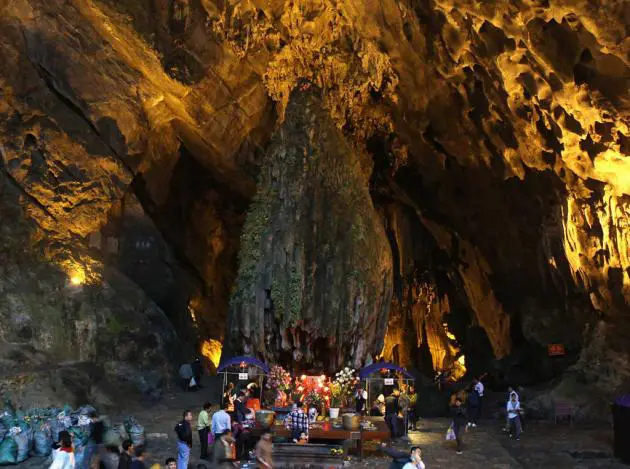
Vietnam’s most famous pilgrimage site – better known as the Perfume Pagoda – was founded in the late 17th century. Spread out among the limestone hills and lush forest at the base of Huong Mountain, 70km southwest of Hanoi, is the pagoda’s cluster of Buddhist shrines. These surround deep caverns that have been moulded into fantastic shapes over thousands of years by stalactites.
At the centre of this complex lies the Perfume Pagoda, located in Huong Tich Cave, which is thought to have been discovered 2,000 years ago. Inside, a message written in 1770 by Lord Trinh Sam (ruler of northern Vietnam from 1767-82) describes the cavern as the most beautiful in the country.
Every year, the site welcomes more than one million pilgrims and tourists from across the country, who arrive at the sacred cave to pray for a happy and prosperous year, or simply to soak up its strange beauty.
The stream of pilgrims reaches its peak during the huge three-month Pagoda Festival, which lasts until the end of this month.
“On the first day of the festival alone we had more than 50,000 pilgrims and tourists, despite the rain and the cold,” says Nguyen Van Hau, head of the festival organising group. “This season we expect to welcome 1.5 million in total.”
The festival this year is the biggest ever and tourists have been offered a much more diverse range of activities, including a photo exhibition of ancient pagodas, performances of traditional music and dancing aboard river boats, and mass-releases of birds at the Thien Tru wharf.
A poetry night and a parade of flower garlands and coloured lanterns along the river also offers visitors more than just the pagoda to remember from their trip.
“My family had to leave at 2 in the morning to to get to Huong Tich cave for the festival’s opening at 9am,” says Nguyen Thi Minh, a visitor from Hanoi. “We knew that the pagoda would be very crowded and wanted to avoid traffic jams on the road and at the pagoda.”
This year the festival organisers have arranged 5,000 boats to serve the demand from pilgrims.
However, if you can’t stand crowds and want to enjoy the serenity of the landscape and the spirituality of the site, I would advise that you wait at least another two weeks. That way, you can visit the pagoda when the festival is over and Huong Tich Cave has returned to its natural, tranquil state.
Getting there
Most visitors take a day trip from Ha Noi. Several coaches depart every morning from the terminals of Giap Bat and Luong Yen to Ben Duc pier. It takes three hours from Luong Yen and two from Giap Bat.
When you arrive at the pier you have a choice of transport to the base of pagoda complex. Take the bus, or climb aboard a boat for a more romantic and scenic alternative. The 45-minute boat ride is the highlight of the trip for some visitors.
Wear sturdy shoes – visitors must climb about 1,000 steps through spectacular scenery if they want to reach the most sacred part of the pagoda, the Huong Tich Cave. Shops along the way give you the chance to sit down and take a well deserved break.
If the long walk still doesn’t appeal, take the cable car. The cost is 80,000 dong (Bt112) to get up to the cave and 60,000 dong to come down.
Legend has it that the female Bodhisatva Quan Am once lived in Huong Tich Cave, fulfilling her vow to save the souls of all living beings. True or not, the cave radiates a sense of peace. Our visit brought us some luck, too. Strangers we met at the pagoda kindly offered to give us a lift home.
