
Akbar the Great and flexible


Play
Under the tolerant rule of the greatest Muslim emperor, civilisation reached glorious new heights in northern India
The Mughal Empire flourished in South Asia from the 16th to 19th centuries, but it was Akbar the Great who took a small kingdom in northern India and turned it into a vast territory that stretched across present-day India, Pakistan and Afghanistan.
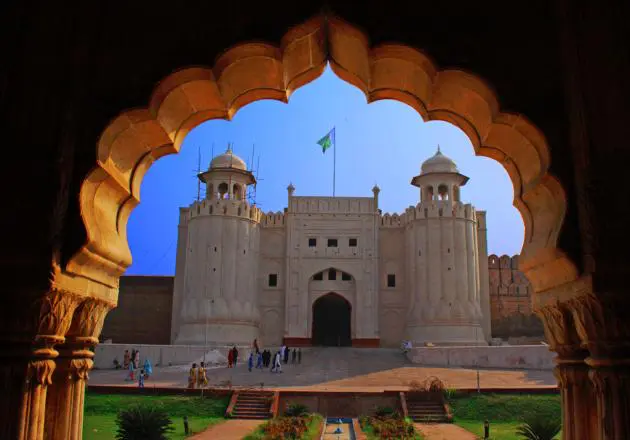
Akbar, the third Mughal emperor, ruled over his expanding dominion from the enormous Lahore Fort in the eastern Pakistani city of Lahore.
The fort, a World Heritage Site, is still buzzing with visitors four centuries later.
Walking along the grassy slope that skirts its stout external walls, I dodge groups of schoolchildren being given outdoor history lessons. Vendors mingle with the tourists, hawking chickpea snacks and souvenirs.
Tour guide Khalid, 50, says Akbar is his “favourite” emperor.
“He was a master at getting people of different religions and cultures to come together,” he explains.
Akbar inherited the throne when he was just 13 years old, after his father Humayun died in a fall down a flight of stairs. The old emperor’s aides took over the day-to-day running of the small, Muslim kingdom near Delhi in what is now northern India, until Akbar came of age.
Most modern historians share Khalid’s opinion that Akbar’s religious policies were the key to his success.
The boy emperor came to the throne at a time when non-Muslims were taxed harshly and Hindu temples were commonly destroyed. Akbar, although a devout Muslim, abolished the poll tax and established a meritocracy that sought the most talented people – regardless of religion or sect – to serve at the court in Lahore Fort.
Akbar’s curiosity and tolerance of other faiths extended into his personal life. He took a Hindu woman as one of his many wives and she bore him the son, Jahangir, who was to follow him on the throne.
Legend has it that when Akbar was asked why he allowed the construction of Hindu temples, he answered, “They have the right to love their own religion.”
But Akbar might also have had a practical, even ruthless, reason for showing such tolerance.
“He knew that if he persecuted other faiths, he wouldn’t be able to rule such a large nation,” says Qamar Abbas, former head of the history department at Punjab University.
Others, however, prefer to think Akbar simply had a high regard for the wisdom of different religions.
Whatever the case, the result was that dissatisfaction among the Hindus he ruled never grew so great as to threaten the stability of the empire.
Successful policies such as opening the military up to Hindus and forming alliances with leading families through marriage led to steady expansion of the empire
Yet like any successful ruler, Akbar was given to cruel and ruthless fits of action. He is known for mercilessly destroying his enemies and summarily banishing long-time aides. Yet he remains a popular historical figure.
Perhaps locals contrast the confusion of life in the subcontinent today with the good times under Akbar’s reign. Tension between Hindu-majority India and predominantly Muslim Pakistan continues to this day.
Last month, Shi’ite and Sunni Muslims clashed in the suburbs of Islamabad, leaving about 10 people dead. Conflict between different sects and faiths is a disease of our times.
If Akbar were alive today, how would he deal with such bitter feuding? Visitors to Lahore Fort have the perfect opportunity to contemplate that question.
Mughal melting pot
Akbar means “great” in Arabic. As the third Mughal emperor, he ruled from 1556 until his death in 1605. Under Akbar’s rule, the empire founded by his central Asian grandfather Babur trippled in size and wealth. He reformed taxation, the military and the bureaucracy to end persecution of non-Muslims. He is also known for initiating grand building projects, leaving magnificent courts, palaces and mausoleums that still stand today. In 1854, soon after coming to the throne, he moved his court to Lahore Fort. From there he ruled his empire for the next 14 years.
