
The Crusades through Arab eyes


Play
Glass puppets are the stars in Egyptian artist's epic historical battle film trilogy
Damascus, Bagdad, Aleppo – these war-torn Middle Eastern cities feature constantly at the top of Western news bulletins.
Even before the onslaught of the terrorist group Islamic State began dominating headlines and horrifying TV audiences around the world, there has long been a debate in the West about Islam’s place in it.
Now artist Wael Shawky, born in the Egyptian city of Alexandria, is turning the tables and forcing Western countries to take a look at European history from an Arab perspective.
Over the past couple of years, he has especially attracted praise for his “Cabaret Crusade” films.
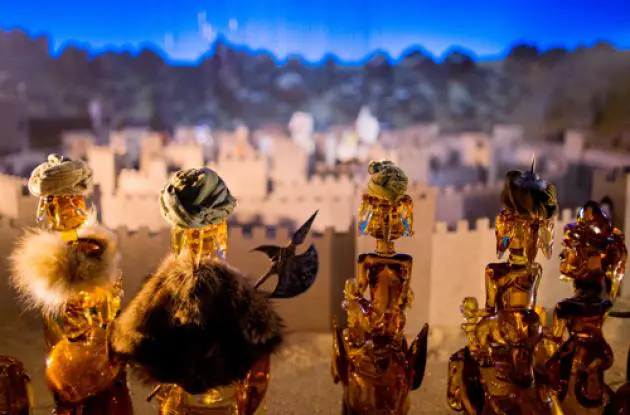
The series uses puppets made of glass to explore the medieval crusades launched by Christian Europe against the Muslims of the Middle East in almost exactly the same places which are now racked by conflict once again.
The puppets, half people, half mythical creatures, childlike and ferocious at the same time, portray the key events of the 11th and 12th century invasions speaking classical Arabic.
With the third and final instalment of the trilogy, “The Secrets of Karbala”, Shawky invited Western audiences to get even closer.
As part of his first major exhibition in Germany, visitors to the Kunstsammlung NRW K20 Museum in Dusseldorf were able to watch from behind a glass screen in late October as Shawky and a team of cameramen and actors recorded scenes for the film.
That film was given its first public airing on December 4. The trilogy, which is to be shown in full at the Museum of Modern Art in New York this year, is based on the 1984 book by French-Lebanese author Amin Maalouf, “The Crusades Through Arab Eyes”.
“The first big clash between the Orient and the West was the Crusades,” says Shawky, who studied art in Egypt and the United States.
He rejects the idea that his films are a political reaction to the current violence in the Middle East, pointing out that he began making them in 2010, before the revolutions began.
“But you can’t escape reality,” he adds. “You see things [in the films] which remind you a lot of what is currently happening.”
Shawky doesn’t believe “in one version of history”, something that is reflected in his films – the puppets hang by visible strings and poles, so that the stories appear staged.
The trilogy covers the period from 1095 to 1204, from Pope Urban II’s call to arms to the destruction of Constantinople. In the first film, a highly civilised Muslim society reacts with disbelief and horror at this invasion of barbarians from the West, which reduces Jerusalem to rubble.
The third part of the trilogy is a brilliant mix of theatre and film. It is not just the puppets, which move, but also the scenery, which is mounted on a stage made up of three motor-powered rings.
The stage isn’t just reminiscent of the medieval folk belief that the Earth was flat, but also illustrates the displacement of power in the Middle East which was unleashed by the Crusades.
At the end, everything is broken unto fragments – a metaphor for the destructive force of the fanatical Christian warriors.
The film also contains references to the 680 Battle of Karbala, which sealed the split between Shia and Sunni Muslims.
“A lot of what you see happening in Iraq today is a result of the Battle of Karbala,” says Shawky.
The fact that his films address such sensitive topics is perhaps one of the reasons why he is not allowed to show his work in Egypt.
