
Thai Army presents evidence Cambodia laid new PMN-2 landmines, cites Ottawa Convention report
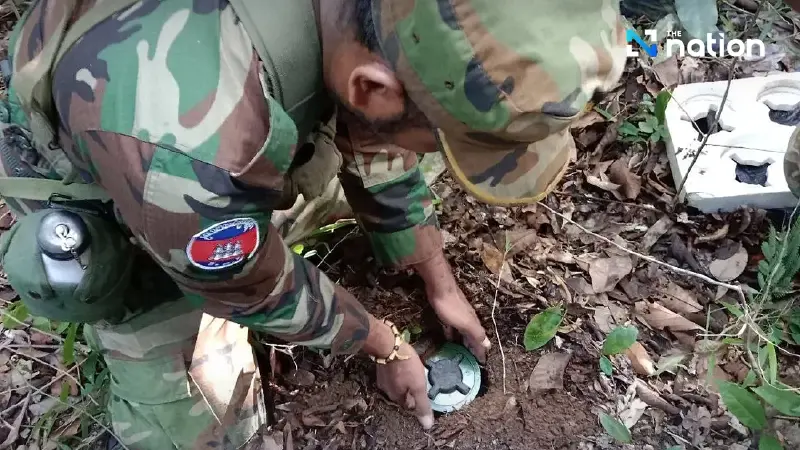


Thai Army cites 2024 Ottawa Convention report showing Cambodia possesses 3,700+ PMN-2 landmines, urges adherence to agreements amid border tensions.
The Royal Thai Army has presented evidence that Cambodia has laid PMN-2 landmines on Thai territory, citing documents submitted to the Ottawa Convention in 2024 indicating that Cambodia possessed over 3,700 PMN-2 and other types of landmines, ostensibly for training purposes.
This follows Cambodia’s denial on August 27 of recent incidents in which Thai soldiers were injured by landmines. Cambodia claimed it had not deployed new mines and maintained compliance with its obligations under the Anti-Personnel Mine Ban Convention (Ottawa Convention).

On August 28, Major General Winthai Suwaree, spokesperson for the Royal Thai Army, responded, emphasising that only Thailand and Cambodia are directly involved in the border area. He highlighted that all previous incidents have involved Thai forces as the victims. On August 4, Thai military engineers detected numerous PMN-2 landmines—both staged and already installed—along Cambodia’s established deployment line in the Phu Ma Kua area.
Further, on August 22, Thai forces encountered two to three Cambodian soldiers dressed in BHQ unit attire conducting surveillance near Hill 350 close to Ta Kwai Temple. Thai troops fired to repel them, and subsequent inspections revealed three PMN-2 landmines in the area. Additional evidence included social media posts by Cambodian influencers filmed at Ta Kwai Temple on July 30, showing PMN-2 landmine clusters.

Winthai added that undisclosed sources provided video clips and audio of Cambodian soldiers handling and relocating PMN-2 mines for deployment, including footage recovered by Thailand Mine Action Centre (TMAC) on August 19 in Phu Ma Kua. The material clearly shows soldiers demonstrating use of PMN-2 mines before illicitly burying them on Thai soil, with conversations in Khmer confirming the purpose.
The Thai Army also criticised Cambodia’s conduct during the August 7 GBC meeting, where Cambodia refused Thailand’s proposal for joint mine clearance despite its international image as an anti-landmine nation and its receipt of substantial annual funding for this purpose. Even during the RBC meeting, Cambodia appeared to delay engagement, requesting further discussion in another GBC session—behaviour Thailand perceives as stalling.
Claims by the Cambodian Ministry of Defence that certain border areas still contain unexploded ordnance from Cambodia’s civil war were refuted by Winthai. TMAC completed clearance of legacy mines in 2019, recovering 1,300 units, none of which were PMN-2. He emphasised that PMN-2 mines were not used in Cambodia’s civil war and confirmed that the mines found are of a new type: hard plastic, glossy, with clearly printed letters and numbers.

The Thai Army noted Cambodia’s repeated refusal to cooperate with TMAC in prior clearance operations near the border, suggesting a lack of transparency. Supporting evidence comes from Cambodia’s own submission to the Ottawa Convention on December 31, 2024, acknowledging possession of over 3,700 PMN-2 and other landmines, claimed to be for training under Article 3—but which have been illicitly placed in Thailand’s sovereign territory.
“Thailand’s Army urges Cambodian soldiers to uphold the dignity of their profession and respect the international rules and bilateral agreements,” Winthai said. “Denying actions that are clearly documented while expecting Thailand to accept this is deeply shameful. Cambodia must demonstrate compliance not just through words, but through action.”
