
Cambodia lies to AIPA, urges ASEAN to halt Thai use of force and violence
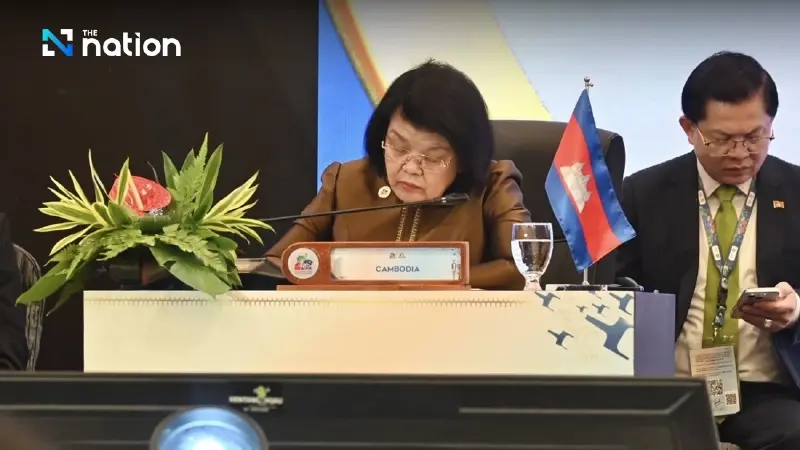


At the ASEAN Inter-Parliamentary Assembly (AIPA) meeting in Kuala Lumpur, Cambodia accused Thailand of violating the ceasefire and unlawfully detaining prisoners of war.
- Cambodia accused Thailand at the ASEAN Inter-Parliamentary Assembly (AIPA) of violating a ceasefire, unlawfully detaining soldiers, and infringing on its sovereignty, urging ASEAN to intervene and halt Thai military force.
- Thailand refuted Cambodia's claims, presenting evidence that Cambodia had breached international law by firing rockets at civilians and laying internationally banned landmines, which constitute war crimes.
- The Thai delegation argued that Cambodia was distorting facts and inappropriately bringing a bilateral issue to a multilateral forum, as effective bilateral mechanisms were already in place to resolve the conflict.
- Following Thailand's counter-arguments, the AIPA meeting rejected Cambodia's proposal to place the border conflict on the urgent agenda, siding with the position that it should be handled bilaterally.
The Thai delegation, however, countered with evidence pointing to Cambodia's breach of international law, including the firing of rockets at civilians and the laying of landmines. The Thai side reaffirmed its commitment to peaceful negotiations.
On September 18, 2025, Khuon Sudary, Speaker of the National Assembly of Cambodia, made a statement as the ASEAN parliamentary leader in Kuala Lumpur, Malaysia.
She emphasised the importance of stability and peace in the region for ASEAN integration and thanked the countries that supported the ceasefire between Thailand and Cambodia, which she described as a significant step toward security.
However, she warned that the situation remained fragile, accusing Thailand of unlawfully detaining 18 Cambodian soldiers and illegally erecting barbed wire that hindered the livelihoods of border residents.
She called on ASEAN members to prevent the use of military force, the destruction of property, and violations of the ceasefire, which could lead to further conflict. She criticised Thailand's declaration of martial law as an infringement on sovereignty and proposed the establishment of an ASEAN Observer Team (IOT) to visit the disputed area.

At the same time, she urged the cessation of military violence and unilateral border demarcation, supporting the formation of a joint commission to ensure compliance with international law.
The Cambodian speaker further stated that the region was at a critical crossroads amidst the global peace crisis. ASEAN should utilise every tool to address the fragile Thailand-Cambodia border issue through parliamentary diplomacy, building trust and cooperation instead of erecting barriers that hinder bilateral relations.
She advocated for strengthening people-to-people relations and promoting sustainable peace rather than laying blame. She also emphasised the importance of ASEAN unity, standing firm on values and principles, refusing to let power dictate what is right, and ensuring that the weak are not silenced.
Following the statement, the Cambodian delegation stood, applauded, and cheered their leader, creating an energetic atmosphere in the meeting room.

Thailand retaliates: Cambodia fires BM-21, killing civilians
In response, Chalad Khamchuang, the Second Deputy Speaker of the House of Representatives and head of the Thai parliamentary delegation, delivered a counter-statement. He affirmed that the Thai Parliament did not wish to destroy the friendly atmosphere of AIPA by expanding the conflict or presenting information on this platform, as every incident had documented evidence. He emphasised the importance of maintaining mutual respect among members.
However, Chalad clarified that the border situation was a distortion of international law by Cambodia, noting that Cambodia had attacked Thai civilians and infrastructure with multiple BM-21 rocket systems, resulting in the deaths and injuries of innocent civilians, including children.
This, he said, violated the United Nations Charter, the Geneva Conventions, the International Covenant on Civil and Political Rights, international humanitarian law, the Convention on the Rights of the Child, the Rights of Disabled Persons, and constituted a war crime under the Rome Statute.
Thailand further pointed out that Cambodia had laid PMN-2 landmines, which caused permanent disability among Thai soldiers, violating the Ottawa Convention. Evidence confirmed that these landmines belonged to Cambodia, as per transparency reports, while Thailand did not possess them. Cambodian soldiers were also found to have trained in laying these mines.
Chalad also rejected Cambodia’s allegations that Thailand had attacked near the Preah Vihear Temple, asserting that operations did not impact the temple and that Thailand had notified UNESCO.
Regarding the incident where Cambodian villagers dismantled barbed wire at Ban Nong Ya Kaew in Sa Kaeo province, Chalad explained that the event occurred in Thai sovereign territory, where Thai officials were obstructed and injured while Cambodian villagers attempted to illegally remove the barriers.
As a result, Thailand was compelled to take appropriate action in accordance with international standards and human rights.
The Thai Parliament expressed its gratitude to all parties who helped ease the situation, emphasising that violence brings no benefit, only harm and emotional scars. It called for mutual understanding and reconciliation.
The Thai Parliament adheres to the principles of the United Nations, international law, human rights, and ASEAN values, supporting the peaceful resolution of disputes through bilateral channels. It affirmed that Thailand does not wish to be in conflict and believes that AIPA, as a representative of the people, will use legislative mechanisms to build trust and find a sustainable resolution for the benefit of both nations' citizens.

During the AIPA Executive Committee meeting on Wednesday (17 September), Khuon Sudary proposed an urgent agenda to discuss the issue of the Thailand-Cambodia border conflict and the request to open border checkpoints. In response, Rangsiman Rome, as the Thai representative, objected to bringing the issue into the meeting, stating:
"The Kingdom of Thailand reaffirms its support for ASEAN's unity, solidarity, and joint mission to uphold peace. We, along with all member countries, call for a reduction in tensions and swift restoration of security along the Thailand-Cambodia border.
However, with this intent in mind, Thailand finds it necessary to oppose certain provisions of the draft resolution on 'Maintaining ASEAN Unity and Principles for Regional Security Amid Challenges' (which Cambodia proposed).
The reason is that there are already existing bilateral mechanisms. Thailand and Cambodia have been continuously holding high-level discussions, including meetings of the General Border Committee (GBC) to implement the July ceasefire agreement.
The GBC meetings have been recognised as a 'successful example of using bilateral mechanisms to resolve conflicts.' These mechanisms, including the Regional Border Committee, are working effectively on both security and humanitarian matters. Bringing this bilateral dispute to a multilateral resolution forum risks politicising the issue and undermining ongoing efforts.
It is inappropriate for Cambodia to bring a bilateral issue between Thailand and Cambodia to the multilateral platform. Thailand firmly believes that such matters should be resolved through direct negotiations between Bangkok and Phnom Penh, which have already initiated serious confidence-building measures.
Additionally, there is the ASEAN Observer Team (AOT) mechanism. Thailand welcomes the role of ASEAN observers and has led temporary observer teams along the border to monitor the ceasefire and protect civilians. Last month, the ASEAN Interim Observer Team (IOT), led by Malaysia, arrived in Phnom Penh and began its operations."
Thailand has consistently emphasised that the ASEAN-led IOT mechanism is the most feasible and effective tool for rapid monitoring. Therefore, it is neither necessary nor beneficial to reiterate or extend the framework of this mechanism through parliamentary resolutions.
Adding provisions about the IOT to the draft resolution will not improve the ceasefire situation but could politicise the confidence-building measures that both governments support.
Regarding the temporary border checkpoint closure, the draft resolution calls for Cambodia and Thailand to "open the border as soon as possible," reflecting legitimate concerns about trade and livelihoods.
Thailand shares the goal of creating a peaceful and prosperous border region. However, security issues in the area cannot be overlooked. The Thai government has clearly stated that no border checkpoints will be reopened until three conditions are met:
Withdrawal of heavy weapons: All heavy weapons must be removed from the border area to avoid further clashes.
Cooperation on landmine clearance: Joint humanitarian operations must be carried out to clear landmines and unexploded ordnance, ensuring safe passage for civilians.
Combating cross-border crime: Both parties must take concrete actions against criminal networks and illegal activities in Cambodia’s border areas, which affect multiple ASEAN countries, including human trafficking.
Thailand has been actively sharing intelligence on more than 50 criminal operation sites in Cambodia with the Cambodian authorities for joint action. Until these criminal networks are dismantled and border communities are safe, the closure of certain Thai border checkpoints remains a necessary measure to protect the public.
He continued by stating that Thailand's commitment to peace and ASEAN unity is not a challenge but a responsibility. Thailand remains steadfast in adhering to the ceasefire agreement, maintaining border community welfare, and preserving ASEAN unity.
We continue to cooperate with ASEAN mechanisms, including the ASEAN Coordination Centre for Humanitarian Assistance. Unity must be based on fairness and mutual respect. Thailand believes that Cambodia will understand Thailand's security concerns and the efforts we are making to resolve issues through bilateral means.

Finally, Thailand reaffirmed to the meeting that we will work relentlessly for peace and the restoration of normalcy in the border areas. Thailand is always ready to engage in sincere negotiations and cooperate bilaterally. We remain committed to ASEAN's central role and values, and we will preserve them by protecting sovereignty and fostering reconciliation.
The Kingdom of Thailand stands for a peaceful and prosperous ASEAN, but such a future must be based on realistic approaches and cooperation, not on resolutions that avoid ongoing peacebuilding negotiations. Thailand cannot support this draft resolution."
In the end, the meeting decided to reject Cambodia's urgent agenda proposal, as raised by the Thai representative.
Khuon Sudary was seen at certain moments raising her hand and placing it on her temples, showing visible concern, while the Speaker of the Malaysian House of Representatives allowed Rangsiman to voice his opinion, nodding in agreement throughout his speech.
