
Chinese state firm expanding rare earth mines near Thai border, SHRF warns
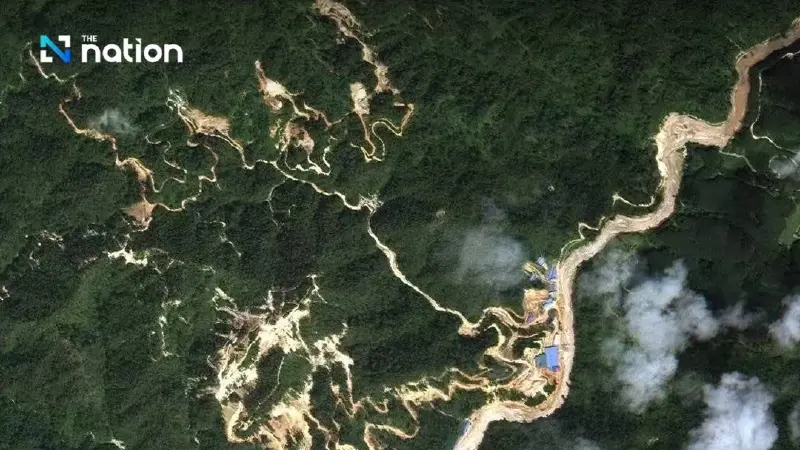


The Shan Human Rights Foundation reports Chinese state firm expanding rare earth and gold mining along Myanmar’s Kok River, raising cross-border pollution fears.
The Shan Human Rights Foundation (SHRF) issued a statement on October 28, 2025, revealing through new satellite imagery that China Investment Mining Company, a Chinese state-owned enterprise, is expanding rare earth and gold mining operations along both sides of the Kok River near Mong Yawn, southern Mong Hsat township, in eastern Shan State, Myanmar.
Images taken on October 14, 2025 show extensive changes in the area, including new road networks and mining sites at the forested foothills near the river’s source — roughly 30 kilometres from Thailand’s border at Tha Ton district, Chiang Mai. The mining waste, containing heavy metals, is reportedly being discharged directly into the Kok River.
Gold extraction is ongoing at multiple processing sites on the western bank, where chemical residues are likely being released into the river system.
The report also confirmed that two rare earth mines, one on each side of the Kok River, have undergone significant expansion. Both use in-situ leaching, a method involving the injection of large quantities of chemicals into the ground, known to cause severe environmental damage.

Satellite images taken on May 6, 2025 showed circular rare earth processing ponds under construction on the western side of the river. The latest images from October 14 indicate that the ponds have since been completed and covered with black roofing, although the structures underneath remain visible.
Meanwhile, at the eastern site, mining operations have been active since January 2025, with bright blue chemical ponds clearly visible through the black mesh covering. Several new buildings have also been erected in the northeastern section of the site, suggesting a marked increase in operations.

The expansion of these three mining sites — two rare earth and one gold — has raised serious concerns over toxic waste discharge into the Kok River, which could affect communities on both sides of the Thai-Myanmar border. The river ultimately flows into the Mekong, posing potential risks to over one million residents in Chiang Mai and Chiang Rai and tens of millions more living downstream along the Mekong basin.
Thai authorities have been monitoring Kok River water quality every two weeks since April 2025, with tests repeatedly showing arsenic and lead levels exceeding safety standards.
The Mong Yawn area of eastern Mong Hsat township is jointly controlled by the United Wa State Army (UWSA) and the Burmese military regime, necessitating permission from both entities for the mines to operate. According to inside sources, the operator of both the rare earth mines and the main gold mining operation along the Kok River in Mong Yawn is China Investment Mining Company, which is carrying out rare earth mining in northern Laos.

China Investment Mining Company is 90% owned by Shanghai Chijin Xiawu Metal Resources Co. Ltd., which is a joint venture formed in September 2022 to develop rare earth resources in Laos by China’s state-backed Xiamen Tungsten Corporation and Chifeng Gold, the largest non-state owned gold producer in China. Xiamen Tungsten Corporation is one of China’s major rare earth corporations.
Recent satellite images of China Investment Mining Company’s rare earth mines northeast of Muang Kham town (a.k.a. Mengkang) in Xiangkhuang province of northern Laos (in the southern orange-shaded concession area on Chifeng Gold’s map) already shows widespread environmental destruction, suggesting what is in store for the Kok river basin. The Muang Kham rare earth mines drain into the Nam Khao stream, then into the Nam Khan River, which joins the Mekong River at Luang Prabang.
In April 2025, a peg labelled “China Investment” was visible on Google Earth locating the China Investment Mining Company rare earth mining area near Muang Kham, but this has since been removed.
Source: https://shanhumanrights.org
