
Rare earth deal tied to Trump tariff cuts; government insists Thailand not legally bound
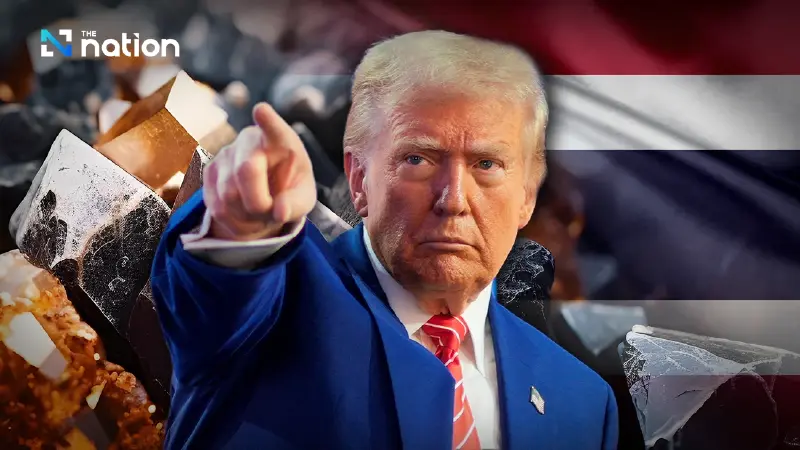


Thailand’s Cabinet confirmed the US-Thailand rare earth MOU is non-binding, though linked to trade talks that could see US tariff reductions for Thai exports.
At its meeting on October 28, the Cabinet acknowledged the signing of a memorandum of understanding (MOU) between Thailand and the United States on cooperation to diversify critical mineral supply chains, aimed at promoting trade, investment, and technology development in the rare earth sector. The MOU was officially signed on October 26, 2025.
Ekniti Nitithanprapas, Deputy Prime Minister and Minister of Finance, clarified that the document is not a legally binding agreement, but rather a mutual understanding to enhance cooperation in supply chain development and investment. He stressed that it does not grant any exclusive rights to either country.
The MOU outlines five key areas of collaboration:
- Exchange of technical knowledge and international best practices to strengthen competitiveness.
- Establishing joint cooperation mechanisms, such as workshops, seminars, and scientific collaboration, to share information and boost innovation capacity.
- Promoting good regulatory practices, including relevant laws, licensing, and process streamlining.
- Sharing information on projects and global market prices of rare earth materials.
- Coordinating on market protection through fair trade mechanisms, transparent pricing, and adherence to high international standards.
When asked whether the MOU was linked to ongoing US-Thailand tariff negotiations, Ekniti said it forms part of a broader diplomatic and trade partnership that strengthens bilateral relations and creates leverage for reciprocal trade discussions.
He explained that the US has provided a negotiation channel under “Appendix 3” of the agreement, allowing partner countries with close relations to apply for preferential trade treatment. These privileges may include partial or full exemptions from the 19% tariff currently applied to ASEAN goods, or reductions on specific product categories.
“Negotiations so far have been positive for Thailand. Most ASEAN countries face a 19% tariff, while Vietnam faces 20%. If our talks succeed, it will enhance the competitiveness of Thai exporters,” Ekniti said.
He added that further discussions with the US Trade Representative (USTR) are being scheduled to advance the talks on tariff reductions.
Council of State clarifies US investors granted no special privileges
Pakorn Nilprapunt, Secretary-General of the Council of State, said the special Cabinet meeting on October 23 had approved the draft Thailand-US rare earth MOU, but noted that many media outlets had misinterpreted the document, particularly due to mistranslations.
“Documents like this must be read carefully. I recommend referring directly to the English version, because when I tested AI translation tools, they gave oversimplified interpretations that caused significant misunderstandings,” Pakorn said.
He explained that the MOU contains no legally binding commitments and does not grant the United States exclusive rights to mine or produce rare earth minerals in Thailand, as some reports suggested. If rare earth deposits are found in the future, US investors will be required to comply with Thailand’s mining laws just like investors from any other country.
The Department of Primary Industries and Mines under the Ministry of Industry is responsible for handling any future projects, which must go through an open and fair bidding process, considering both state benefits and environmental protection.
“Environmental concerns are valid,” he said, “especially given the pollution caused by rare earth mining in Myanmar, which contaminated the Kok River. The Cabinet has already discussed this issue and will prioritise environmental safeguards should rare earth investment occur in Thailand.”
On legal terminology in the MOU, Pakorn clarified that the term “Participant” refers to partners cooperating in a specific area, not contracting parties. The framework adheres to World Trade Organization (WTO) principles of equality, and the MOU explicitly states that it is not a treaty under Section 178 of the Constitution and has no binding effect under international law. It merely represents a bilateral cooperation framework for developing critical minerals, including rare earths.
He stressed that all activities under the MOU must comply with Thai law when investments are made in Thailand, and with US law when Thai investors operate in the United States.
Addressing the phrase “Participants have first opportunity to invest,” Pakorn explained that it signifies mutual respect and goodwill, not preferential treatment.
“Thailand’s mining law requires open and fair bidding, in line with WTO standards. Moreover, Thailand and the United States have maintained the Treaty of Amity since 1976, which ensures Americans receive national treatment in Thailand. Therefore, US investors have no advantage or special privileges under this MOU,” he said.
Pakorn also clarified that the Good Regulatory Practice (GRP) clause in the MOU reflects Thailand’s ongoing efforts to align with international standards as part of its goal to join the Organisation for Economic Co-operation and Development (OECD).
“This is part of Thailand’s effort to strengthen the quality of its regulatory framework and to enable fair trade and investment agreements with other nations. It is not a clause designed to benefit the United States specifically,” he added.
Caution urged for careful, transparent negotiations
Werapong Prapha, Deputy Leader of the Democrat Party for International Economic Affairs and former Thai Trade Representative, warned that while Thailand has the potential to become a regional leader in rare earth production, the government must handle future negotiations with care and transparency to avoid potential risks.
Werapong explained that critical minerals and rare earth elements are vital to the global supply chain, particularly for the clean energy transition and industries such as electric vehicles (EVs), electronics, magnets, mobile devices, wind turbines, and solar panels.
Thailand is currently the world’s sixth-largest rare earth producer, with output rising 260% last year, driven by growth in downstream industries such as EV manufacturing. Meanwhile, China dominates the global market, accounting for 71% of production, positioning Thailand as an alternative supply-chain hub amid geoeconomic competition between Beijing and Washington.
He noted that the Thailand-US MOU focuses primarily on technical cooperation, with the US providing technology, personnel, and expertise to develop Thai industrial capacity, while also gaining a “first right of investment” in potential projects.
“Rare earths are an industry of the future, crucial to the clean energy transition. This is a major opportunity for Thailand to lead the region and build a new economic engine. But the outcome depends entirely on how the government negotiates — this deal could either benefit or harm Thailand,” Werapong said.
He stressed that the government must consider three equally important dimensions in all future negotiations:
- Transparency – ensure open and fair competition to prevent monopolisation by a few powerful business groups.
- Economic impact – create jobs and income for Thai citizens, rather than merely serving as a production base where profits flow overseas.
- Environmental and human rights standards – strictly adhere to ESG principles, ensuring proper management of water, air, and community impacts, and preventing forced labour or human rights abuses.
Werapong recommended that the government adopt international frameworks such as those from the OECD or EU, adjusted to the Thai context, enforcing penalties for violations and providing incentives for compliant businesses.
“These issues must be addressed clearly during negotiations to reassure the Thai public that they are being prioritised at the discussion table,” he said.
Given China’s dominance over 71% of the global rare earth market, Thailand could face difficulties balancing its position between the US and China, he cautioned.
Werapong suggested Thailand reduce overreliance on both powers by opening new trade channels with the European Union (EU) and allowing competition between the US and China under the MOU framework. He said Thailand should also hold parallel talks with China to hear its proposals on rare earth industry cooperation and maintain a balanced stance between the two superpowers.
“Malaysia also signed a rare earth MOU with the US while engaging China in parallel discussions on joint investment in the same industry,” Werapong noted.
