
Anutin highlights ‘Thailand FastPass’ at APEC 2025 to boost investor confidence
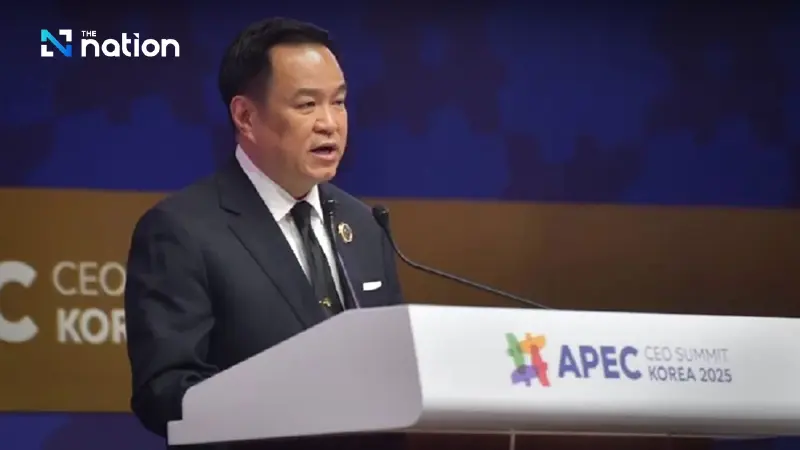


PM Anutin Charnvirakul promotes Thailand’s FastPass scheme at APEC 2025, pledging to strengthen regional cooperation, digital skills, and sustainable growth

On October 31, 2025, in Gyeongju, Republic of Korea, Prime Minister and Interior Minister Anutin Charnvirakul attended the 32nd APEC Economic Leaders’ Meeting – Session I, held under the theme “Towards a More Connected, Resilient Region and Beyond”. He delivered Thailand’s statement, outlining key priorities for sustainable and inclusive regional growth.
Anutin began by thanking the host and the Government of the Republic of Korea, for their warm hospitality and excellent organisation of the summit. He also welcomed the participation of the United Arab Emirates as the Chair’s special guest and expressed appreciation to the IMF Managing Director for presenting the 2025 global economic outlook, quoting her remark that “uncertainty is the new normal.”

The prime minister emphasised that in a world facing multidimensional challenges, “cooperation is not an option, but a necessity.” He reaffirmed that APEC must remain open, inclusive, and forward-looking to build a stronger and more resilient region.
He noted that free trade and interconnected markets are the foundations of sustainable prosperity. Thailand supports modern, inclusive, and rules-based cooperation frameworks to ensure that all sectors—especially micro, small, and medium-sized enterprises (MSMEs)—benefit from regional economic connectivity.
Turning to investment, Anutin stressed that it should be a driver of both innovation and sustainability. He introduced the Thailand FastPass initiative, designed to facilitate high-quality investors in clean energy, digital infrastructure, and advanced technology sectors. The programme aims to ensure that today’s growth contributes to a livable world for future generations.
The prime minister further underlined that the private sector plays a central role in driving the transition towards the future. Investments in human capital, digital and artificial intelligence (AI) skills, and harmonised digital standards will enhance efficiency and inclusivity in regional trade.
He added that Thailand has drawn inspiration from APEC cooperation and has begun the process of joining the Organisation for Economic Co-operation and Development (OECD), reflecting its commitment to international standards and global economic partnership.
Thailand also seeks to deepen engagement with economies beyond the Asia–Pacific region. This year, Thailand and China will co-host the Lancang–Mekong Cooperation Summit, while next year, Thailand will host both the Asia Cooperation Dialogue (ACD) Ministerial Meeting and the Annual Meetings of the IMF and the World Bank Group.
“These meetings will serve as vital platforms to strengthen collaboration between APEC members and non-members, to jointly confront challenges and unlock new economic opportunities,” Anutin concluded. “Together, APEC economies can build a more connected, resilient, and sustainable region—for our people today and generations to come.”
