
Thailand’s high-speed rail faces delays as new transport minister takes charge
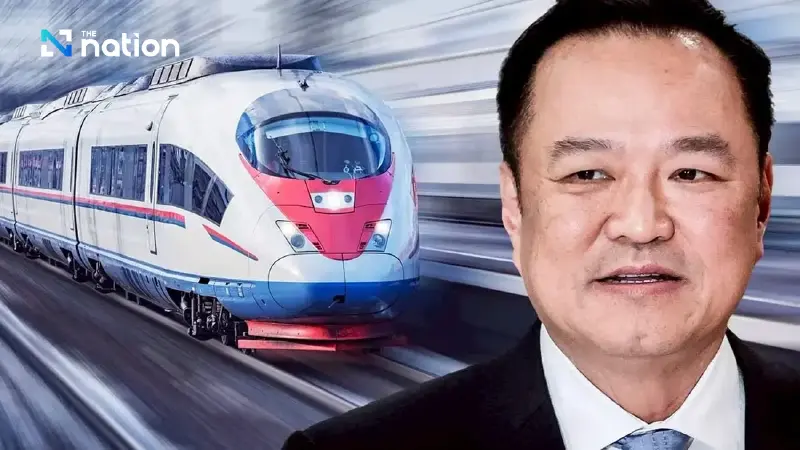


Thailand’s China-linked high-speed rail faces stalled contracts and heritage concerns. New minister Phiphat must resolve delays to push Phase 2 forward.
The Thailand-China high-speed rail project, a long-awaited mega infrastructure scheme, continues to face significant delays. With the new government in place and Phiphat Ratchakitprakarn at the helm of the Ministry of Transport, attention is now on whether policy will accelerate progress.
Tracing the timeline, the project has spanned a decade since the groundbreaking ceremony for the control and administration centre in Chiang Rak Noi, Ayutthaya, on December 19, 2015.
Currently, construction is underway for Phase 1, covering the Bangkok-Nakhon Ratchasima route over approximately 253 kilometres, with a budget of 179.41 billion baht. Of 14 contracts, two have been completed, ten are in progress, and two are awaiting signing. The two problematic contracts are as follows:
Contract 4-1: Bang Sue – Don Mueang, 15.21 km, 9.21 billion baht
Construction overlaps with the high-speed link connecting the three airports (Don Mueang, Suvarnabhumi, U-Tapao), managed by the private contractor CP Group. However, construction has stalled pending a revised joint investment agreement.
Contract 4-5: Ban Pho – Phra Kaew, 13.30 km, 9.91 billion baht
Initially awarded to Boonchai Panich (1979) Co Ltd, the contract remains unsigned due to concerns that the Ayutthaya station may impact UNESCO cultural heritage sites. The contractor has recently refused to sign or extend their bid, forcing the State Railway of Thailand (SRT) to prepare a new tender.
Despite these setbacks, SRT is advancing plans for Phase 2, covering Nakhon Ratchasima-Nong Khai over 357.12 km with a construction budget of 341.35 billion baht. Following Cabinet approval on February 4, 2025, SRT has begun preparing tender documents, aiming to open bidding within the year and complete construction by 2031.
All eyes are now on the transport minister under the Anutin government to see how the outstanding issues will be resolved, whether Phase 2 bidding can proceed, and if Thailand’s first high-speed rail line can finally link the country with Laos and China, boosting both transportation and regional economic connectivity.
