
Anutin highlights weaknesses in Thailand’s political and legal systems, calls for strengthened rule of law
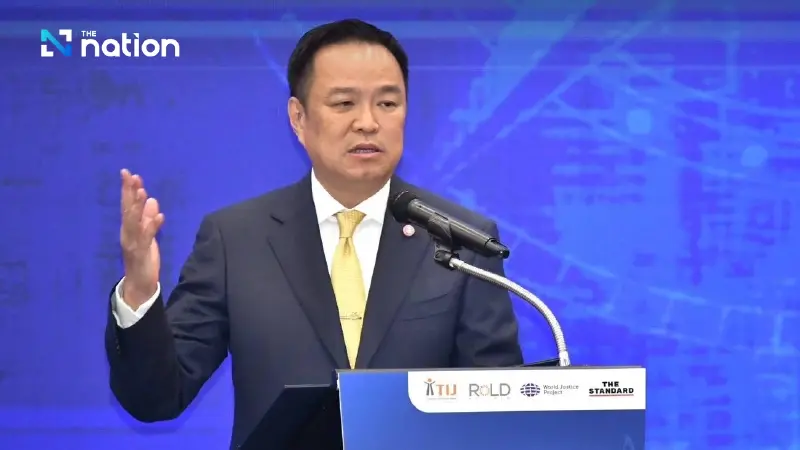


Prime Minister Anutin Charnvirakul addressed the challenges facing Thailand, including inequality and political instability, while emphasising the importance of the rule of law for economic growth and national competitiveness. He called for a cultural shift towards justice for all.
Prime Minister and Interior Minister Anutin Charnvirakul on Wednesday delivered a keynote speech at the 3rd Rule of Law Forum organised by the Thailand Institute of Justice (TIJ). Speaking on the topic, “Institutional Mechanisms and the Country’s Competitiveness”, he reflected on his personal journey, from his business career to politics, and emphasised the central role that the rule of law has played throughout.
The Prime Minister noted that justice serves as the foundation of every society, necessary for the existence and well-being of human beings. He stressed that justice should be for everyone equally, not just certain groups, saying, "Justice for all, not justice for some". He went on to explain that no country can achieve sustainable competitiveness without a solid foundation in the rule of law. To build a strong economy, the law must be stable, predictable, and trusted, ensuring confidence from both investors and the public.
For Anutin, the rule of law is not just a legal matter; it is a cultural commitment to fairness that must be deeply embedded in society at every level. Thailand must ensure that both the laws and the systems instil public trust, while standing firm on what is right.
He acknowledged that Thailand is currently facing challenges in terms of security, economy, and society, with deep-rooted inequality and political instability. He identified the root cause of these issues as the weakness of the legal system and a culture that does not support justice. As such, state agencies and civil servants must adhere firmly to the rule of law, exercising the courage to enforce the law for fairness, without allowing the justice system to be misused for political gain, harassment, pressure, or intimidation.
The Prime Minister further explained that the government has included in its policy statement that using the law for political advantage or neglecting law enforcement, especially in cases such as drug prevention, gambling, online crime, cyber threats, fake news, and other forms of public deceit, should be considered a serious disciplinary offence. This should be met with criminal prosecution to increase trust among the public and international investors, as the rule of law is a key foundation for economic confidence.
Anutin shared that the government is planning to join the Organisation for Economic Co-operation and Development (OECD) by meeting key standards, including good governance and rule of law. He outlined three major initiatives to achieve this goal:
- Roadmap for Rule of Law: The government will focus on enhancing legal standards and justice processes to prepare for OECD membership. This includes setting a clear roadmap to elevate the country's legal frameworks and ensure fairness in legal proceedings.
- Fighting Corruption and Legal Reforms: Efforts will be made to unlock barriers caused by corruption and reform laws that hinder business operations. Importantly, the government will work to close legal loopholes and prevent opaque mechanisms, which can lead to grey-market businesses, ensuring that fair and transparent businesses can compete and receive genuine support.
- Transparency and Public Participation: The government will enhance Open Government by using digital technologies to increase public access to government data, making it more transparent and accessible. Citizens will be able to follow, scrutinise, and give feedback on government operations, which will also enable the government to listen and respond to the public's concerns effectively.
Anutin stressed that the key objective is to create an ecosystem of transparency, where every decision is open to scrutiny throughout the budgeting process and policy implementation. He added that restoring the rule of law is challenging, but starting today will pave the way for future governments to continue these efforts sustainably, elevating the rule of law as a national agenda to boost the country's competitiveness and ensure a peaceful society.
