
Thai army confirms operations in Sa Kaeo border fully comply with international law amid Cambodian provocations
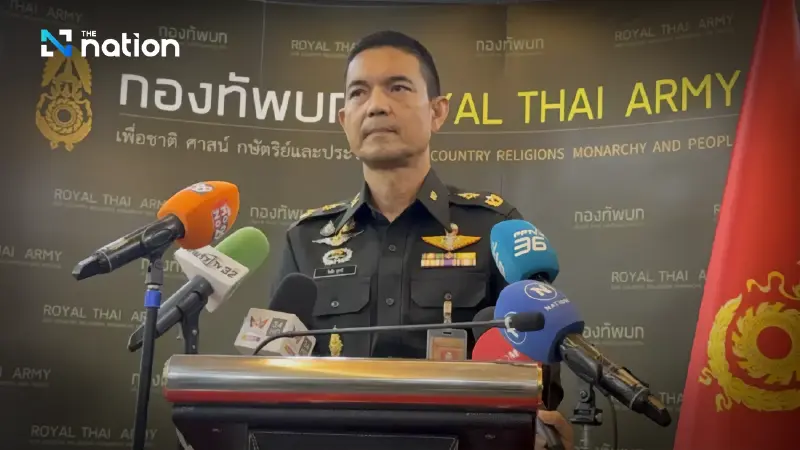


The Royal Thai Army reports ongoing staging incidents by Cambodian forces along the Sa Kaeo border, with all Thai actions conducted according to international law within Thai sovereignty.
Major General Winthai Suvaree, spokesperson for the Royal Thai Army, on Wednesday provided an update on the situation along the Thai-Cambodian border in Sa Kaeo province. He confirmed that Cambodian forces continue to stage incidents despite multiple bilateral agreements and prior discussions aimed at resolving border disputes.
The army has observed persistent efforts by Cambodia to deploy organised groups of civilians—including children, women, the elderly, and monks—who are not actual residents of the affected areas, seemingly staged to produce images for international media consumption. Cambodian media personnel were reportedly brought to the area at night, alongside the Interim Observer Team (IOT), without notifying Thai authorities, to document scenes already arranged in advance. This has been interpreted by Thai officials as an attempt to distort the reality on the ground.
Furthermore, the issue of sound amplification on the Thai side of the Sa Kaeo border was addressed. The area falls under Thai sovereignty, yet Cambodian incursions have repeatedly provoked the Thai population, causing widespread public concern. Maj Gen Winthai explained that the Thai use of loudspeakers is consistent with practices in other countries as a non-lethal, precautionary measure to minimise risk, particularly against those violating the law.
He distinguished between the lawful Thai response and the actions of individuals such as Gunnathat Pongpaiboonwet, also known as Gun Jompalang, who broadcast sounds and historical documentaries. These acts are considered expressions of civilian dissatisfaction with Cambodian incursions, in contrast to aggressive Cambodian demonstrators wielding fake weapons and attacking Thai police.
Maj Gen Winthai emphasised that civilians exposed to the loudspeakers are not forcibly subjected to harm; they may leave the area at any time. Furthermore, as Mr Gunnathat is not a state official, his actions do not constitute torture under international law. The army urged Thai citizens to remain steadfast, avoid being manipulated by exaggerated reports from Cambodia, and to consider the welfare of fellow Thai citizens affected by the provocations, which in many instances constitute breaches of humanitarian principles.
The spokesperson added that the issue regarding the postponement of the Regional Border Committee (RBC) meeting between Thailand’s First and Second Army Areas and Cambodia’s regional forces arises from Cambodia’s lack of seriousness and engagement in addressing border issues as agreed in previous GBC meetings. This includes resolving the encroachment of Thai territory in Sa Kaeo province, the clearance of landmines, and the withdrawal of heavy weapons from disputed areas. In addition, there have been cases of misinformation and provocations towards Thai forces, reflecting Cambodia’s insincerity in genuinely addressing these problems.
Maj Gen Winthai emphasised that the Royal Thai Army remains committed to implementing all measures under the GBC cooperation framework and called on Cambodia to act sincerely and constructively, ensuring maximum benefit for both countries and paving the way for sustainable resolution of these issues in the future.
