Thailand and Laos advance railway bridge linking Nong Khai and Vientiane to boost regional logistics
SATURDAY, OCTOBER 18, 2025
Play
Thailand and Laos discuss a new rail-dedicated bridge across the Mekong between Nong Khai and Vientiane to enhance trade and connectivity
A meeting was held at the Ministry of Public Works and Transport of the Lao People’s Democratic Republic (Lao PDR) on October 17, 2025 to discuss the construction of a new cross-Mekong railway bridge. The meeting was co-chaired by Dr. Pichet Kunadhamraks, Director-General of Thailand’s Department of Rail Transport (DRT), and Chanthon Sayakhon, Director of the Lao Railway Department.
This session follows a high-level discussion between Thailand’s Prime Minister and the Lao Minister of Transport on October 16, 2025. Senior officials from both countries’ key agencies participated, including representatives from the Foreign Ministries, Customs Departments, Immigration, the Neighbouring Countries Economic Development Cooperation Agency (NEDA), the Office of Transport and Traffic Policy and Planning (OTP), the Department of Highways, the State Railway of Thailand (SRT), and the Rail Technology Research & Development Institute.
Why the “Second Thai–Lao Friendship Bridge” is urgent
Thailand’s Ministry of Transport emphasises the need to link the Thai–Lao rail network to support passenger and freight movement, and to boost competitiveness in industry, agriculture, trade, investment and services. Presently, rail traffic between Nong Khai (Thailand) and Thanaleng (Vientiane Capital, Lao PDR) uses the First Thai–Lao Friendship Bridge (1,050 metres long). However, this bridge carries both road and rail traffic, creating a bottleneck in transport flows.
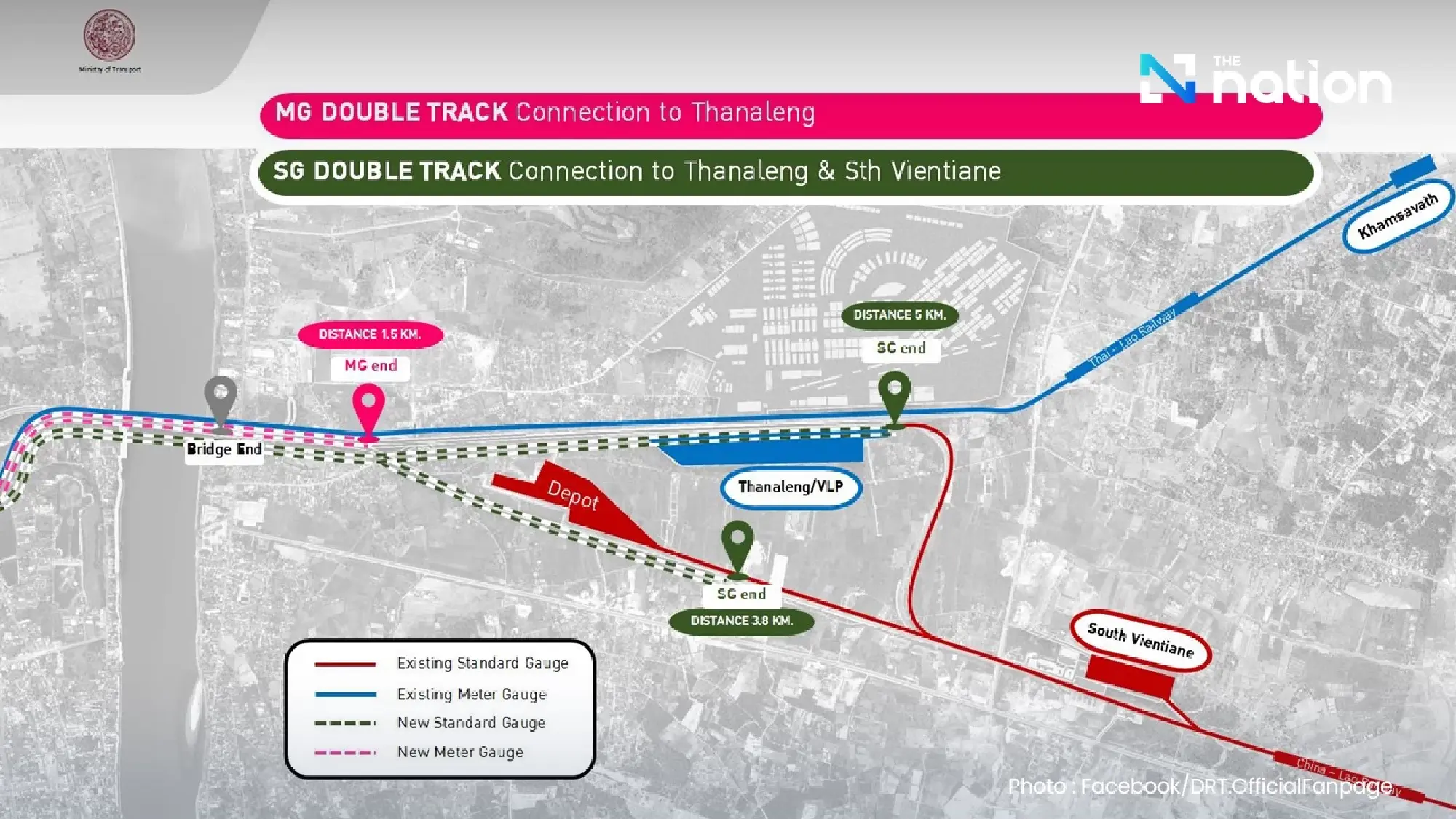
Thus, the construction of the Second Thai–Lao Friendship Bridge (Nong Khai–Vientiane) is seen as a pressing priority to alleviate the bottleneck and improve freight efficiency. According to the Thai side’s proposal, the new bridge will be located approximately 30 metres from the existing structure. The bridge is designed exclusively for rail, with dual tracks:
A standard gauge rail (1.435 metres) to link into the Thailand–China high-speed rail line and the Laos–China rail network.
A metre gauge rail (1.0 metre) to connect into Thailand’s existing rail system.
The bridge will connect to Vientiane South Station and Thanaleng Station. The SRT is currently conducting detailed design and studies, with construction expected to begin in 2027 and service to open in 2030.
Tying into the “Thailand–China High-Speed Rail” mega-project
In addition to the bridge discussion, the Thai side presented updates on key rail infrastructure that will enhance connectivity:
Phase 1 of the Thailand–China High-Speed Rail (Bangkok–Nakhon Ratchasima) is under construction and 48% complete.
Phase 2 (Nakhon Ratchasima–Nong Khai) is preparing bidding documents, expected to open tender within 2025.
Development of Natha trans-shipment centre to act as a hub linking Nong Khai into the Lao rail network.
Upgrading regional logistics
Dr. Pichet said this joint meeting marks the beginning of concrete progress in rail transport cooperation between the two countries, strengthening economic ties and regional security, linking trade and investment, and paving the way for further rail links to neighbouring countries.