
Drone boom takes off in Thailand with Air Taxi on the horizon


The Civil Aviation Authority of Thailand (CAAT) is fast-tracking the development of a legal framework and a national Drone Master Plan to regulate safety standards and promote systematic commercial use, with the new law expected to take effect by 2026.
- Thailand's drone industry is experiencing a major growth phase, with projections suggesting the number of registered drones could soon exceed one million, expanding beyond agriculture into logistics and passenger transport.
- To manage this expansion, the government is creating a comprehensive legal framework, including a new Drone Act and a national Master Plan, to regulate safety and commercial use.
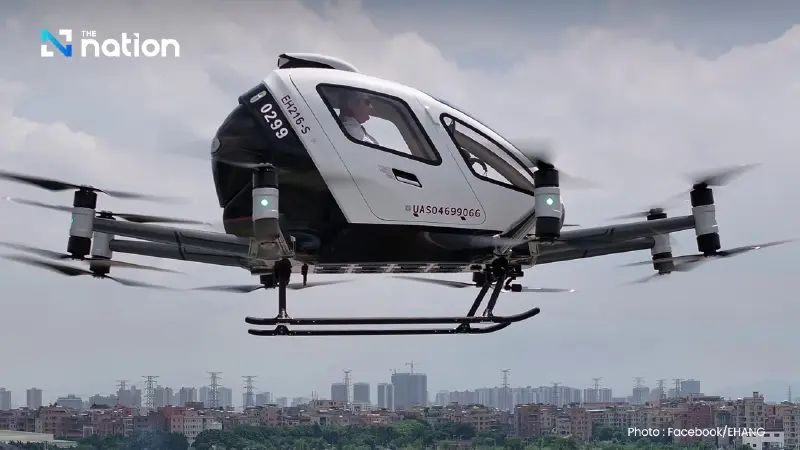
- A key development is the testing of the EH216-S passenger drone for future "Air Taxi" services, with plans to launch in major tourist destinations like Pattaya and Phuket.
- These initiatives are part of a broader strategy to establish Urban Air Mobility (UAM) and position Thailand as a pioneer in next-generation transport in Southeast Asia.
Thailand’s drone industry is entering a new growth phase, with a draft law, master plan, and Air Taxi trials paving the way for urban air mobility.
The Civil Aviation Authority of Thailand (CAAT) has projected that the country’s drone industry is on the verge of a major transformation, with strong growth expected in the coming years, particularly in logistics and passenger transport, which could soon become a new aviation infrastructure pillar.
CAAT estimates that the number of drones in Thailand could exceed one million units in the near future, driven by expanding applications in agriculture, logistics, surveying, and passenger services. As of 2024, 27,822 drones have been registered nationwide, up sharply from just a few hundred when registration first began in 2015.

To support this growth, CAAT is drafting Thailand’s first Drone Act, a comprehensive law focused on drone operations for transport and logistics. The legislation aims to set safety and regulatory standards for commercial use and is expected to be enacted by 2026.
Beyond regulation, CAAT is developing a Drone Master Plan, a national roadmap covering policy, legal frameworks, workforce development, safety infrastructure, privacy protection, and supporting technologies. This includes real-time flight tracking systems, AI-based permit processing, and a “Fast Track” licensing system to modernise drone operations.
In partnership with the private sector, CAAT has signed an MOU with National Telecom (NT) to develop a Drone Delivery System, advancing Thailand’s readiness for commercial drone transport. The collaboration aims to extend drone applications beyond agriculture and surveying to include goods and passenger delivery.

A key highlight of the initiative is the passenger drone EH216-S, developed by China’s EHang Intelligent Equipment. The model was recently tested in Thailand by TAO AAM Co., Ltd. and J Capital Public Company Limited (GCAP), as part of preparations for future Air Taxi services in key tourist destinations, including Pattaya, Phuket, Koh Samui, Koh Phangan, and Koh Tao.
If approved, these services would mark Thailand’s entry into the era of Urban Air Mobility (UAM), positioning the country as one of Southeast Asia’s pioneers in next-generation transport.

Overall, Thailand appears to be entering a transformative phase in its aviation landscape. Once regarded merely as tools for agriculture or aerial surveying, drones are now evolving into a regulated, standards-driven technology that demands a comprehensive legal and management framework.
This shift aims to ensure safe and efficient commercial use, opening new business opportunities while signalling that Thailand’s transport and logistics landscape could look markedly different within the next few years.
While the direction is clear, CAAT noted that several issues require attention, such as urban drone flight zones, unmanned air traffic management, privacy protection, and public awareness.
Thailand’s push into drone regulation and Air Taxi development marks a significant step toward reshaping the nation’s transport landscape, turning futuristic flight into a practical, commercial reality.
