
Thailand, Cambodia outline peace roadmap and phased border weapon withdrawal
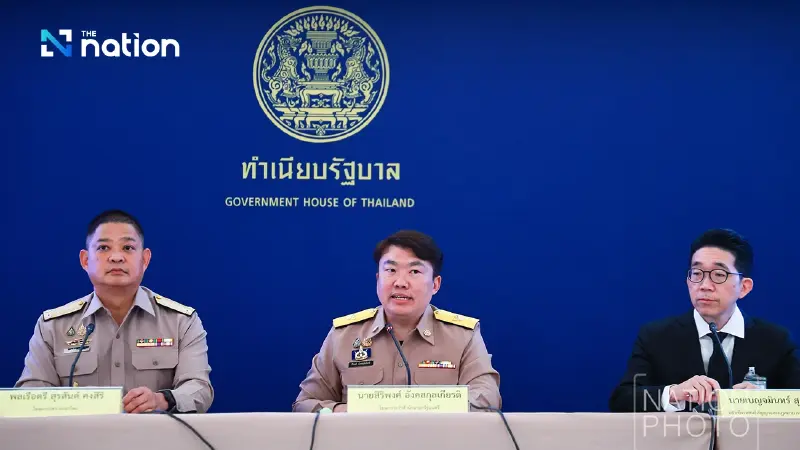


Thailand and Cambodia have agreed on a peace roadmap with phased weapon withdrawals, border surveys, and stronger cooperation against cross-border crime.
- Thailand and Cambodia have signed a "Joint Declaration on Peace" to de-escalate border tensions and establish a framework for coexistence following a recent deadly conflict.
- A three-phase plan for weapon withdrawal from the border will be implemented from November 1 to December 31, starting with heavy weapons, followed by artillery, and finally tanks and armoured vehicles.
- An ASEAN Observer Team (AOT) will monitor the disarmament process on both sides, though Thai troops will remain in their positions to safeguard national sovereignty.
- As part of the roadmap, the Joint Boundary Commission (JBC) will use aerial survey technology to create temporary boundary markings in disputed areas to prevent future conflicts.
Government spokesman Siripong Angkasakulkiat and related officials on Monday briefed the press at Government House in Bangkok on the outcomes of talks between the prime ministers of Thailand and Cambodia, including the signing of a Joint Declaration on Peace and related meetings of the Joint Boundary Commission (JBC) and General Border Committee (GBC).
Siripong explained that Thailand and Cambodia had enjoyed cordial relations until March–April, when tensions escalated due to incursions and the digging of defensive trenches.
In July, three Thai soldiers lost their legs after stepping on landmines while patrolling Thai territory. On July 24, a Cambodian shell struck a petrol station in Si Sa Ket province, killing eight civilians, including an eight-year-old child.

The grief and anger from those losses are undeniable, Siripong said. The conflict lasted four days and five nights, costing the lives of more than 10 Thai soldiers and injuring 666 others, until a ceasefire was reached on July 28. It has now been 96 days since the truce.
He said that although feelings of resentment linger, both nations must face the fact that their lands are inseparably adjacent.
“Do we want people along the border to wake up each day to the sound of tanks and artillery?” he asked. “We do not wish for our citizens to live in constant fear of evacuation. Thais simply want to see normal life restored across the country — without losing even a single square centimetre of our land.”
He added that the next step, drawn from the May 28 ceasefire agreement, is to establish practical frameworks for coexistence. Four key principles have been reaffirmed under the new Joint Declaration signed by both sides.

Defence Ministry outlines phased weapon withdrawal
RAdm Surasan Kongsiri, spokesman for the Defence Ministry, said the ongoing discussions aim to restore normal conditions along the border, with the people’s safety and stability as the top priority.
He detailed the three-phase withdrawal plan:
- Phase 1 (November 1–21): Removal of heavy weapons with high destructive power.
- Phase 2 (November 22–December 12): Withdrawal of all types of artillery.
- Phase 3 (December 13–31): Withdrawal of armoured vehicles and tanks.
However, Surasan confirmed that Thai troops will remain in position to safeguard national sovereignty.
He added that an ASEAN Observer Team (AOT) will monitor the disarmament process on both sides and report to the respective national commands. “If any issues arise, either Thailand or Cambodia can alert the AOT to apply diplomatic pressure,” he said.
Mine clearance operations are also underway in 13 designated areas, though some have faced obstruction from Cambodian forces. Negotiations are ongoing to ensure progress without infringing upon sovereignty. The Foreign Ministry, through the JBC, is responsible for clarifying the demarcation line to prevent future disputes.

JBC to begin aerial survey and temporary boundary marking
Benjamin Sukanjanajtee, Director-General of the Department of Treaties and Legal Affairs, said the JBC will use Lidar aerial imaging technology to expedite the survey and temporary marking of boundary points between Markers 42 and 47 in Ban Nong Chan and Ban Nong Ya Kaew.
Cambodia is currently finalising its technical guidelines, while Thailand has already submitted its draft and expects a reply by November 14. Field operations are scheduled to start on November 17.
He emphasised that temporary boundary markers serve surveying purposes only and do not affect either country’s territorial rights under international law. The two sides have also agreed to hold the next JBC meeting in early January 2026 to review progress and determine appropriate land management mechanisms for local communities.

Thailand, Cambodia deepen cooperation against cross-border scams
Pol Maj Gen Siriwat Deepor, deputy spokesman of the Royal Thai Police, said authorities have continued to suppress cyber scams and other transnational crimes in close coordination with neighbouring countries.
He noted that Thai and Cambodian police have collaborated since 2021 to repatriate Thai nationals—both victims and voluntary participants—in call centre gangs. This year alone, Cambodia has handed over multiple groups of offenders: 119 in March, 56 in April, 43 in May, 4 in July, and 27 in August.
On October 23, Pol Lt Gen Jirabhop Bhuridej, assistant national police chief, signed a Joint Operational Plan on Combating Transnational Crimes, which covers cyber fraud and human trafficking.
The plan outlines key actions, including:
- Intelligence sharing, including investigation reports and warrants.
- Exchange of suspect lists for rapid border prevention.
- Simultaneous operations in both countries against cross-border criminal orders.
- Procedures for extradition and victim protection under international standards.
- Biannual review meetings, hosted alternately by Thailand and Cambodia.
A joint working group has been appointed for a two-year term, complementing the existing extradition treaty.

Siriwat said Pol Gen Thana Chuwong, deputy national police chief, has been appointed as director of the Cyber Crime Suppression Centre, with Pol Lt Gen Trairong Phiwphan overseeing online gambling suppression.
A war room has also been established with the National Broadcasting and Telecommunication Commission (NBTC), telecom operators, Bank of Thailand, and the Thai Bankers’ Association to strengthen financial oversight and law enforcement cooperation against online fraud.
