
Deputy 2nd Army commander offers two options to reclaim Prasat Ta Kwai temple: “Fast but bloody, or slow but sure”
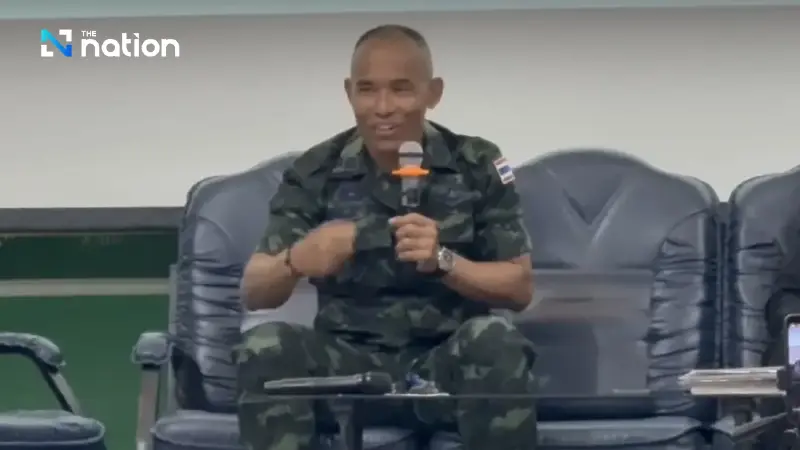


Maj Gen Nutt says military can seize Prasat Ta Kwai now at high cost or use tech and time to prove claims and regain the site more safely
At a border-security seminar held at the Faculty of Management Sciences, Surindra Rajabhat University, Maj Gen Nutt Sri-in, Deputy Commander of the 2nd Army Area said his talks with Cambodian counterparts carry a blunt, personal undertone: when he speaks to Cambodian officials or soldiers, “they fear me because they know that if they break an agreement, ‘they’re in big trouble.’”
Speaking of his experience as a former ranger commander, he said he has seen many casualties in past clashes — and that he would not hesitate to act. “If you don’t believe me, ‘I’ll take you — you try me,’” he said, adding that previous adversaries had mistaken him for a softer officer but found otherwise when clashes occurred and bodies were returned; “a week later it was dead quiet.”
On international peace accords and ceasefire pacts, Maj Gen Nutt said some have questioned why Thailand signs such agreements, asking whether signing gives advantage or disadvantage. He defended the prime minister’s decision to sign peace accords, suggesting national leaders may be under external pressures — for example, from U.S. President Donald Trump over tariff walls — that make ceasefire commitments politically necessary.
He told citizens they can judge a prime minister’s performance over a four-month term: if the PM does well, vote for him; if not, do not. “No prime minister would knowingly harm the country — they know their record is on the line,” he said.
The deputy army commander added that the security forces have been instructed to monitor the border while negotiations continue. He stressed that today’s soldiers are not the same as those of the past: once, soldiers on opposite sides were mates who drank together and let things slide; now, “modern soldiers don’t even want to talk when they see me.” He warned that talks must be taken seriously — if agreements are not honoured, there will be consequences.
Asked whether Thailand would be able to retake Prasat Ta Kwai in Phanom Dong Rak district of Surin province, Maj Gen Nutt said the terrain disadvantages Thai forces and a direct assault could cost “hundreds” of soldiers’ lives. “Would we accept that?” he asked. He stressed that while control is currently compromised, the country has not lost the site permanently.
He outlined two options to recover the temple:
• First option — immediate military recapture: a direct assault that would be fast but would risk heavy casualties.
• Second option — slower, technology-led approach: use radar and other survey technologies to verify and document the territory — as was done in Ban Nong Chan, Sa Kaeo — then proceed based on the evidence. This route would take longer but be safer and more certain.
Maj Gen Nutt said the armed forces would prioritise urgent measures while pursuing the methodical approach for longer-term resolution, and he expressed confidence that Prasat Ta Kwai will eventually be returned to Thai control by one method or another.
