
Foreign Ministry spokesman denies claims of envoy opposition to Thailand’s JD suspension, affirms right to defend national sovereignty
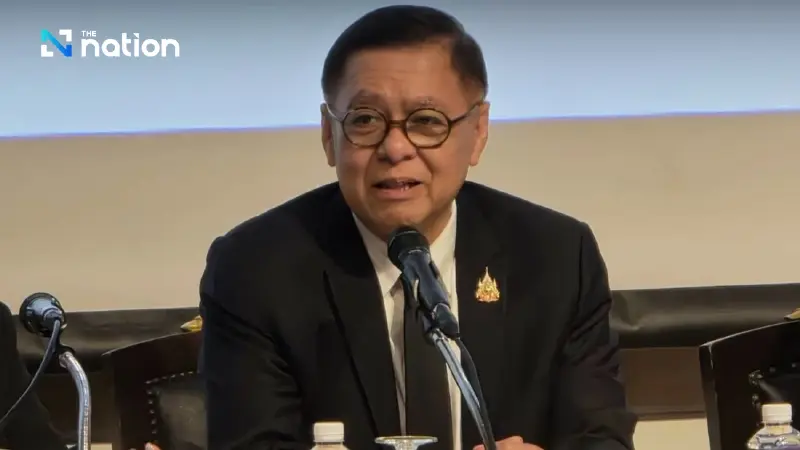


Nikorndej Balankura confirms no envoy opposed JD suspension, affirming Thailand’s right to act to defend sovereignty after Cambodia’s new mine incident

Nikorndej Balankura, Director-General of the Department of Information and Foreign Ministry Spokesperson, confirmed that there were no ambassadors who objected to Thailand’s suspension of the Thai–Cambodian Joint Declaration (JD) and reaffirmed that the Thai government reserves the right to take necessary actions to protect the nation’s sovereignty and territorial integrity as appropriate to the situation, adding that preparations are underway to invite ASEAN observer teams (AOT) to visit the Huai Ta Maria area.
Nikorndej’s statement followed a briefing held by Foreign Minister Sihasak Phuangketkeow, joined by the Permanent Secretary and the Director-General of the East Asian Affairs Department, to update 59 embassies, one international organisation, and four intergovernmental organisations — a total of 71 attendees — on the latest developments in Thai–Cambodian relations after four Thai soldiers were injured by a landmine in Huai Ta Maria, Kantharalak district, Si Sa Ket province, on November 10, one of whom lost his leg.
The minister presented four key points to the diplomatic corps, detailing that the explosion resulted from newly planted landmines by Cambodian forces, who had illegally crossed into Thai territory, constituting a breach of sovereignty and a violation of the Ottawa Convention.
Foreign Minister Sihasak explained that Thailand attaches great importance to the JD as a path toward sustainable peace but that its success depends on the sincerity of both sides. Following the incident, Prime Minister Anutin Charnvirakul convened a meeting of the National Security Council (NSC) on November 11, which resolved to suspend the JD and delay the repatriation of 18 Cambodian prisoners of war, citing Cambodia’s breach of the JD through its new landmine operations, which violated Thailand’s sovereignty and territorial integrity and breached the Ottawa Convention. The minister said these actions reflect Cambodia’s lack of sincerity in de-escalating tensions.
Thailand has called on Cambodia to express regret over the incident, conduct an investigation, punish those responsible, and implement measures to prevent such occurrences in the future. Thailand will reconsider the JD only when Cambodia takes responsibility and demonstrates reduced hostility.
The minister also said he had contacted Prak Sokhonn, Cambodia’s Deputy Prime Minister and Foreign Minister, twice to protest the incident. The Thai Foreign Ministry has also submitted a written protest through the Cambodian Embassy in Bangkok. Furthermore, Thailand will submit a formal communication under the Ottawa Convention to Japan, which will chair the 22nd Meeting of the States Parties to the Ottawa Convention on December 1–5, and will also brief the UN Secretary-General, ASEAN member states, Malaysia in its capacity as ASEAN Chair, and the United States as a witness to the peace framework. Thailand will also arrange for ASEAN observer teams (AOT) to visit the area soon.
The Foreign Ministry spokesman also revealed questions raised by diplomats regarding Thailand’s position following the NSC’s decision on November 11. Sihasak reaffirmed that Thailand reserves the right to take necessary action to protect the sovereignty and territorial integrity of the country and will proceed in line with the situation on the ground.
When asked whether Thailand’s suspension of the JD meant that it had been scrapped, the minister clarified that it is currently suspended. However, given the sentiment among the Thai public, it remains uncertain how long the suspension can be maintained, as this will depend on Cambodia’s response to Thailand’s demands. No country has expressed opposition to Thailand’s suspension of the JD; all have shown understanding, though some expressed concern that the situation should not escalate further.
The spokesman also confirmed that the suspension of the JD will not affect operations to suppress scam networks in Cambodia. The NSC emphasised that measures which Thailand can carry out independently or in cooperation with other countries, such as demining operations and anti-scam efforts, will continue. In December, Thailand will host an international conference on scam prevention, following ASEAN and APEC discussions, in cooperation with other nations. The spokesman affirmed that these efforts are ongoing and will be further strengthened.
Nikorndej assured the public that the Foreign Ministry remains committed to peaceful methods and that the government and all relevant agencies are acting comprehensively and decisively to uphold Thailand’s sovereignty, territorial integrity, and the safety of its people. Thailand expects Cambodia to take responsibility for the incident in good faith and restore confidence that such events will not happen again.
When asked whether the ministry will file additional protests with countries supporting Cambodia under the Ottawa Convention, Nikorndej confirmed that countries such as Japan, which is chairing the upcoming States Parties meeting, have already been informed through official channels. Thailand is also considering sending letters directly to countries that support Cambodia, and these actions will proceed in parallel.
Regarding reactions from the United States and Malaysia, which serve as observers to the Thai–Cambodian JD, the spokesman said that the Thai Ambassador in Washington has already briefed U.S. representatives on Thailand’s expectations that Cambodia take responsibility for the incident. Malaysia has also dispatched a senior military representative to monitor the situation and explore what measures it can take.
In response to questions about when the protests under the Ottawa Convention might yield results and whether the Foreign Minister would attend the meeting in person, Nikorndej said it remains under consideration. If the minister does not attend personally, a senior representative will go in his place. The agenda is still being reviewed to ensure the highest possible outcome.
He explained that the Ottawa Convention does not include punitive measures but allows for the condemnation of a party state at the meeting, which can prompt donor countries to reconsider their support. The accused state is also allowed to explain its position, but he insisted that Thailand’s evidence is clear and well-founded.
