
Thailand moves to clarify stance after landmine incident on Cambodian border
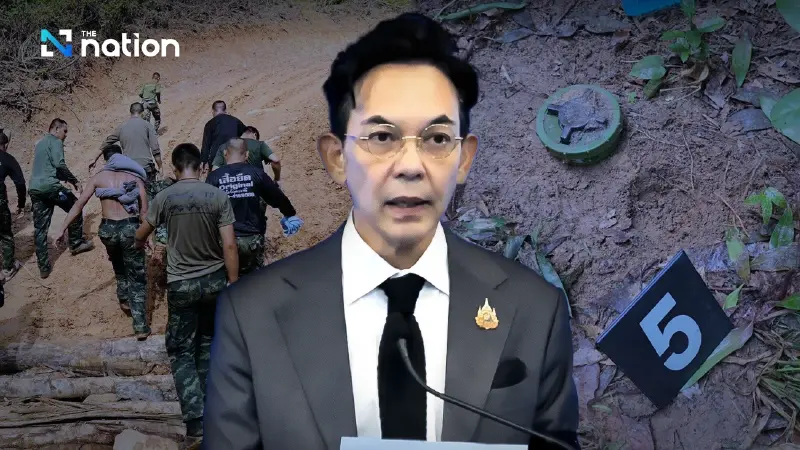


The Foreign Ministry announced measures to clarify Thailand’s stance to the global community after a Thai soldier was injured by a landmine allegedly planted by Cambodian troops in Si Sa Ket.
Nikorndej Balankura, Director-General of the Department of Information and Foreign Ministry Spokesperson, briefed reporters on Tuesday (November 11) about the latest developments along the Thai-Cambodian border.
He said the incident in which a Thai soldier stepped on a landmine at Huai Ta Maria in Si Sa Ket’s Kantharalak district on Monday (November 10) — allegedly due to newly planted explosives by Cambodian forces — constituted a violation of the Joint Declaration, Thailand’s sovereignty and territorial integrity, as well as Cambodia’s obligations under the Ottawa Convention, to which it is a state party.
“This act reflects Cambodia’s insincerity in reducing tensions,” Nikorndej said. He added that Thailand had decided to suspend the implementation of the Joint Declaration and demanded that Cambodia express regret, conduct a thorough investigation, and ensure that such incidents do not recur.
Thailand also requested that the ASEAN Observer Team (AOT) be allowed to inspect the site.
He said that since the incident, Foreign Minister Sihasak Phuangketkeow had twice telephoned Cambodian Deputy Prime Minister and Foreign Minister Prak Sokhonn — once on Monday while on official duty in Hong Kong and again on Tuesday morning — to lodge an initial protest.
The ministry will follow up with an official protest note through the Cambodian Embassy in Bangkok.
Thailand will also act in accordance with international law, including provisions of the Ottawa Convention, by submitting letters to Japan — the current chair of the convention’s state parties — and to the UN Secretary-General.
Additionally, Thailand will inform the international community through diplomatic channels, including letters to the United States and Malaysia (the current ASEAN chair), while circulating the documents among other ASEAN member states. Both the US and Malaysia were observers during the signing of the Joint Declaration.
“Tomorrow, the Foreign Ministry will host a briefing for all foreign ambassadors in Thailand to clarify the country’s position. The foreign minister has also instructed all Thai embassies worldwide to convey this message to their respective host countries,” Nikorndej said.
When asked whether the timing of Thailand’s letters might affect its diplomatic leverage, Nikorndej replied that they would be sent no later than Wednesday (November 12).
“The advantage or disadvantage lies in the substance of the letter — specifically, in how much verifiable evidence it presents,” he said.
“Thailand possesses both factual and logical evidence. For example, the laying of three landmines has occurred in the past, which clearly reflects a pattern of conduct by the other side. This is what Thailand intends to explain, based on facts.”
