
Watch the Leonids meteor shower as it peaks at up to 15 meteors per hour
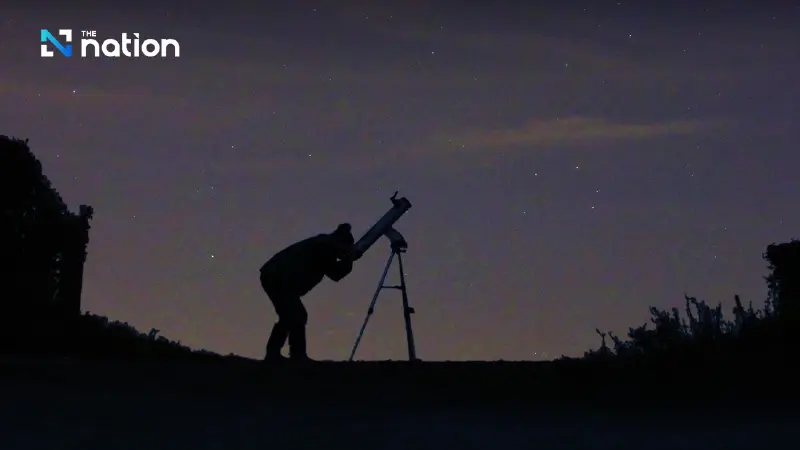


The Leonids meteor shower, originating from the constellation Leo, will be visible on the night of November 17 through to the early hours of November 18.
Skywatchers are invited to enjoy the Leonids meteor shower on Monday night, according to the National Astronomical Research Institute of Thailand (NARIT).
The phenomenon will occur from the night of November 17 into the early morning of November 18, with a projected peak rate of around 15 meteors per hour. The radiant — the point in the sky from which the meteors appear to originate — lies in the constellation Leo.
Leo, one of the ancient zodiac constellations, has long been recognised for its striking form resembling a lion with its head facing west and tail extending eastward. Its brightest star, Regulus, also known as the Lion’s Heart, marks the constellation’s prominent position in the night sky and serves as the radiant of the famous Leonids.

The Leonids are produced by dust and rocky debris from the comet 55P/Tempel–Tuttle, which orbits the Sun every 33 years. The comet leaves a trail of particles along its orbit, and when the Earth passes through this stream each November, the fragments are pulled into the Earth’s atmosphere and burn up as bright streaks of light.
Because the meteoroids travel in a direction opposite to the Earth’s orbit around the Sun, they enter the atmosphere at very high speed — approximately 71 kilometres per second. This makes the Leonids exceptionally bright, earning them the title “the King of Meteor Showers”.
The radiant in Leo will rise above the horizon at around 1am on November 18, after which the meteor shower can be observed until dawn.
Although the expected rate is modest, excellent viewing conditions are anticipated due to the absence of moonlight. Observers in dark locations away from city lights will have a better chance of witnessing the display.

The legend of the “Lion” constellation
According to Greek mythology, the constellation Leo represents the Nemean Lion — a fearsome beast with golden fur that no weapon could pierce and claws sharper than any blade. The lion terrorised the region, capturing young women to lure rescuers into its lair.
Heracles, the son of Zeus, was tasked with defeating the creature as the first of his Twelve Labours. After slaying the lion through sheer strength, Zeus placed its spirit among the stars as a tribute. This myth is the origin of the constellation Leo that continues to be recognised in the night sky today.
