
Thai and Cambodian teams agree on drone use and temporary boundary markers


Thai–Cambodian talks on temporary boundary markers at Ban Nong Chan–Ban Nong Ya Kaew conclude with agreement on two issues: drone flights and marker installation; joint surveying unresolved
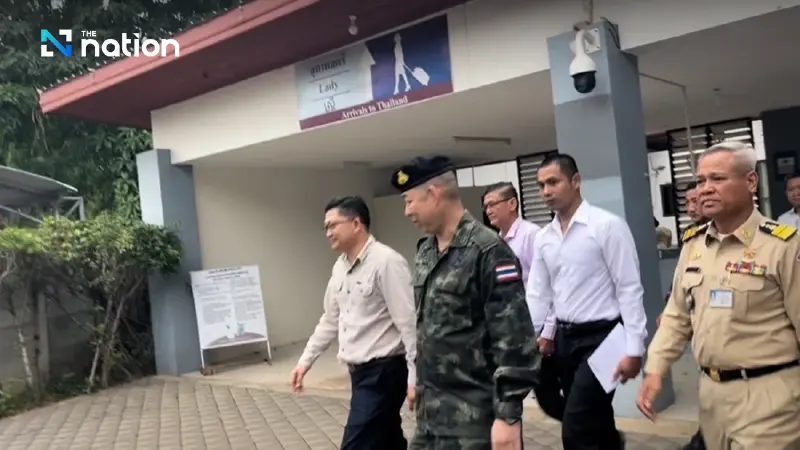
On November 18, 2025, at 08:54 a.m., the Cambodian delegation led by Sruoy Bora, head of the Cambodian operations group, together with a 10-member team including survey officers, incident-resolution officers, border-affairs personnel, military representatives, and the deputy district chief of O’Chrov district, Banteay Meanchey, crossed from Cambodia and walked through the Khlong Luek Border Checkpoint in Aranyaprathet district, Sa Kaeo province, to attend a meeting with the Thai side at Rangers Company 1201.
The meeting aimed to prepare temporary boundary markers between Boundary Posts 42–47, covering 13 kilometres in the Ban Nong Chan–Ban Nong Ya Kaew area of Khok Sung district, Sa Kaeo, following the earlier agreement for both field-team leaders to meet and plan before actual field operations.
Earlier, Cambodia postponed the meeting by one day because its technical-certification documents were not ready, shifting the date from November 17 to today.

Upon arrival at Rangers Company 1201, the Cambodian delegation proceeded directly into the meeting room.
The Thai delegation attending today’s meeting was led by Col Kriangkrai Boontoem, head of the Thai operations team, together with Col Yutthaphon Sujarit, chief of the Thai–Cambodian joint boundary field survey team, Royal Thai Armed Forces’ Military Mapping Department; Col Suphakrit Eksiri, head of the survey unit; representatives from the Aranyaprathet Special Task Force, the Burapha Task Force, Sa Kaeo province, and District Chief Naris Palkawong na Ayutthaya of Khok Sung district.
The meeting involved comparing and verifying all data, with both parties bringing their technical documents for discussion before beginning the joint survey and installation of temporary markers. If the schedule proceeds as planned, the temporary marker installation is expected to begin tomorrow.
There were reports that today’s meeting discussed major topics:
• the use of drones to survey the area,
• installation of temporary markers in claimed areas,
• and joint surveying.
On the drone-surveying agenda alone, discussions lasted more than four hours, from 09:00 a.m. to 13:45 p.m. At one point, a Cambodian representative stepped out of the meeting room carrying technical documents related to the temporary markers and made a phone call, apparently consulting decision-makers on the Cambodian side, before returning to the meeting for the next agenda item.
There were at least three main discussion topics, and the meeting only began the second item around 14:00 p.m., which took about one hour before moving to the third topic on area surveying.
During the talks, Veera Somkwamkid, together with local residents of Ban Nong Chan and Ban Nong Ya Kaew, arrived to observe the meeting. No disturbances occurred.
At 16:15 p.m., the meeting concluded after more than seven hours. The Cambodian delegation then returned to Cambodia through the Khlong Luek Border Checkpoint.
Col Kriangkrai, Director of the Military Geography Division, Royal Thai Armed Forces, and head of the Thai operations team, walked with the Cambodian delegation to the border crossing.
After seeing off the Cambodian team, reporters asked Col Kriangkrai, who responded briefly:
“The meeting went smoothly. We will be able to begin installing the temporary markers tomorrow. Cambodia cooperated well, starting at Boundary Post 42 at Ban Nong Ya Kaew.”
When asked whether he was confident that Cambodia would join the temporary marker installation tomorrow, he replied:
“We’ll have to wait and see.”
When asked whether Cambodia had made any demands, Col Kriangkrai said:
“No.”
While Col Kriangkrai answered the media, residents of Ban Nong Chan called out asking him to tell reporters about the results, as people wanted to know. He turned back and said:
“Everything went fine.”
There were reports that the meeting was intense but proceeded smoothly.
Originally, there were three negotiation topics:
- drone flights for area surveying,
- installation of temporary markers in claimed areas,
- area surveying.
However, the meeting reached agreement on only two issues —
the use of drones and the installation of temporary markers.
The joint surveying issue remained unresolved, because Cambodia wanted to conduct surveying inside Thai territory, making agreement impossible at this stage.
