
Thailand’s 2026 economy shaped by 45 key trends, led by digital, electronics, EVs and smart farming
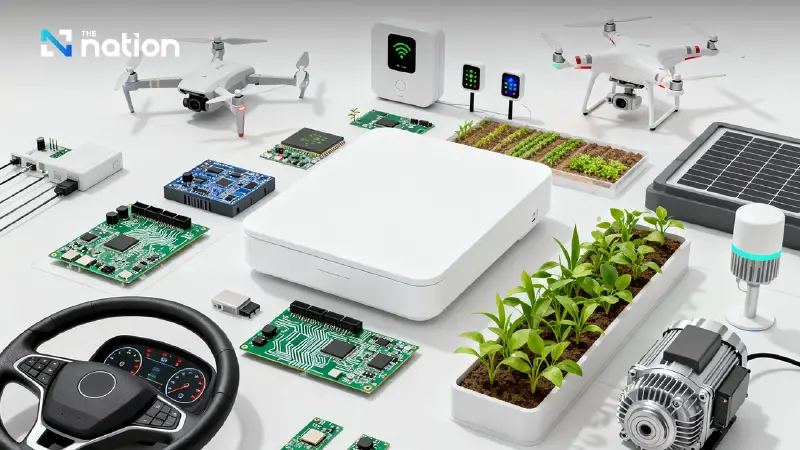


Thailand unveils 45 economic trends shaping 2026 as digital, electronics and automotive investment surges, while smart farming and ageing-market demand rise
Thailand’s economy remains fragile going into 2026, but key industries—digital, electronics, electric vehicles, energy, agriculture and wellness—are expected to anchor new growth. A comprehensive review by Thansettakij and insights from government agencies reveal 45 trends in investment, exports, agriculture, consumer behaviour, marketing and tourism that are set to shape the country’s economic trajectory next year.
GDP expanded just 2.4% in the first three quarters of 2025, with full-year growth forecast at around 2%. For 2026, the IMF and the Bank of Thailand project growth of only 1.6%, citing structural weaknesses, geopolitical risks, US trade policy uncertainty and high household debt.
Despite this backdrop, several sectors are poised to drive forward momentum.
Investment: digital, electronics and automotive lead Thailand’s new economic pillars
- Digital
- Electronics and electrical appliances
- Automotive and auto parts
Together, these accounted for 730 projects valued at 867.831 billion baht, and are expected to form the “three pillars of the new economy”.
Another 868 projects worth 199.166 billion baht were submitted across five secondary industries: renewable energy, agriculture and food, petrochemicals and chemicals, medical services and tourism. In total, the seven industries attracted 1,577 projects worth more than 1.06 trillion baht.
Electronics boom driven by global supply-chain shifts
The BOI expects continued expansion in smart electronics and electrical appliances in 2026, fuelled by the global tech trade conflict that is pushing companies to relocate production to Southeast Asia. Thailand is receiving strong interest in:
- Semiconductors
- Printed circuit boards (PCBs)
- Smart appliances
- Electronic components
- Hard-disk manufacturing — particularly as global demand rises with the growth of data centres.
Digital economy and data centres expanding
Investment in digital infrastructure—including cloud, software, digital platforms and content—remains strong.
However, the BOI warns that new data-centre investments depend heavily on electricity reliability, especially in the Eastern Economic Corridor (EEC).
Electric vehicles to remain robust
While the overall car market is soft, segments such as HEVs and BEVs continue to grow, supporting ongoing investment in EV production and components.
Meanwhile, renewable-energy investments are being propelled by corporate decarbonisation needs.
Upcoming mechanisms such as UGT and Direct PPA, expected by the end of 2025, are set to stimulate clean-energy demand across industry.
Exports: six product groups to remain strong in 2026
- Automobiles
- Electronic components
- Electrical appliances
- Gems and jewellery
- High-value food products
- Future Food
Agriculture and food exports will benefit from rising global food-security concerns despite external challenges and a high 2025 base. These sectors are expected to be major economic engines in 2026.
Agriculture: Thailand enters the era of smart farming
- IoT sensors
- Drones
- Satellite imagery
- AI
- Big data
These tools will reduce costs and labour need—though adoption must consider crop suitability and farmers’ financial capacity.
Global agri-tech market booming
- Smart-agri technologies were worth USD 18–19 billion in 2024 and are expected to nearly double by 2033.
- Agricultural IoT is growing 7–10% annually, set to exceed USD 50 billion before 2030.
- AI in agriculture is rising more than 20% per year.
The department’s 2026–2027 strategy includes:
- Turning extension officers into tech and financial coaches
- Creating standards and certification for tech-service providers
- Upskilling farmers and officers in digital and AI tools
- Linking smart farming with climate-smart and high-value agriculture
Marketing: 10 trends that will reshape 2026
According to Dr. Buranin Rattanasombat, President of the Marketing Association of Thailand (MAT), the world is entering an era of “intelligent but fragile markets.”
The 10 dominant trends for 2026 are:
- The world is moving out of old equilibrium; agility beats size.
- Fragmentation: mega-markets break into micro-markets.
- Asian and Chinese soft power rise sharply.
- AI becomes basic infrastructure, but creativity remains the key differentiator.
- Multiverse, agentic AI and humanoids create new virtual engagement spaces.
- Consumers focus more on social responsibility.
- Influencers evolve into Key Opinion Customers (KOCs).
- Culture becomes branding capital.
- Marketing becomes more crucial than production in saturated markets.
- Brands without a clear identity will disappear.
Health & Wellness: rapid growth driven by ageing society and post-COVID lifestyles
Dr. Tanupol Virunhagarun, CEO of BDMS Wellness Clinic and BDMS Wellness Resort, said investment in wellness will accelerate in 2026, fuelled by:
- Rising non-communicable diseases (NCDs)
- An expanding elderly population
- High medical costs
- Post-COVID health awareness
Six wellness megatrends for 2026:
- Mental wellness amid global stress and conflict
- Longevity and biological-age management
- AI-driven personalised wellness
- Wellness real estate using regenerative design
- Wellness retreats for long-stay health travel
- Spiritual health, driven by rising interest in meditation and emotional healing
Food & Beverage: six consumer trends
According to Paisarn Aowsathapornof ThaiBev, Thai consumers in 2026 will prioritise:
- Health & wellness (plant-based, immunity-boost foods)
- Sustainability & ethics (local sourcing, eco-packaging)
- Digital convenience (mobile ordering, cashless payments)
- Value & quality (clean ingredients, fair pricing)
- Experiential dining (chef-led concepts, immersive venues)
- Authenticity innovation (craft beverages, fusion cuisine)
Tourism: five major global travel trends for 2026
A joint report by Trip.com Group and Google, titled Why Travel?, highlights five trends reshaping tourism worldwide:
- Travel as expression – 75% of travellers watch travel livestreams, and up to 76% book via livestream links.
- Travel with purpose – rising interest in deep cultural experiences (e.g., searches for “Japanese tea ceremony” up 53%).
- Travel to heal – searches for “golf and spa resorts” up 300%; “ski and spa” up 250%.
- Travel to connect – two-thirds willing to travel abroad for concerts; endurance tourism grows fivefold.
- Travel of tomorrow – AI becomes core to trip planning; searches for “travel planning help” up 190%.
These trends reflect a shift towards meaningful, culturally connected and tech-enabled travel.
