
Thai military says AOT confirms newly planted Cambodian landmines inside Thai territory
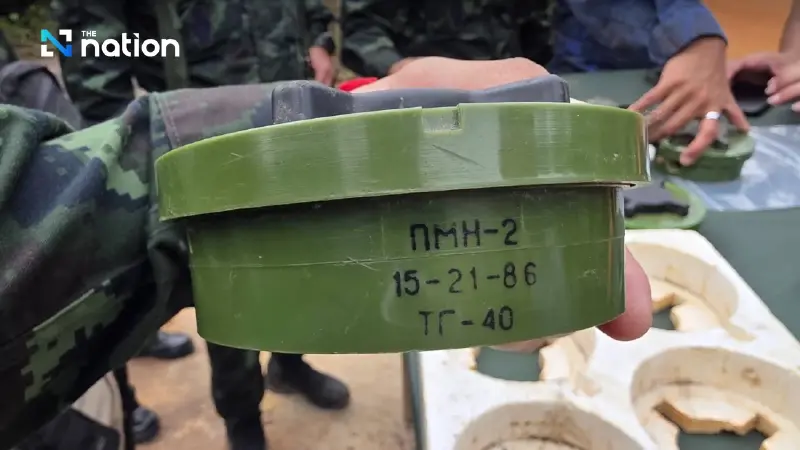


ASEAN Observer Team has confirmed that PMN-2 landmines found in Sisaket were newly planted inside Thai territory, backed by GPS and video evidence
The Royal Thai Armed Forces (RTARF) (November 24, 2025) released the findings of the ASEAN Observer Team–Thailand (AOT-TH) confirming that the landmine that injured a Thai soldier in Sisaket’s Phu Makua area on November 10 was a newly planted PMN-2 anti-personnel mine, and not an old unexploded device as claimed by the Cambodian military.
According to the official assessment, AOT-TH officers were deployed to the site immediately after the incident. Their inspection of soil conditions, placement patterns and signs of recent digging indicated that the PMN-2 mine had been planted during the latest round of tensions, consistent with previous incidents along the Thai–Cambodian border. Officials stressed that none of the PMN-2 mines found in recent years were remnants of past conflicts, but were newly buried devices.
Additional mines suspected; area unsafe for clearance
Joint engineering units working with AOT-TH also detected indications of additional mines in the surrounding area. Due to safety risks, the military said it is not yet possible to carry out clearance operations.
AOT-TH verified all mine locations using mobile GPS (Google Maps) cross-referenced with official topographic maps. The coordinates confirmed that every mine found was inside Thai sovereign territory, with no discovery outside the Thai border.
Evidence found in abandoned Cambodian soldier’s phone
In a significant development, the head of AOT-TH examined a mobile phone left behind by Cambodian soldiers during their withdrawal from Phu Makua. The device contained:
- Photos and videos of PMN-2 mines being planted
- Footage of Cambodian troop activities in the area
- Phone registration details confirming Cambodian ownership
The RTARF described this as material, verifiable evidence showing that Cambodian forces planted the mines on Thai soil.
AOT–TH: high likelihood of recent planting during heightened tensions
Observers noted that the area had served as a forward operating position during previous clashes, and the nature of the devices suggested they were planted during the latest escalation, not leftover mines as Cambodia had claimed.
Thailand stresses transparency and adherence to bilateral mechanisms
The RTARF emphasised that all information released comes directly from field observations, physical evidence, geolocation data, photographic and video documentation, and scientific analysis conducted by AOT-TH — which, it said, operates neutrally, transparently and in line with international standards.
Thailand continues to comply fully with all bilateral mechanisms, including:
- General Border Committee (GBC)
- Joint Boundary Commission (JBC)
- All joint observation agreements
The statement reiterated Thailand’s commitment to peaceful resolution, transparency and adherence to international standards to de-escalate tensions and protect communities on both sides of the border.
Concerns over Cambodian statements
The RTARF also noted several instances where Cambodian authorities provided inaccurate or contradictory information in multiple dialogue forums, causing strain in negotiations and eroding confidence in cooperation mechanisms.
Thailand said it will continue to present factual findings across all relevant platforms to defend its sovereignty and territorial integrity.
