
Thai chamber of commerce submits ‘White Paper 2025’ to unlock growth in five key dimensions
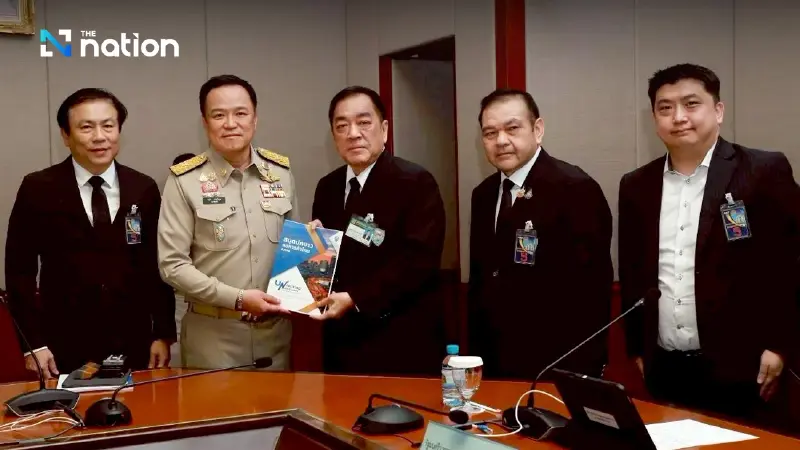


The Thai Chamber of Commerce has submitted its White Paper 2025 to the government, calling for urgent reforms to unlock economic growth across five national and regional dimensions

The nationwide seminar of the Thai Chamber of Commerce concluded in Songkhla, where the Thai Chamber of Commerce formally submitted its “White Paper 2025” to the government, calling for urgent action to remove structural barriers and drive economic growth across five national and regional dimensions.
Dr Poj Aramwattananont, Chairman of the Thai Chamber of Commerce and the Board of Trade of Thailand, said the chamber had presented the “Thai Chamber of Commerce White Paper 2025”—a compilation of views gathered during the 43rd National Chamber of Commerce Seminar held at the 60th Anniversary of His Majesty the King’s Accession to the Throne International Convention Centre, Prince of Songkla University, Songkhla.
Held under the theme “Unlocking New Growth: Thailand’s New Potential for Expansion”, the paper was submitted to the Prime Minister for consideration in shaping national policy direction and economic strategy.
Although the seminar had to be cancelled after the first day due to severe flooding in Hat Yai and nearby areas, the Thai Chamber of Commerce and the Board of Trade expressed their condolences to affected residents, including the more than 1,500 delegates attending the seminar. The chamber thanked public and private sector agencies for assisting evacuees and helping ensure their safety.
Most participants have now returned home. Meanwhile, the Foundation for Commercial Welfare, under the Thai Chamber of Commerce, has launched a fundraising initiative to support affected communities, as flooding in the province has not yet subsided.
The White Paper 2025 was compiled from nationwide chamber networks even before the seminar took place. The document was formally submitted to the Prime Minister during today’s meeting of the Economic Cabinet, enabling the government to consider and act on the proposals.
This year’s recommendations focus on unlocking new growth potential at both structural and regional levels, centred around five key dimensions:
1. Trade and Investment
The chamber proposes enhancing Thailand’s trade and investment competitiveness by accelerating ratification of key FTAs (Thailand–Sri Lanka, Thailand–EFTA) and pursuing OECD membership. It also calls for legal and regulatory reforms, logistics liberalisation, revision of the Foreign Business Act, and the establishment of a Fast Track Reform (Guillotine Unit) to remove outdated regulations.
Support for emerging industries—such as bioplastics and clean energy—is also recommended.
For labour, the chamber proposes Pay-by-Skills wage structures, nationwide Up/Reskill training programmes, a one-stop labour service centre, and a joint public–private labour committee.
For retail, it suggests expanding Easy e-Receipt Phase 2, establishing tax-free zones in major tourism provinces, offering instant VAT refunds to tourists, and developing tourism service hubs.
2. Agriculture and Food
It supports expansion of processing industries, gene-editing crop development, and promotion of GI products and future foods. It also recommends a long-term Tropical Fruit Metropolis Strategy to position Thailand as a global centre for tropical fruit trade and research.
Infrastructure development—including water systems, land management, farmer databases and the Agricultural & Food Coordination Centre (AFC)—should serve as core market-information hubs.
For fisheries, proposals include reducing raw material tariffs, improving labour standards (GLP), and easing export restrictions through one-stop services to support retailers.
3. Tourism and Services
The Thai Chamber of Commerce proposes positioning Thailand as a Global Wellness & Tourism Hub, using the Happy Model as a framework to elevate high-quality tourism.
It recommends strengthening safety and confidence through Trusted Thailand, and deploying tax and financial measures such as tax deductions up to 15,000 baht and triple tax deductions for out-of-province training.
The chamber also urges development of the TAGTHAi platform into a National Digital Tourism Utility to connect data from major and secondary cities, enhance wellness and cruise tourism routes, and expand access to low-interest soft loans for tourism SMEs and startups.
4. Digital, Technology and Innovation
The chamber promotes a Digital–Green Economy, targeting an increase in the digital economy’s share of GDP from 23.9% to 35% by 2036, creating over 2 million quality jobs.
It proposes establishing a Digital Economy Command Centre (DECC) and a Digital–Green Infrastructure Fund to support investment in AI, cloud services, data centres and clean energy.
It also calls for a Thailand AI Ready programme to upskill more than 5 million people, a Digital Visa to attract global talent, and Digital Vouchers for SMEs.
A new legal framework for digital–green economic promotion, including AI ethics and data governance standards, is also recommended. The chamber further supports large-scale automation and robotics transformation towards Smart Business.
5. Sustainability
The chamber emphasises advancing both the Green Economy and Circular Economy.
Key proposals include agricultural traceability to reduce crop burning, improved recyclable packaging design standards, increased use of circular materials, and tax incentives for green innovation.
It also supports establishing an Open Electricity Market and expanding Extended Producer Responsibility (EPR) to major industries such as automotive, packaging and construction materials.
In addition, the chamber encourages development of a national carbon-credit trading platform (Carbon Neutrality 4 ALL).
Beyond the five dimensions, the Thai Chamber of Commerce, together with the Joint Standing Committee on Commerce, Industry and Banking (JSCCIB), has established a Zero Corruption Taskforce, recognising it as a crucial starting point for restoring confidence in the Thai economy.
The private sector aims to create a more transparent, accountable and fair economic system, laying the groundwork for long-term, high-quality growth. Reducing corruption will help lower hidden costs, improve public spending efficiency, enhance SME competitiveness and reinforce investor confidence in Thailand’s capacity for long-term development.
Dr Poj said:
“All proposed measures are actionable and intended to benefit the Thai economy in every region. We also thank the Songkhla Chamber of Commerce, public agencies, private-sector partners and local stakeholders for assisting seminar participants and ensuring their safe return home. We hope the flooding situation will improve soon and that the economy of Hat Yai and Songkhla will recover quickly.”
