
Government urged to overhaul Thailand’s water-management budget
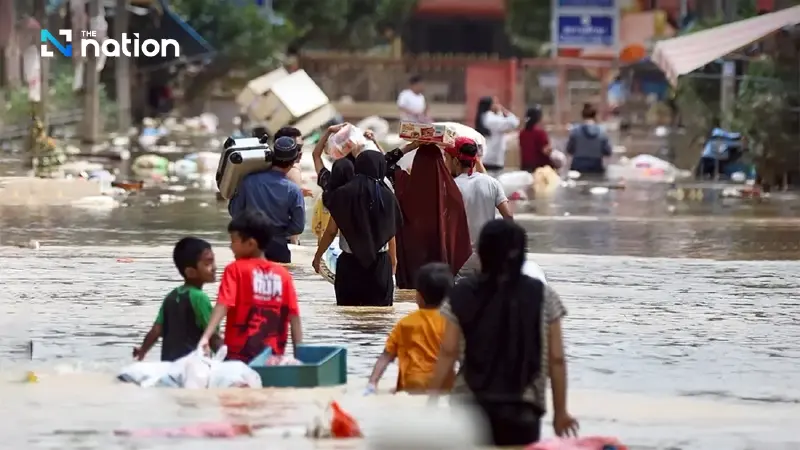


Thailand’s water-management agencies propose a major overhaul of the 60-billion-baht integrated water budget, pushing for large-scale infrastructure
- Water-management agencies are proposing that the government reform the structure of Thailand’s integrated water-management budget, shifting from numerous small projects toward larger strategic infrastructure plans.
- Agencies recommend an annual 60-billion-baht integrated water-management budget, noting that the current system—frequently divided into small projects driven by political interests—lacks long-term planning and weakens national disaster preparedness.
- For Hat Yai, proposals include upgrading R.1 Canal and Khlong U-Tapao, and constructing a new flood-diversion system from Khao Kho Hong to protect the economic zone.
Budget reform proposed after repeated major flood disasters
Thailand allocates more than 100 billion baht per year for water-management efforts. This includes around 60 billion baht for the country’s integrated water-resources management plan and 40–50 billion baht annually for disaster compensation related to floods and droughts. Compensation funds come from the central emergency budget, under the authority of the Prime Minister with Cabinet approval.
A Government House source revealed that, after Thailand has suffered several major flood disasters in recent years, water-related agencies have revisited their budgeting approach.
For the FY2027 budget, senior officials from key agencies—including the Royal Irrigation Department, Office of the National Water Resources (ONWR), NESDC, Ministry of Finance, and the Budget Bureau—held discussions aimed at proposing a reform of the water-management budget model.
Their recommendation: Thailand’s 60-billion-baht integrated plan should be restructured to fund large-scale, long-term infrastructure, instead of being fragmented into politically driven small projects. Strategic projects, they argued, are crucial to protecting the country from severe flood disasters.
Call to stop political “fragmentation” of water budgets
“Executives across water-related agencies agree that budget allocation for water projects must shift from meeting political demands to meeting national needs. We need long-term strategic planning—not short-term fixes,” the source said.
They urged the government to adopt this approach immediately, beginning with the FY2027 national budget, now being drafted.
The initial 2027 Integrated Water Management Plan aims to reduce the severe impacts of floods on communities and accelerate long-term, sustainable solutions.
The plan is being reviewed by the National Water Resources Committee (NWRC) chaired by Deputy Prime Minister Sophon Sarum. It must first be approved by river basin committees before submission to the NWRC in December 2025.
The guidelines require each integrated project to involve at least two agencies, and all must align with the 20-year Master Plan on Water Resources Management, covering:
- Water supply for consumption
- Water security for production
- Flood and disaster management
- Water ecosystem conservation and restoration
- Water-management governance
Projects must link upstream–midstream–downstream solutions—such as retention areas, drainage systems, and emergency response plans—to create complete, effective flood-prevention systems.
Prioritising urgent areas for maximum impact
Agencies will prioritise regions facing the most severe problems to ensure the most efficient use of the national budget.
The latest integrated water-management plan approved by the Cabinet in June 2025 includes 55,003 projects worth 439.44 billion baht across eight ministries, 67 provinces, and 1,643 local government bodies.
However, for the 2027 budget, urgent water-management projects must be prioritised to prevent severe flooding in key economic zones.
For Hat Yai, proposed urgent projects include:
- Dredging and deepening R.1 Canal
- Widening Khlong U-Tapao
- Constructing a new water-diversion structure from Khao Kho Hong to redirect mountain runoff away from the city and into Songkhla Lake for faster discharge
These should be considered priority infrastructure to protect Hat Yai’s urban and commercial areas.
Meanwhile, in the Central Plain, agencies are considering the construction of new dams north of the Chao Phraya Dam in Chainat to divert upstream water and reduce peak flows downstream.
