
Sihasak slams Cambodia, saying its explanations are unacceptable over newly planted landmines


Thailand rebukes Cambodia’s explanation over newly planted landmines as evidence mounts; Bangkok seeks UN-led fact-finding mission after seven Thai soldiers lose limbs

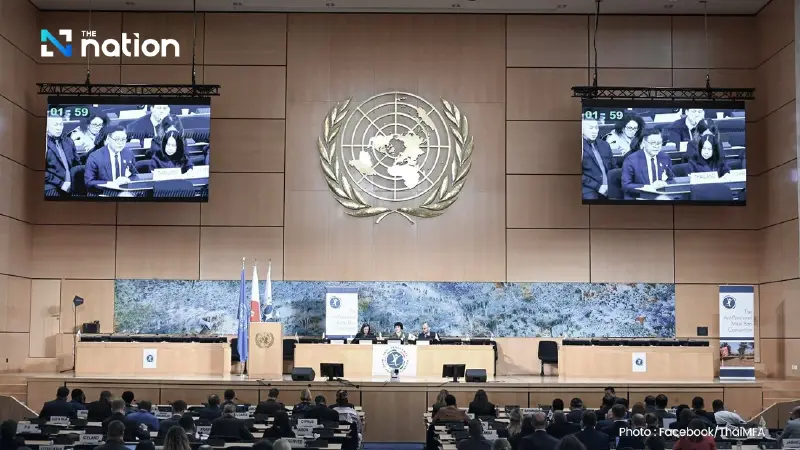
On December 6, Foreign Minister Sihasak Phuangketkeow spoke after returning from the 22nd Meeting of States Parties (22MSP) to the Ottawa Convention at the United Nations Office in Geneva, Switzerland. He said he chose to personally deliver Thailand’s statement to emphasise how seriously the government views the injuries suffered by Thai soldiers who stepped on newly planted landmines along the Thai–Cambodian border.
Thailand has requested clarification from Cambodia, but Sihasak said Cambodia’s explanations are unacceptable, evasive, and do not address what actually happened. Cambodia continues to insist there were no newly planted landmines and that the devices were old mines, despite clear evidence to the contrary.
Sihasak stated that Thailand has shown patience for a long time. However, when violations occur, the Ottawa Convention provides mechanisms that States Parties must follow. “Both sides are parties to the Convention, so we should proceed in accordance with its provisions,” he said.
He explained that Thailand had already taken the first step by formally requesting clarification, but Cambodia has not responded to the specific incidents. Therefore, Thailand will ask the UN Secretary-General, or an appointed representative, to coordinate under Article 8 of the Ottawa Convention.
This process could lead to an independent, impartial fact-finding mission to establish what truly happened. “If such a committee is formed, both Thailand and Cambodia must cooperate. This is the best way forward, especially because Thai soldiers have been injured and the Thai public is deeply affected,” Sihasak said.

As expected, he added, Cambodia did not present anything new and instead claimed that the incidents were provoked by Thailand, repeating that no new mines had been laid. This contradicts the findings of the ASEAN Observer Team (AOT), which confirmed new mine-laying activities. Thailand presented AOT’s documented evidence to the Ottawa meeting to underline the facts.

“Every time, Cambodia says Thailand is the bigger country and is somehow bullying them. But ask yourself — have any of their soldiers stepped on landmines? No. So this is not about Thailand picking on a smaller neighbour. If they say they want peace, then their actions must reflect that,” Sihasak said.
Following Cambodia’s intervention at the meeting, Sihasak instructed Usana Berananda, Thailand’s Permanent Representative to the UN in Geneva, to respond using factual evidence already submitted to the UN — including a video from a Cambodian soldier’s phone showing the deployment of PMN-2 landmines, and AOT documents confirming the mines were newly planted.
He added that Cambodia protested against the use of visual evidence and said explanations must be verbal only, but the Chair of the Meeting ruled that parties may present evidence in any format. “It was a good proactive strategy. It also put pressure back on Cambodia,” Sihasak noted.
A potentially positive development, Sihasak said, was Cambodia expressing interest in establishing a joint investigative committee. However, he cautioned that Thailand does not yet know Cambodia’s true intentions — whether sincere, or simply an attempt to buy time. Further discussions will be required, and Thailand must remain open-minded to evaluate whether proposals from both sides can be aligned.
He emphasised that forming a fact-finding committee involves multiple steps and cannot happen immediately, but Thailand has already initiated the process to request coordination from the UN Secretary-General as stipulated by the Ottawa Convention.
When asked whether he was satisfied with the outcome of the meeting, Sihasak replied:
“We came in person to show how seriously we take this matter. Thailand has done everything it can. But Cambodia has not taken responsibility for any of the seven separate incidents. They should acknowledge responsibility.”
Cambodia showcases mine-action achievements as Thai soldiers lose seven limbs

During the same Ottawa Convention meeting, reporters noted that Cambodia’s Cambodian Mine Action and Victim Assistance Authority (CMAA) distributed brochures highlighting its achievements in mine clearance.
The brochure outlined Cambodia’s background, its obligations under the Convention, operational structures, clearance plans, progress made, and remaining challenges. It also highlighted Cambodia’s hosting of the Siem Reap–Angkor Summit for a Mine-Free World in November 2024 — a milestone Cambodia proudly emphasised.
This promotional display comes despite ongoing tensions at the Thai–Cambodian border, where Thai soldiers have suffered seven limb losses after stepping on landmines in seven separate incidents. Thailand has since formally notified States Parties of Cambodia’s violations of the Ottawa Convention.

