
Sandalwood rite to craft royal urn and coffin for Queen Sirikit’s cremation
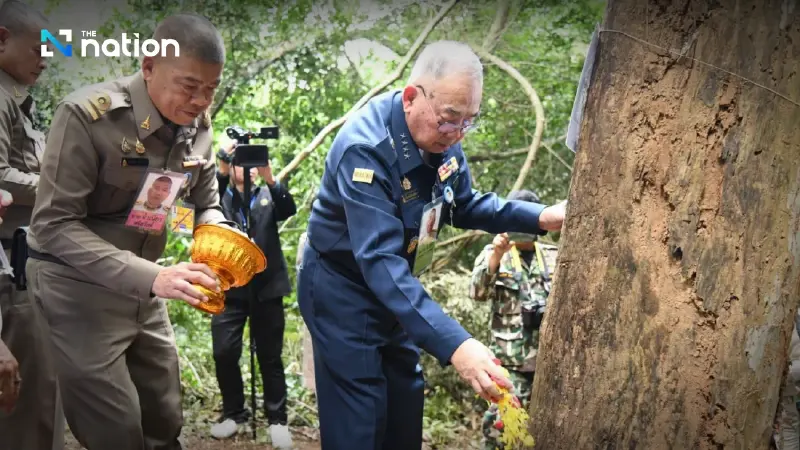


Fragrant sandalwood trees blessed and felled in Kui Buri National Park to craft the royal urn and coffin for the cremation of Her Majesty Queen Sirikit the Queen Mother.
- A Brahmin ceremony was held at Kui Buri National Park to bless the felling of fragrant sandalwood trees for the future royal cremation of Queen Sirikit the Queen Mother.
- The harvested timber will be used to craft a royal sandalwood urn and coffin, with designs for both already completed by the Office of Traditional Arts.
- Following ancient royal tradition, the wood is sourced from naturally fragrant, standing dead trees from the same forest used for previous royal cremations, including that of King Bhumibol Adulyadej.
- The Office of Traditional Arts will oversee the crafting process, which will involve skilled volunteer artisans, and for every tree felled, ten new saplings will be planted.
On December 6 at 12.19pm, at Kui Buri National Park in Prachuap Khiri Khan province, Air Chief Marshal Charuek Sanitwong Na Ayudhya, Special Operations Officer of the Royal Security Command, presided over a Brahmin ceremony to bless the felling of fragrant sandalwood trees.
The timber will be used to craft the royal sandalwood urn and coffin for the royal cremation of Her Majesty Queen Sirikit the Queen Mother, in accordance with ancient royal tradition.
Attending the ceremony were Deputy Prime Minister and Natural Resources and Environment Minister Suchart Chomklin; Culture Minister Sabeeda Thaised; Fine Arts Department Director-General Phanombut Chantarachot; Prachuap Khiri Khan Governor Sittichai Sawatsaen; and Department of National Parks, Wildlife and Plant Conservation Director-General Attapol Charoenchansa.

Charuek began the ritual by pouring sacred lustral water and anointing the ceremonial axe to be used in felling the sandalwood trees. He then lit candles and incense at the main offering table. Court Brahmin astrologer Chatchai Pinngern then recited the invocation for the ceremony.
After the prayers, Charuek proceeded to the selected sandalwood trees, sprinkled them with sacred lustral water and struck three designated trees – numbered 1, 2 and 3 – with the ceremonial axe as the auspicious first cuts. He then scattered flower petals around the base of the trees.
Under royal tradition for the cremation of a queen consort, sandalwood used for the royal urn and coffin must come from standing dead trees which naturally emit a fragrance.

For this royal cremation, the fragrant sandalwood trees are naturally occurring in Kui Buri National Park in Kui Buri district, Prachuap Khiri Khan, in the same forest area that supplied sandalwood for the royal cremation of His Majesty King Bhumibol Adulyadej The Great in October 2017, the royal cremation of Her Royal Highness Princess Galyani Vadhana in November 2008, and the royal funeral of the Supreme Patriarch in December 2015.
A survey carried out on 20 sandalwood trees on November 28 found trees with an average circumference of 150 centimetres and average height of over 10 metres. Ten trees were deemed sufficiently sound to be fully processed, while eight others can be used in part.

Following the blessing ceremony, the trees will be felled and processed in line with official regulations. The timber, cut to specified sizes and quantities, will then be delivered to the Office of Traditional Arts of the Fine Arts Department to be crafted into the royal sandalwood urn, royal sandalwood coffin, sandalwood firewood logs and sandalwood bouquets.
The designs for the royal sandalwood urn and coffin have already been completed by Somchai Supalakampaiporn, a master craftsman in special techniques at the Office of Traditional Arts, who is also supervising the construction. The urn is octagonal in form, decorated with intricate traditional Thai motifs and bearing the royal cypher of Her Majesty.
The coffin is a rectangular casket, elaborately pierced and carved with delicate Thai patterns. The Fine Arts Department will invite skilled volunteer artisans to participate in the work. For every sandalwood tree felled for the royal cremation, ten new sandalwood saplings will be planted in natural forest areas as replacement.

Culture Minister Sabeeda said Kui Buri National Park officials will now cut the sandalwood into planks before sending the timber to the Office of Traditional Arts, where artisans will carve the designs as planned to ensure the work is exquisitely detailed and befitting the Queen Mother’s exalted status.
She added that the design of the royal crematorium and its auxiliary structures for the royal cremation of Her Majesty Queen Sirikit the Queen Mother is currently being refined, with detailed elements now being finalised.
The Culture Ministry, she stressed, is fully prepared in all aspects to support the royal cremation so that it is conducted with the utmost honour and dignity. A weekly meeting is being held to closely monitor progress on every part of the preparations.
