
Hun Manet and West Point’s Class of 1999: America’s shadow network
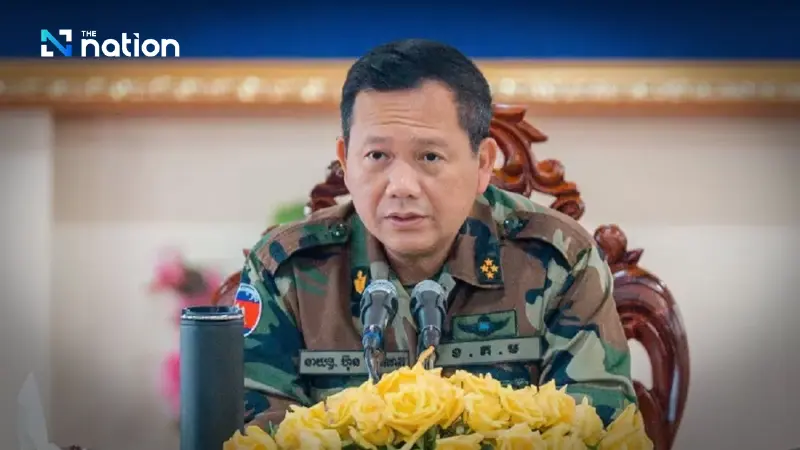


Inside Hun Manet’s West Point Class of 1999 ties—linking Cambodia’s leader to US military, policy and business circles.
US President Donald Trump’s post on Truth Social on December 12, 2025 — claiming Thailand and Cambodia had agreed to “cease all fire” and describing the Thai landmine incident as merely an “accident” — has become a major turning point in the border standoff.
Not because it ended the conflict, but because it exposed a stark gap in perceptions between Washington and Bangkok.
Thailand, particularly Prime Minister and Interior Minister Anutin Charnvirakul, pushed back bluntly. He said the Thai soldiers’ deaths and injuries from landmines were not a roadside mishap, and that Thai military operations would continue until the country was confident there was no longer any threat to Thailand’s sovereignty or its people.
Crucially, he stressed that, in practice, there had been no genuine ceasefire, despite Trump’s declaration.
That response immediately raised a pressing question in Thai security and diplomatic circles: why did the US leader choose language that played down the seriousness of the landmine incident, and communicate as if Cambodia were more of a “partner for peace” than a party to the conflict?
The answer, this analysis argues, cannot be separated from the power networks linking Cambodia’s Prime Minister Hun Manet to the United States — deep ties routed through the US Military Academy at West Point, specifically the Class of 1999.
Hun Manet is a foreign graduate from the same cohort as a group of American officers who now occupy strategically important positions within the US power structure.
The Class of 1999 carries particular weight: its members entered service in the post-Cold War era, experienced combat against terrorism, and are now rising into senior roles as the United States pivots towards great-power competition — especially across space, technology and the defence-industrial domain.

Within this network, the most clearly visible figure is Maj Gen Donald K. Brooks, a West Point Class of 1999 graduate who currently serves as deputy commanding general for operations at the US Army Space and Missile Defence Command.
This is an organisation that holds some of the nation’s most strategic assets — from missile-warning systems to space-related infrastructure. His role is not symbolic; it shapes deterrence and US security at the structural level.

Alongside Brooks is Kevin D. Bradley, also Class of 1999, now a colonel and the director of a specialised task force working on next-generation armoured-vehicle capabilities under the US Army Futures Command.
The position places him at the intersection of defence policy, technology, and vast budgets — directly linked to the defence industry and leading technology firms.
In the private sector, the Class of 1999 network is not confined to uniformed service. Dorian Price, a female graduate from the same cohort, has advanced to senior executive roles in business and finance, and was honoured as a West Point alumna representative at the New York Stock Exchange closing bell ceremony.
That kind of visibility reflects the ties between the security world and the world of capital — ties that can shape investment directions in defence- and high-technology-related industries.
There is also Stephanie Markich, Class of 1999, who after leaving the military worked with Procter & Gamble and now focuses on recruitment and professional development for US veterans.
The role may appear distant from geopolitics, but in practice it helps sustain and expand “The Long Gray Line” — embedding the West Point network more deeply into American business and society.

Viewed through an investigative lens, Hun Manet’s links to the United States are not only state-to-state. They are also people-to-people: classmate relationships that now stretch across the US military, policy institutions, and the private sector.
This network does not need formal meetings to function; it can operate through familiarity, a shared language, and a West Point frame of reference.
This is the context in which Trump’s messaging on the Thailand–Cambodia conflict has been interpreted in Bangkok as tilting towards Cambodia.
Calling the Thai landmine incident an “accident” not only clashes with Thailand’s field reporting, but also reduces Cambodia’s structural responsibility in the eyes of the international community — while creating space for Hun Manet to appear globally as a “peace-ready leader”.
For Thailand, then, this is not simply about a ceasefire. It is a larger question about the US role as a mediator — and about the power networks that may amplify Cambodia’s voice in Washington, even as realities on the border remain at odds with political statements.
Overall, the deal Trump sought to announce is not yet a reality on the ground, but a reality in communication — one that, this analysis suggests, reflects the influence of West Point’s Class of 1999 network linking Cambodia’s leader tightly to the centres of US power.
For Thailand, reading this game in full is essential — not only to handle Cambodia, but to understand which lens the United States is using to view the region, and who may be shaping decisions behind the scenes.
