
Lt Gen Wanchana outlines four ‘end game’ scenarios for Thai-Cambodian border conflict as major powers loom
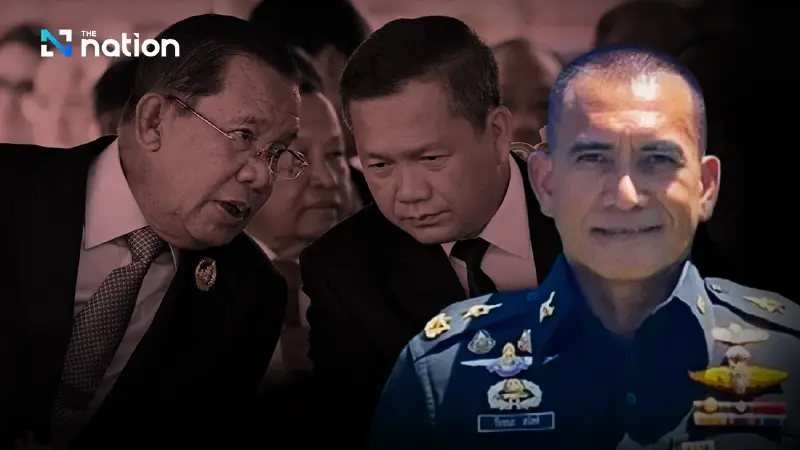


RTARF deputy spokesman Lt Gen Wanchana says the Thai-Cambodian border conflict has become a geopolitical contest, outlining four possible “end game” scenarios.
Lt Gen Wanchana Sawasdee, deputy spokesman of the Royal Thai Armed Forces (RTARF), on Friday posted the following message on Facebook:
Four “end game” scenarios in the Thai-Cambodian conflict: when major powers move, who wins this board?
The conflict along the Thai-Cambodian border is no longer just about “overlapping areas” or “nationalism”. It has become a sub-battle in a broader geopolitical game, watched closely by major powers such as the United States and China.
As a security analyst, I would like to propose four possible long-term “end game” scenarios, viewed through the lens of each side’s interests.
1) The Western Dream: “Regime change” towards democracy
Scenario: The United States and its Western allies push for a shift in power, dismantle the “Hun” family’s rule, and support a liberal-leaning leader such as Sam Rainsy to replace them.
Theory/lessons from the past: This resembles a “regime change” model the United States has used in places such as Iraq or Libya. If the old leader refuses to yield, the ending could be severe, as seen with Saddam Hussein or Gaddafi.
Outcome: Cambodia would quickly pivot to become a key US ally in ASEAN, cutting the China cycle. The risk, however, is domestic turmoil on the scale of civil war.
2) The Dragon’s Restore: “Royal return” as China resets the order
Scenario: China judges that the Hun family is becoming “hard to control” or too problematic, and supports a leadership change by elevating a royal line (descendants of King Norodom Sihanouk) that China has long cultivated in Beijing to take the lead instead.
Theory/lessons from the past: China is adept at using diplomatic soft power through elite-level relationships. It has maintained and nurtured ties with Cambodia’s royal line as a “backup card”.
Outcome: The Hun family would have to go into exile. China retains comprehensive influence, while gaining a better image among Cambodians who respect the monarchy.
3) The Strongman Standoff: Hun Sen steps back (but not really)
Scenario: The Hun family agrees to calm the border situation to ease pressure, but continues to hold absolute power.
Likelihood: Low, because no one likes this scenario.
US & China: Both see Hun Sen as highly “Machiavellian” (cunning and manipulative), practising constant “hedging”. He is not trusted, is hard to negotiate with, and has too much personal clout to be controlled.
4) The Soft Landing: the era of Hun Manet (the chosen one?)
Scenario: Hun Sen truly steps aside, or is pressured out of the power equation, allowing Hun Manet to govern without his father’s shadow.
Why is this the most interesting scenario?
- US perspective: Hun Manet graduated from West Point, is easier for the US to engage with, has a Western military mindset, and appears more “civilised” than his father.
- China perspective: China’s agreements and infrastructure investments (BRI) continue. China can accept this as long as its interests are not harmed.
- Domestic challenge: The hard task for Hun Manet is managing the old power blocs, especially the Tea family (long dominant in the military), to build stability.
Conclusion: why Scenario 4 is the “best-looking exit”
In the long run, Scenario 4 has the highest chance of occurring, and could become the turning point that brings “peace” back to the Thai-Cambodian border, because:
- Scapegoat: Past conflicts and mistakes can be pinned on the “Hun Sen era”. Once he is out of power, Thailand and Cambodia can reset relations by saying, “That was the previous leader’s policy.” This provides a face-saving exit for both sides.
- Game of powers: Both China and the US can claim a “win-win”.
- Negotiating with Hun Manet is easier than with Hun Sen, who is notoriously hard-nosed.
- From a major-power viewpoint, Hun Manet is “weaker” than Hun Sen. If he ever becomes defiant or chooses sides too clearly, it would be far easier to “topple” or “replace” Hun Manet than to confront his father.
Ultimately, calm will be possible when major powers agree that a “new actor” is easier to control than the “old actor”.
