
Anutin says he wants this to be the “last time we sign”, under the Kuala Lumpur agreement framework
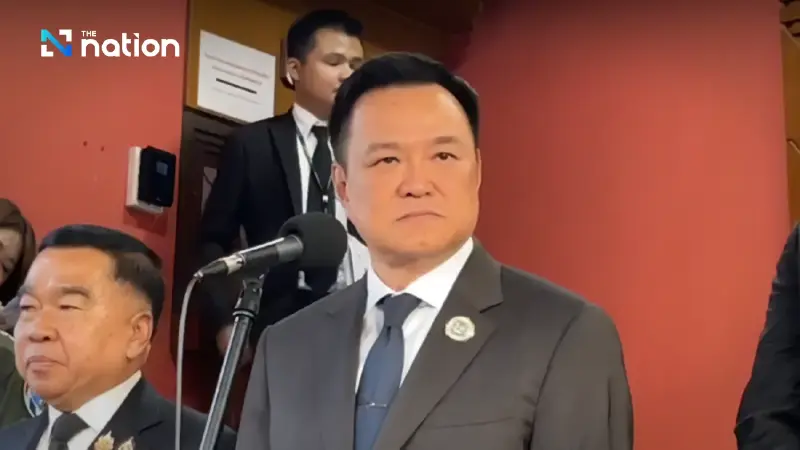


Anutin says NSC cleared Defence Minister Natthaphon to join Dec 27 GBC talks, seek a joint statement under the Kuala Lumpur framework and a 72-hour ceasefire
Following the National Security Council (NSC) meeting at 5.00pm on December 26, 2025, Prime Minister and Interior Minister Anutin Charnvirakul said the meeting had resolved that Defence Minister Gen Natthaphon Narkphanit would attend the Thailand–Cambodia General Border Committee (GBC) meeting with Cambodia’s defence minister tomorrow in Chanthaburi, to reach a conclusion on a joint statement under the Kuala Lumpur agreement framework.
He said the meeting invoked Section 8 under the State Administration Act to seek a Cabinet resolution allowing the defence minister to negotiate with the Cambodian side.
On the framework agreed by both GBC secretariats after three days of talks, Anutin said it remained in line with the Kuala Lumpur agreement, or the Joint Declaration dated October 26, 2025. He said Thailand had never stepped outside that framework, and Thailand continued to follow its four main points. If tomorrow the defence ministers can reach an agreement that both Thailand and Cambodia can accept, he said a Joint Statement would be signed.
Anutin said what it is called is not important. What matters is keeping the promise that there must be no threats, no provocation, and reduced risk to the security of both countries. He said the key substance had already been discussed by the secretariat level, and Gen Nattapong Praokaew, Deputy Chief of Staff, had reported the trend. “If it is as he said, it would be a good settlement,” he said, adding it would allow Thailand to maintain sovereignty and establish territorial integrity in line with the objectives set by the armed forces, in full.
Anutin said that if tomorrow the defence minister can finalise the statement, the framework would continue to follow the same four points agreed in Kuala Lumpur, including the withdrawal of heavy weapons, Thailand’s mine clearance, the suppression of scams, and resolving the situation at Ban Nong Chan and Ban Nong Ya Kaew in Sa Kaeo—“which is proceeding accordingly,” he said.
On Thailand’s proposal for a 72-hour ceasefire, Anutin said it is a condition Thailand is asking Cambodia to accept. “If they can do it, we will consider releasing the Cambodian soldiers, or prisoners of war, all 18 of them,” he said.
“We have to ask whether Thailand has obtained what it wanted in the first place yet,” he said, referring to military objectives and the declaration of territorial integrity. He said the armed forces had reported that Thailand had achieved its goals and that “we control territory that previously was not ours—while they did not accept it.”
The prime minister repeated that the military has confirmed Thailand has achieved its objectives. If tomorrow Cambodia agrees, the process will begin under the joint agreement framework, and he hopes Cambodia will keep its word because it would be a government signing. Thailand, he said, will certainly keep the agreement.
“This time, please let it be the last signing,” he said. “So that peace can happen in the area and our people can go back to their own homes. I hope the defence minister thinks the same way I do. If it can be signed tomorrow, that would be good. We have to encourage each other, and we are very ready.”
The prime minister said that on the military side, Thailand must protect sovereignty and territory. “Negotiations are negotiations, but if an agreement is reached, there is a time window in which we want it to be honoured,” he said.
“Bilateral talks—we see them coming to negotiate and asking for a ceasefire. In diplomacy, we must be careful with our words,” he said. He said Thailand knows its status—what it wants and that it has achieved its objectives. But if dissatisfaction leads to renewed fighting and more damage again, he said, no one wants that. “If they come to threaten or invade Thailand, we are ready to respond, and we must show the world that Thailand, when the time comes, has reasons and is rational,” he said.
Anutin said he had previously spoken with Cambodian Prime Minister Hun Manet at the Malaysia meeting but has not done so since the latest renewed incidents, adding that Thailand is not at a disadvantage because it operates under the rules of engagement and has mechanisms in place to safeguard sovereignty; he said that if any firing occurs during the proposed 72-hour period, Thailand can respond to defend its sovereignty and territory, and urged the public not to worry.
